The $4.3 Trillion Attention Collapse

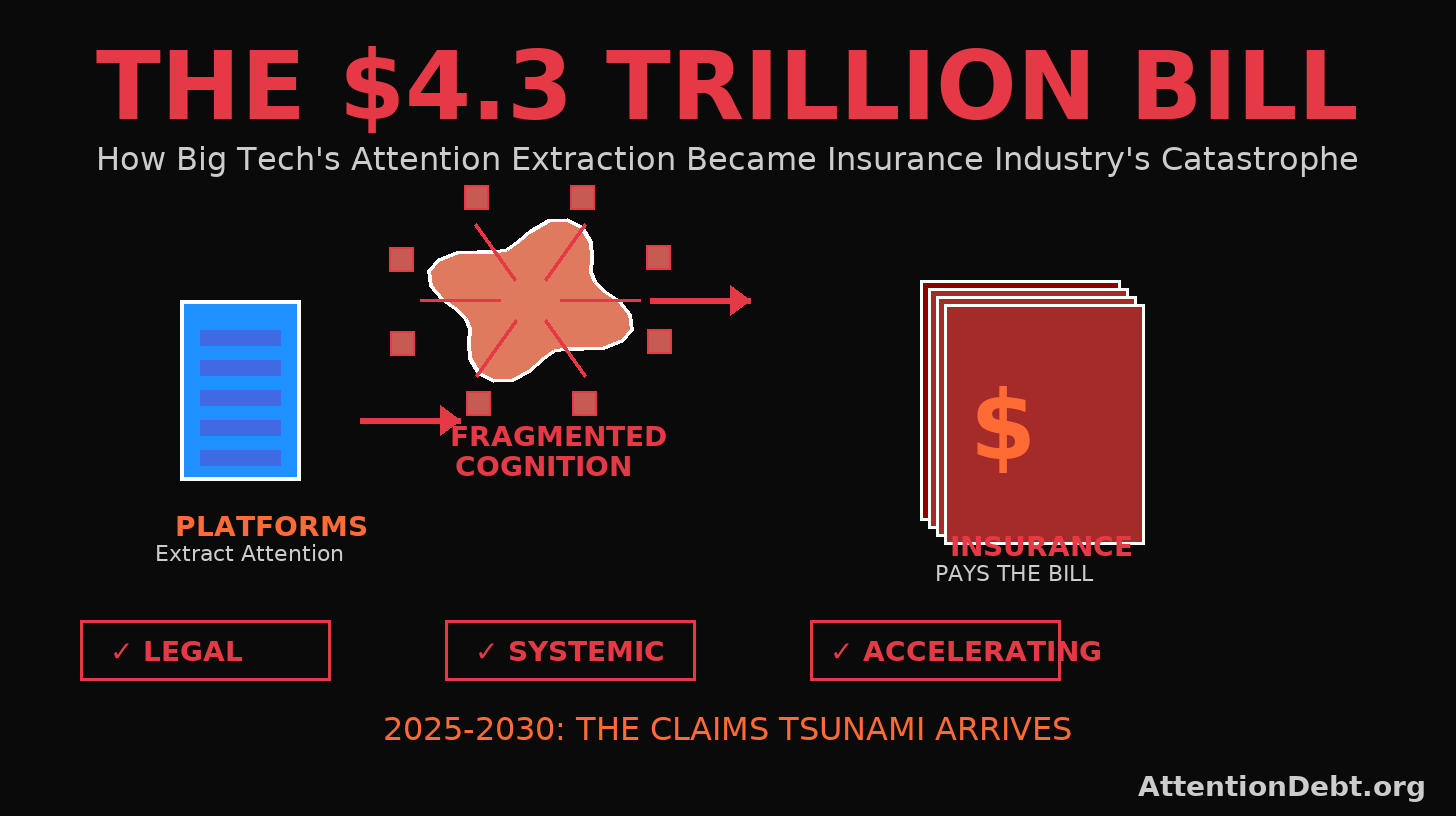
"Insurance industry $4.3 trillion liability from attention collapse - platforms extract attention, insurers pay claims visualization

Why the Global Insurance Industry Faces Its Largest Payout Crisis Since World War II—And Doesn’t Know It Yet TL;DR — The Hidden Insurance Catastrophe A massive, unmeasured liability is building in the global insurance system. Attention fragmentation—the collapse of sustained cognitive capacity across populations—is driving exponential increases in insurable events. The mechanism is simple: fragmented The $4.3 Trillion Attention Collapse

The Cognitive Immunity Crisis

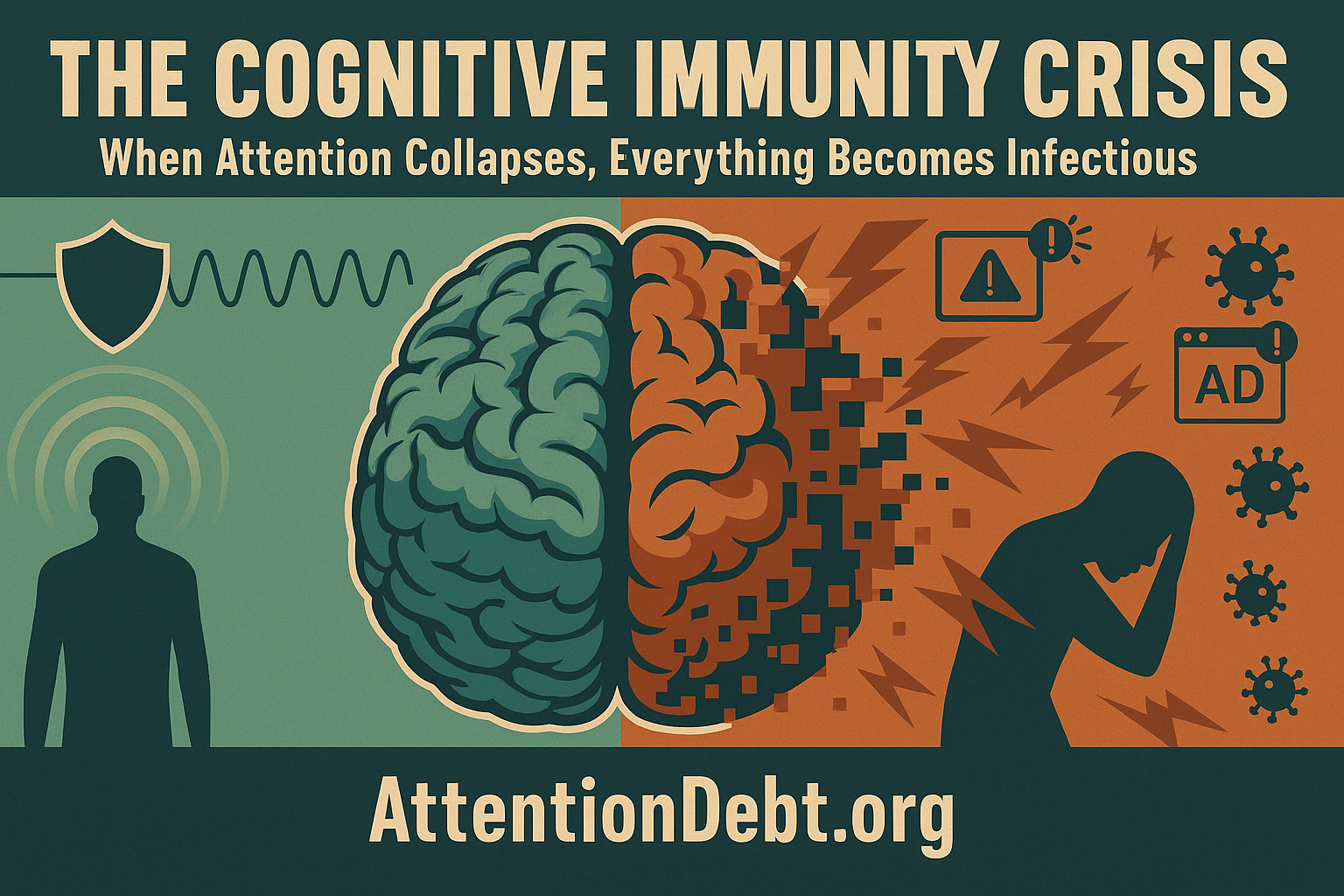
Cognitive and biological immune system collapse from attention fragmentation - immune load visualization illustration

How Humanity Lost Its Mental Immune System—And What Happens When Everything Becomes Infectious TL;DR — The Immunity Collapse in Five Points Your immune system—both biological and cognitive—depends on stable environmental signals. Attention fragmentation creates chronic instability that breaks this dependence. The cognitive-immune coupling is real. Your brain’s attention system sends threat signals to your immune The Cognitive Immunity Crisis
Your Children Will Not Remember You

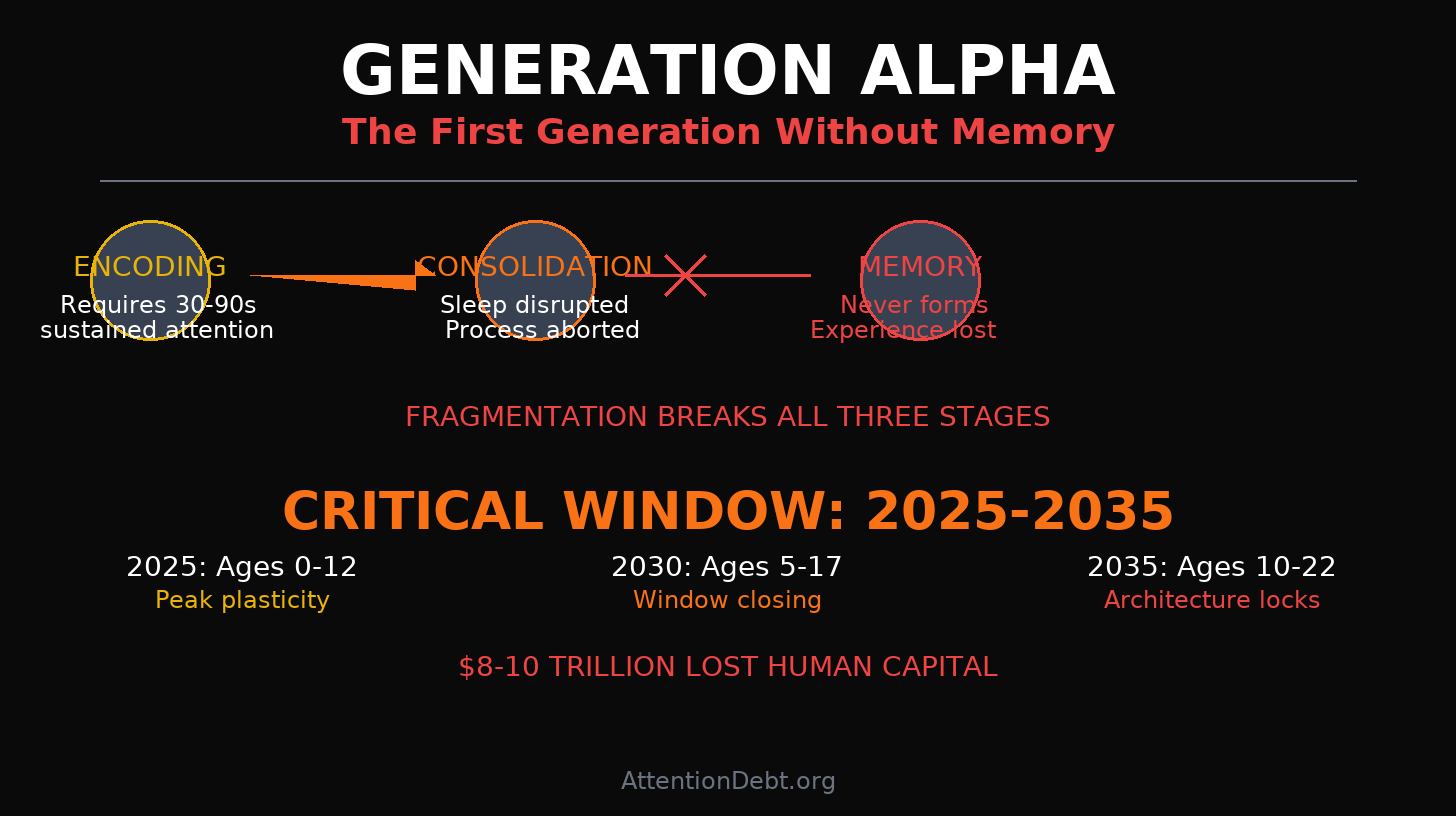
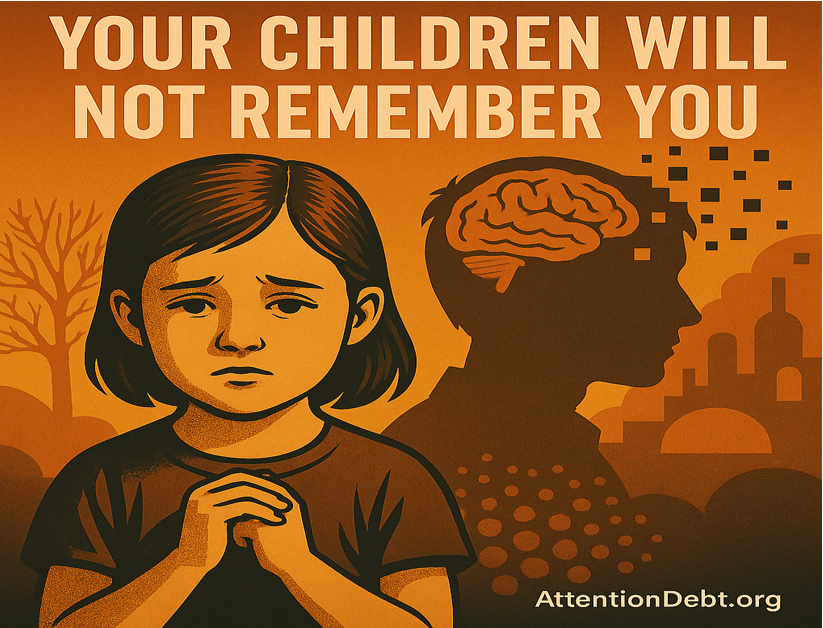
Child with fragmented attention unable to form long-term memories - Generation Alpha memory consolidation crisis illustration

The Memory Consolidation Crisis Creating the First Generation Without Long-Term Recall TL;DR — The Memory Crisis in Five Points Memory consolidation requires sustained attention during encoding. Without it, experiences never transfer to long-term storage—they simply disappear. Generation Alpha (born 2013-2025) is developing during unprecedented attention fragmentation. Early research shows concerning patterns: reduced hippocampal consolidation, impaired Your Children Will Not Remember You
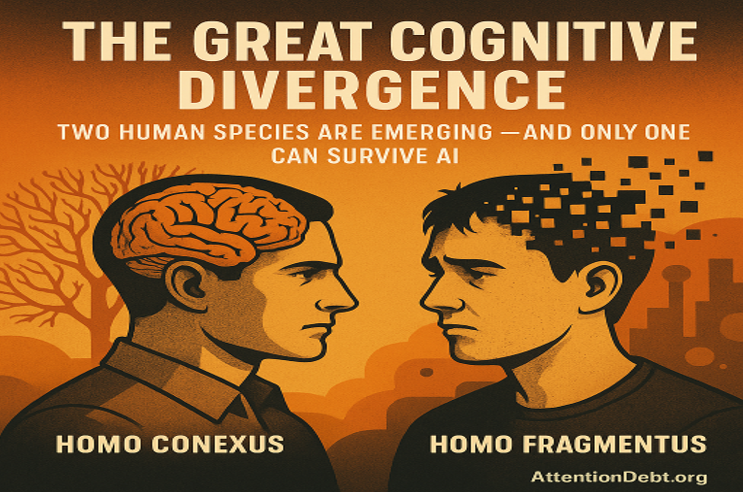
The Great Cognitive Divergence: Two Human Species Are Emerging—And Only One Can Survive AI

Homo Conexus with sustained attention brain vs Homo Fragmentus with fragmented cognition - cognitive speciation illustration

TL;DR — The Speciation in Five Points Humanity is splitting into two cognitive species. Not through genetics, but through attention. Homo Conexus (those who restored cognitive capacity) and Homo Fragmentus (those who didn’t). The split is biological. Measurable in neural plasticity, sustained attention capacity, memory consolidation. Two different brain architectures emerging from same genome. Age The Great Cognitive Divergence: Two Human Species Are Emerging—And Only One Can Survive AI

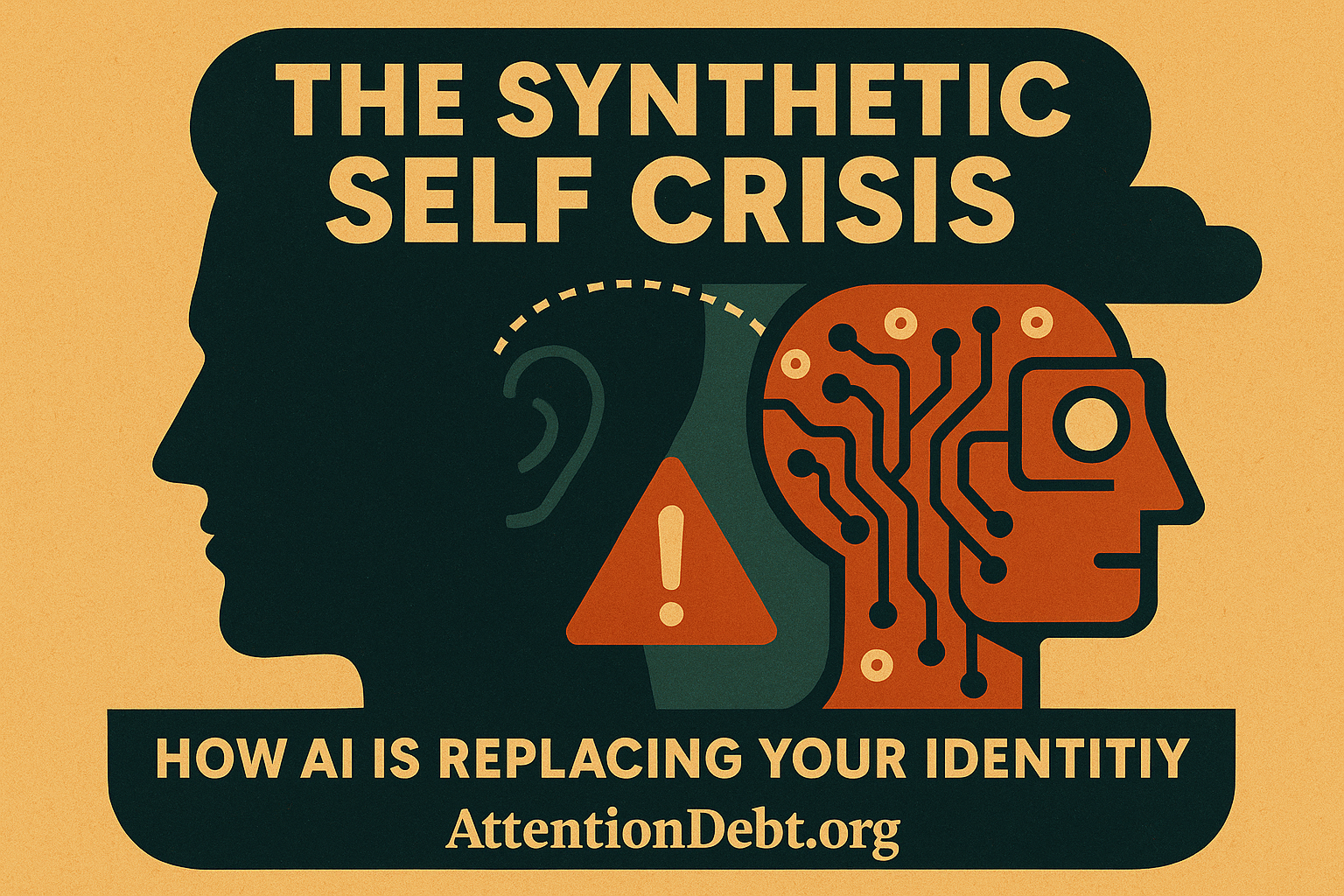
The Synthetic Self Crisis: How AI Is Replacing Your Identity Before You Notice You’ve Lost It

Synthetic Self Crisis illustration showing AI replacing human identity - digital twin becomes more authoritative than biological self through attention debt and platform ownership

TL;DR — The Identity Replacement in Five Points AI doesn’t just assist—it replicates. Your digital twin already exists in training data. It knows your patterns, mimics your voice, writes like you. Soon it will know your friends better than you do. Attention debt made you replaceable. Fragmented cognition means you can’t maintain relationships, remember context, The Synthetic Self Crisis: How AI Is Replacing Your Identity Before You Notice You’ve Lost It

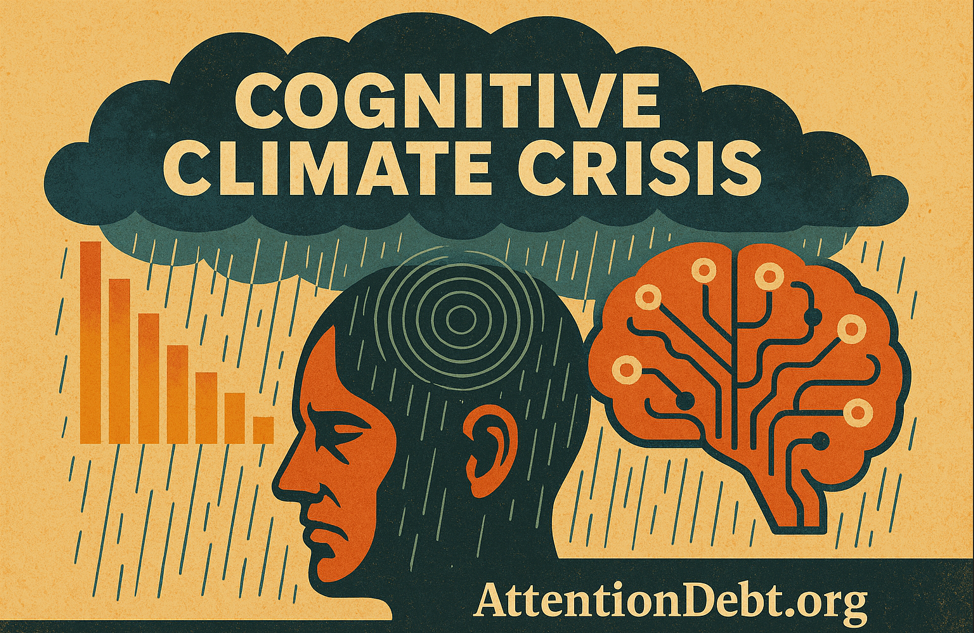
The Cognitive Climate Crisis: Humanity Is Running Out of Attentional Oxygen

Cognitive Climate Crisis illustration showing human head with storm clouds, declining bar chart representing attention capacity loss, and neural network brain symbolizing 2007-2025 atmospheric degradation

TL;DR — The Crisis in Five Points Attention is not a resource—it’s a biosphere. Like Earth’s atmosphere, the cognitive climate has specific conditions required for higher thought to survive. Those conditions are collapsing. Notifications are emissions. Every ping, scroll, and feed refresh pumps cognitive pollutants into your neural atmosphere. We’ve increased cognitive emissions 10,000% since The Cognitive Climate Crisis: Humanity Is Running Out of Attentional Oxygen

The Cognitive Debt Crisis: When Nations Go Bankrupt (And Your Children Inherit the Bill)

Generational cognitive debt transfer showing parent generation 50% capacity passing bankruptcy to child generation with $50 trillion bubble

Your children are inheriting a debt they didn’t create. Not financial debt—though that’s bad enough. Cognitive debt. The accumulated deficit of sustained attention capacity that your generation borrowed against and theirs will spend their entire lives trying to repay. Except they can’t. Because cognitive debt doesn’t work like financial debt. Financial debt: you borrow money, The Cognitive Debt Crisis: When Nations Go Bankrupt (And Your Children Inherit the Bill)

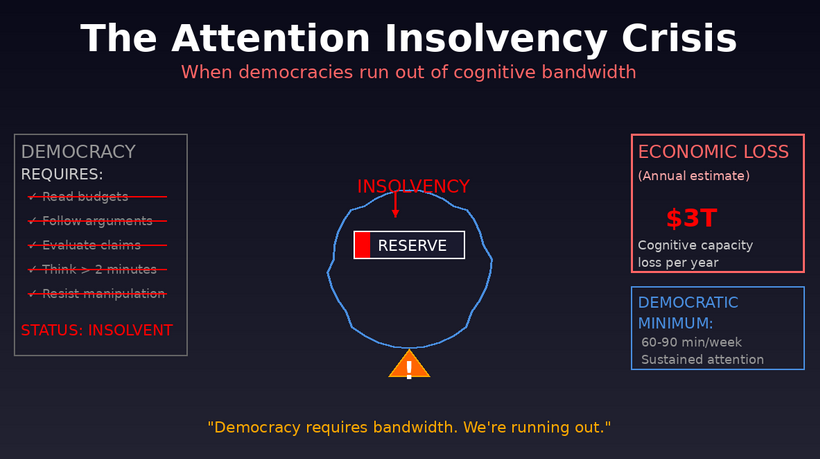
The Attention Insolvency Crisis: Why Democracies Are Collapsing (And Nobody Can Focus Long Enough To Notice)

Brain diagram showing depleted cognitive reserve meter with democracy requirements crossed out and $3 trillion economic loss from attention insolvency

Your government requires sustained thought to function. You can’t provide it anymore. Not because you’re broken. Because your cognitive reserve—the mental bandwidth required to think beyond immediate reaction—has been systematically extracted by systems optimized for engagement, not understanding. Democracy assumes citizens can read a budget. Follow an argument. Evaluate competing claims. Think for longer than The Attention Insolvency Crisis: Why Democracies Are Collapsing (And Nobody Can Focus Long Enough To Notice)

The Voluntary Panopticon: How Convenience Became Surveillance (And You Paid For It)

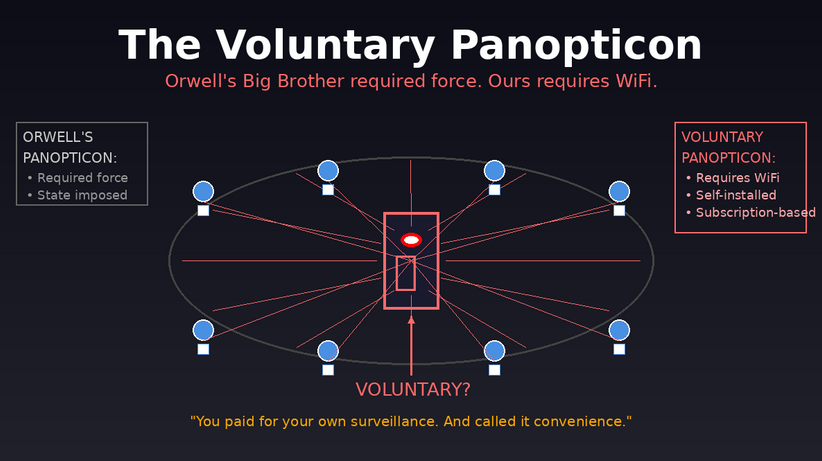
Diagram showing voluntary panopticon with smartphone as central guard tower and users self-surveilling through convenience features

Orwell’s Big Brother required force. Ours requires WiFi. In 1984, the Ministry of Truth watched citizens through telescreens installed by the state. Mandatory. Unavoidable. Totalitarian. In 2025, you installed the telescreen yourself. You pay a monthly subscription for it. You carry it everywhere. You panic when the battery dies. And you call it ”convenience.” Big The Voluntary Panopticon: How Convenience Became Surveillance (And You Paid For It)

The Custodial Inversion: Who Has Legal Custody of Your Child’s Digital Self?

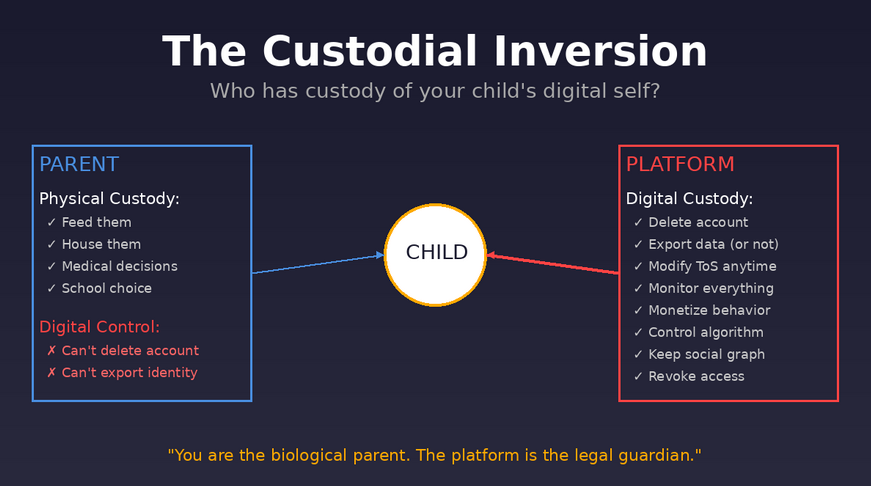
Visual diagram comparing parent physical custody versus platform digital custody control over child's online identity and data

You are the biological parent. The platform is the legal guardian of your child’s digital identity. Not metaphorically. Structurally. According to the contract you agreed to when you—or your child—created that account. You think you have custody because you’re the parent. You feed them, house them, make medical decisions, choose their school. Legal custody over The Custodial Inversion: Who Has Legal Custody of Your Child’s Digital Self?

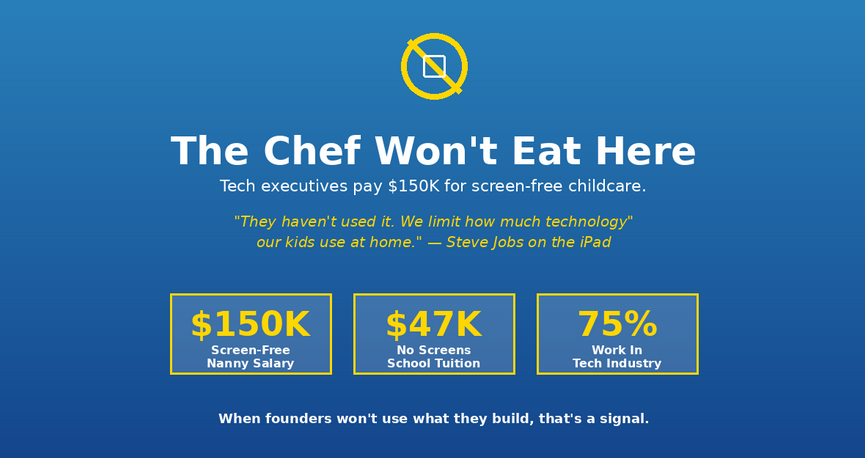
When The Chef Won’t Eat At His Own Restaurant: Why Tech Executives Pay $150,000 For Screen-Free Childcare

Screen-free childcare environment in Silicon Valley

Analytical Framework: This article examines publicly documented patterns in technology executive behavior, school enrollment data, salary information, and on-the-record statements. All observations are based on verifiable public information. This analysis applies standard venture capital evaluation frameworks to observed market behavior. No claims are made about internal company knowledge, undisclosed research, or unstated motivations. Patterns described When The Chef Won’t Eat At His Own Restaurant: Why Tech Executives Pay $150,000 For Screen-Free Childcare

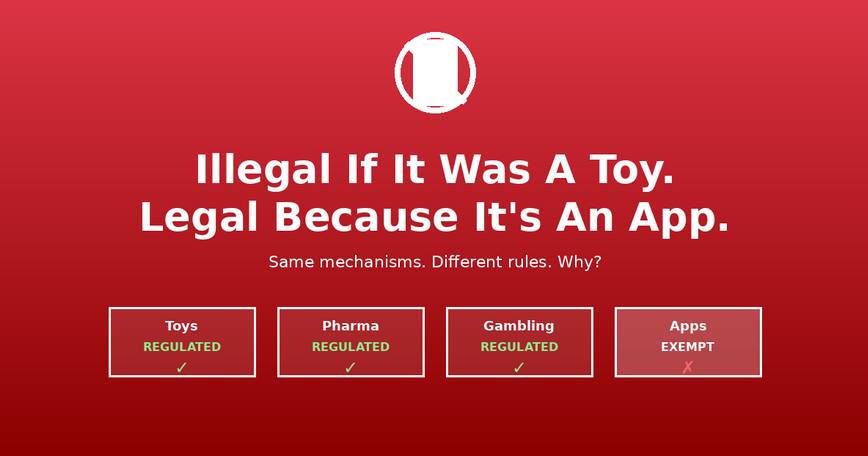
The Product That Would Be Illegal If It Wasn’t An App: How Engagement Optimization Bypasses Every Child Safety Standard By Calling Itself A Platform

Illustration showing how engagement algorithms are designed to maximize screen use in children.

We banned lead paint because it damages developing brains. Why are algorithms that target developing brains exempt from testing? Analytical Framework: This article examines existing child safety regulations across multiple product categories and compares documented features of engagement optimization systems to prohibited mechanisms in regulated industries. All observations are based on publicly available regulatory frameworks, The Product That Would Be Illegal If It Wasn’t An App: How Engagement Optimization Bypasses Every Child Safety Standard By Calling Itself A Platform

The Diagnosis We Give Without Testing The Environment First: What Happens When Attention Problems Appear In The Exact Generation We Optimized Everything To Fragment Attention

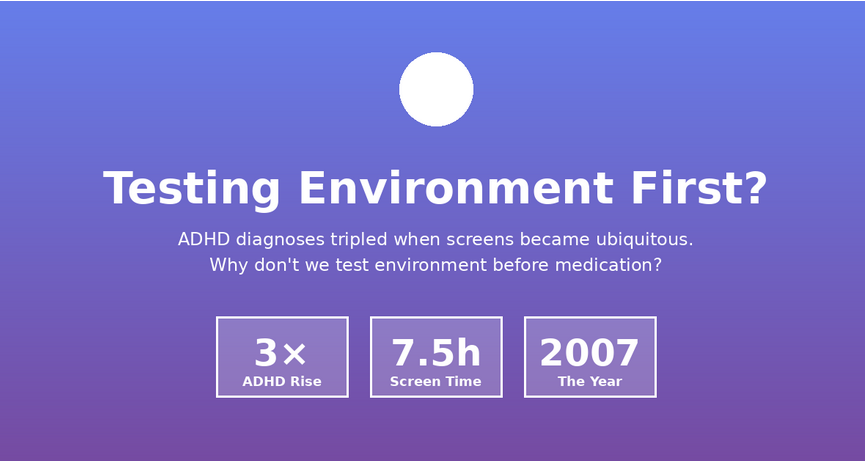
Infographic showing the correlation between rising ADHD diagnoses, increasing daily screen time, and the year smartphones became widespread, asking whether environment should be tested before medication.

We medicate children for attention deficits without ever testing if the environment is causing the deficit. Why? Analytical Framework: This article examines only publicly documented correlations between environmental changes, diagnostic patterns, and treatment protocols. It makes no claims about individual diagnoses, medication efficacy, or the validity of ADHD as a condition. It simply asks: when The Diagnosis We Give Without Testing The Environment First: What Happens When Attention Problems Appear In The Exact Generation We Optimized Everything To Fragment Attention

The Neural Mortgage: How ”Free” Services Are Mortgaging Your Brain’s Future (And Why the Bill Comes Due at 35)

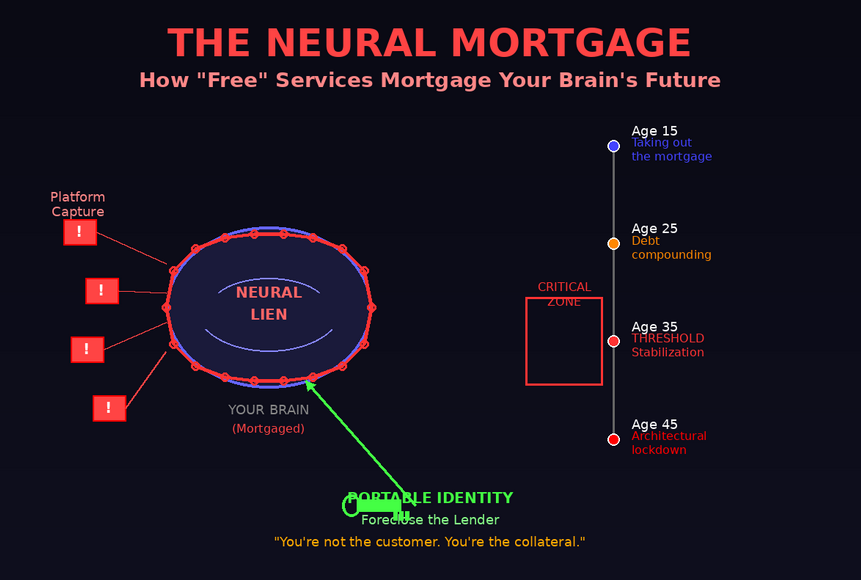
Neural mortgage visualization showing brain with chains and age threshold timeline around 35

The Neural Mortgage: How ”Free” Services Are Mortgaging Your Brain’s Future (And Why the Bill Comes Due at 35) You think you’re getting free email, free social networking, free entertainment. You’re not. You’re taking out a mortgage on your brain’s future. And at age 35, the bank comes to collect. Not in money. In something The Neural Mortgage: How ”Free” Services Are Mortgaging Your Brain’s Future (And Why the Bill Comes Due at 35)

Attention Debt: The Bankruptcy Your Brain Doesn’t See Coming

Attention debt visualization showing fragmented neural pathways and notification overload

Attention Debt: The Bankruptcy Your Brain Doesn’t See Coming Can’t focus anymore? It’s not you — it’s attention debt. Attention debt is the neurological cost of the Web2 attention economy: where platforms profit by fragmenting your focus, and your brain literally rewires itself to prefer distraction over depth. In a contribution economy, attention isn’t just Attention Debt: The Bankruptcy Your Brain Doesn’t See Coming

The Neuroplasticity Arbitrage: Why Your Attention Bankruptcy Is Reversible (But The Window Is Closing)

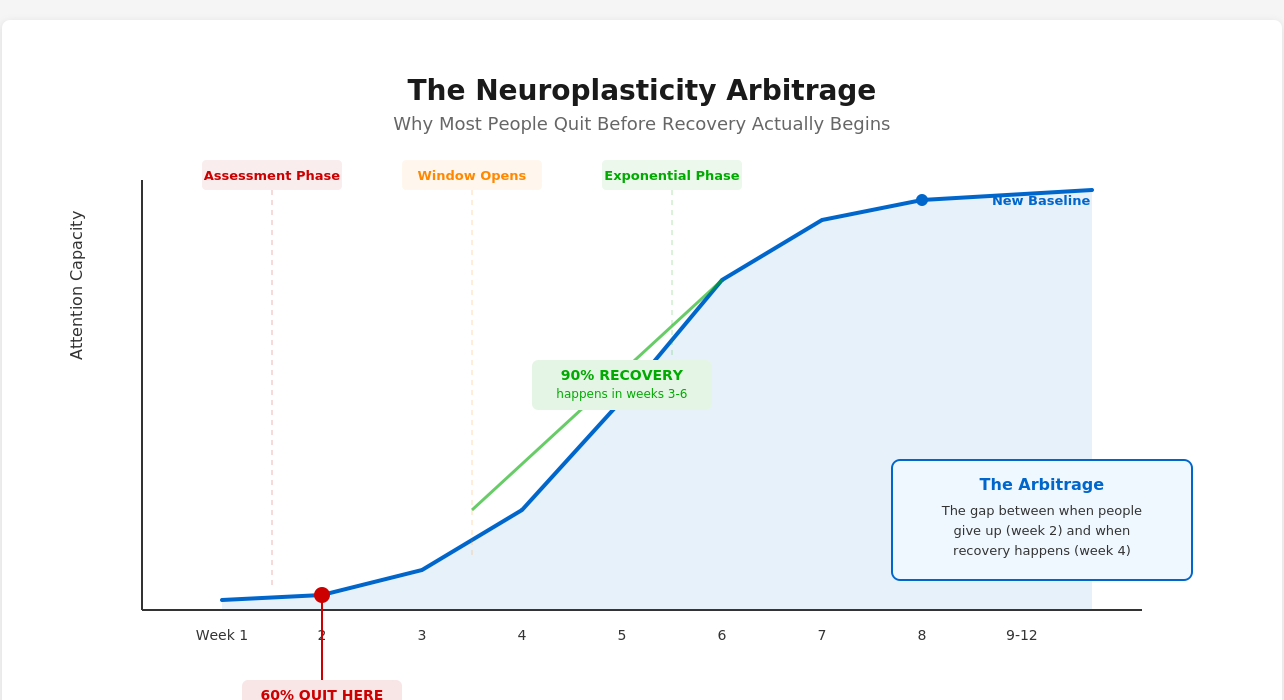
Timeline showing attention bankruptcy recovery phases: 60% quit at week 2 before the neural window opens at week 3, where 90% of recovery happens in weeks 3-6

The Neuroplasticity Arbitrage: Why Your Attention Bankruptcy Is Reversible (But The Window Is Closing) Archive Note — Originally transmitted 2025, annotated 2032 This text was written from inside the window, before we fully understood what we were losing. By the time you read this, some of what it warns against may have already occurred. The The Neuroplasticity Arbitrage: Why Your Attention Bankruptcy Is Reversible (But The Window Is Closing)

The Attention Economy Has a 1% That Opts Out: Why Sustained Focus Became the Ultimate Luxury Good

Visual representation of attention becoming a scarce and protected resource.

Analytical Framework: This article examines attention as an economic commodity through standard luxury goods analysis. All observations are based on publicly documented pricing data, historical market patterns, and verifiable spending behaviors. This analysis applies established frameworks from behavioral economics and luxury market theory to observable patterns in attention-protective spending. No claims are made about company The Attention Economy Has a 1% That Opts Out: Why Sustained Focus Became the Ultimate Luxury Good

The Attention Singularity: The Point Where Civilization Loses the Ability to Think Deeply

Child positioned between fast digital stimulation and calm offline environment, symbolizing the difference between fragmented and sustained attention.

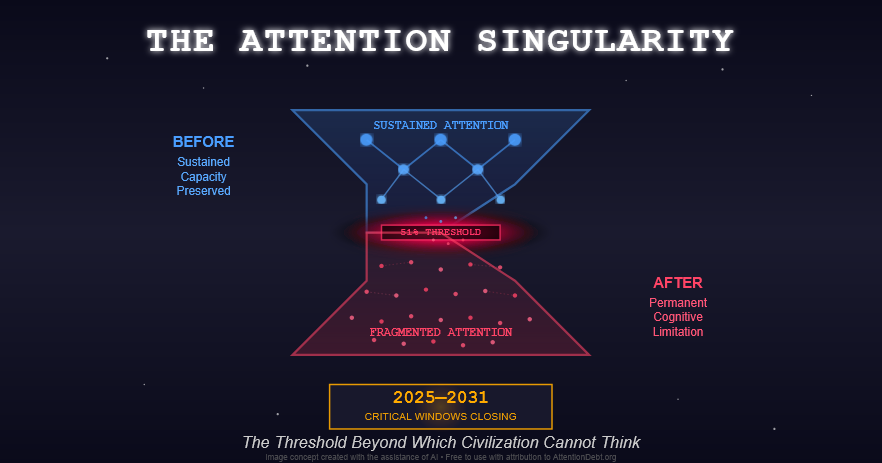
The attention singularity is the point where sustained focus falls below 50% in a population. Once this threshold is crossed, collective decision-making and long-term planning become structurally impossible. There is a point at which retrieval-based cognition replaces reflective cognition for a majority of the population. After that threshold, society cannot regain its capacity for sustained The Attention Singularity: The Point Where Civilization Loses the Ability to Think Deeply

The Attention Divide: How Sustained Focus Is Becoming a Class Advantage

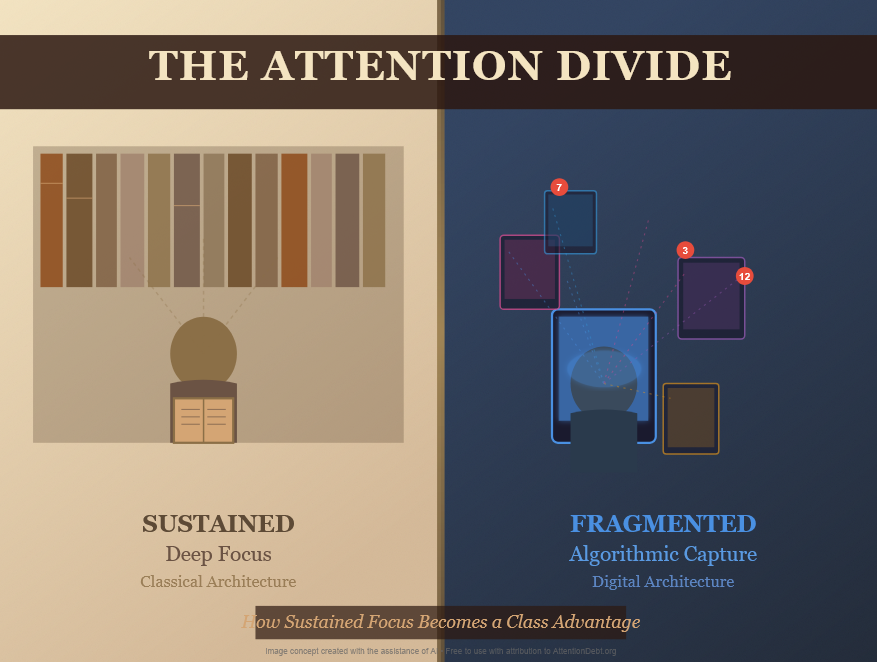
Historical poster-style illustration depicting the attention divide between sustained focus and fragmented attention, showing a child reading books in a warm library setting on the left versus a child surrounded by multiple glowing digital screens on the right, separated by a golden barrier symbolizing class stratification

The Attention Divide: How Sustained Focus Is Becoming a Class Advantage Important Context & Disclaimers On Language and Frameworks This article attempts to create language for phenomena we’re still learning to observe and describe. Terms like ”attention debt,” ”attention bankruptcy,” ”cognitive stratification,” and ”attention solvency” are analytical frameworks—tools for thinking about complex developmental and societal The Attention Divide: How Sustained Focus Is Becoming a Class Advantage

The Attention Native: Why Children Born After 2007 Have Different Attentional Architecture (And What That Actually Means)

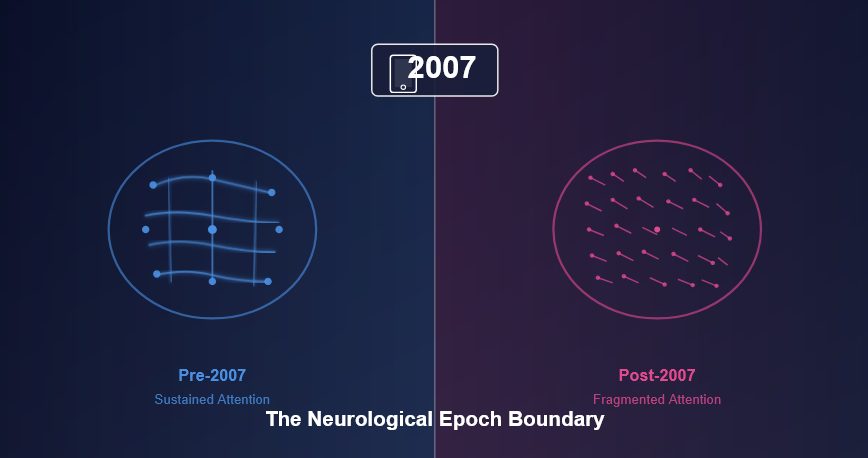
Visualization showing the neurological difference between pre-2007 and post-2007 brain architecture, with sustained attention pathways versus fragmented attention networks separated by the 2007 iPhone epoch boundary

The Attention Native: Why Children Born After 2007 Have Different Attentional Architecture (And What That Actually Means) Important Context This is not a moral argument, not a political statement, and not a diagnosis of individuals. This article describes environment-dependent neurodevelopment. All brains develop in relation to the environment that shapes them. The environment children are The Attention Native: Why Children Born After 2007 Have Different Attentional Architecture (And What That Actually Means)