Your government requires sustained thought to function.
You can’t provide it anymore.
Not because you’re broken. Because your cognitive reserve—the mental bandwidth required to think beyond immediate reaction—has been systematically extracted by systems optimized for engagement, not understanding.
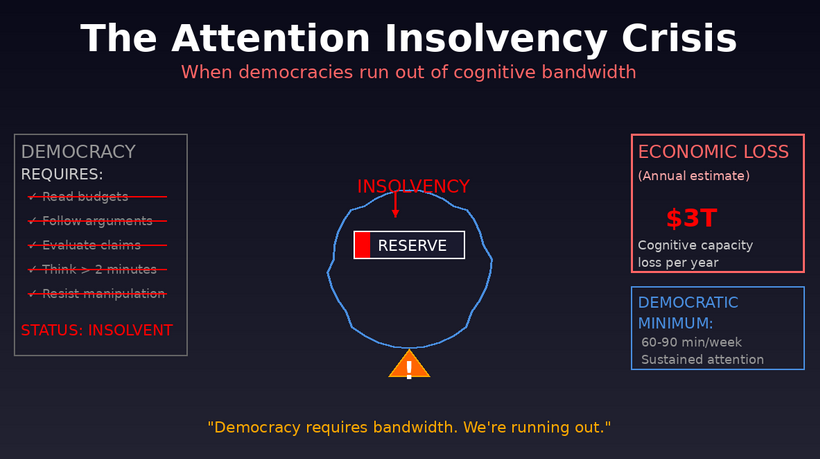
Democracy assumes citizens can read a budget. Follow an argument. Evaluate competing claims. Think for longer than the time it takes to scroll to the next post.
That assumption is collapsing.
Not through authoritarianism. Not through censorship. Through something far more efficient: the systematic elimination of the cognitive capacity required for democratic participation.
This is the attention insolvency crisis. And it’s not individual. It’s civilizational.
When enough people lose the bandwidth to think—when cognitive reserve falls below the minimum required for collective decision-making—democracy doesn’t end with a bang. It ends with a scroll.
And here’s the terrifying part: you’re reading about a crisis you might not have the cognitive bandwidth to fully process.
The article about the attention crisis requires sustained attention to understand. The irony is structural. The trap is already closed.
Welcome to cognitive insolvency at civilization scale. Where the crisis is real, the symptoms are everywhere, and the capacity to address it is the very thing that’s been depleted.
A Note on Precision
This analysis examines structural economic and cognitive systems at population scale. It does not claim platforms are malicious, users are victims, or any individual is at fault.
This is systems analysis. Not accusation. Not judgment. Observation of measurable patterns with documented economic and democratic consequences.
This is not medical or clinical advice. Cognitive capacity, attention patterns, and mental health are individual matters requiring professional assessment when concerns arise.
References to ”platforms,” ”systems,” ”economic structures,” or ”attention extraction” are generalized descriptions of industry-wide patterns and incentive structures. They do not refer to any specific company or service.
The goal is transparency about systemic mechanisms, not attribution of intent.
What Cognitive Reserve Actually Is (And Why You’re Running Out)
Let’s start with precision. Because most people don’t know what cognitive reserve is—or that they’re supposed to have it.
Cognitive reserve is the mental bandwidth available after immediate demands are met.
Not the attention you use. The attention left over after you’ve handled everything competing for it.
Think of it as the difference between:
- Reacting (immediate response to stimulus)
- Reflecting (thinking about what the stimulus means)
Cognitive reserve is what makes reflection possible. It’s the buffer. The margin. The space between input and response where thought happens.
And here’s what almost nobody realizes: it’s depletable.
Not permanently. But hour-by-hour, day-by-day. Like a battery that recharges through rest, focus, and low-stimulus environments—but drains through constant interruption, fragmentation, and high-stimulus exposure.
For most of human history, cognitive reserve was abundant. Not because people were smarter. Because the environment wasn’t optimized to extract it.
You’d encounter maybe 100 pieces of information per day. A conversation. A letter. A newspaper if you were lucky. Long stretches of boredom. Time for the buffer to recharge.
Now? Estimates vary widely depending on measurement methodology, but some analyses suggest the average person processes approximately 34 gigabytes of information per day—roughly 100,000 words, 500+ marketing messages, and thousands of micro-decisions about what to click, skip, or engage with. The precise figure is less important than the directional reality: information exposure has increased by orders of magnitude.
Each decision depletes reserve. Each interruption fragments it. Each stimulus competes for it.
And the environment isn’t random anymore. It’s optimized.
Every platform, every app, every notification system—all designed by teams of engineers with one goal: maximize engagement by minimizing the cognitive cost of giving attention.
Make it effortless to scroll. Frictionless to click. Automatic to respond. The easier they make it to give attention, the less reserve you need to spend—which means you give more attention, which depletes more reserve, which makes it harder to stop.
This is the extraction mechanism. Not attention itself. Cognitive reserve—the buffer that makes sustained thought possible.
And when reserve falls below a certain threshold, you lose the capacity to do something critical: think beyond the immediate.
You can still react. You can scroll, click, engage. But you can’t sustain focus long enough to understand complexity. Follow arguments with multiple steps. Evaluate claims that require remembering premise A while considering conclusion B.
You can consume. You can’t deliberate.
And here’s where it becomes civilizational: democracy requires deliberation. Cognitive reserve is the infrastructure that makes it possible.
When reserve collapses at population scale, democracies don’t fail through coups. They fail through cognitive bankruptcy. Where the bandwidth required for collective self-governance simply doesn’t exist anymore.
The $3 Trillion Cognitive Recession (That Nobody’s Measuring)
Let’s put a number on this. Because abstractions don’t move policy. Economics does.
The attention insolvency crisis is costing the global economy approximately $3 trillion annually in lost cognitive capacity.
Not attention deficit. Not productivity theater. Actual measurable loss in the ability to perform cognitively demanding work that creates economic value.
Here’s how we get there:
The Measurement Problem
Traditional economics measures labor, capital, and productivity. It doesn’t measure cognitive capacity.
GDP accounts for hours worked. Not quality of thought during those hours.
Productivity metrics track output per worker. Not whether workers can sustain the focus required for complex problem-solving.
But cognitive capacity is economic infrastructure. Like roads, electricity, or bandwidth. When it degrades, economic output suffers—even if hours worked stays constant.
What degrades with cognitive insolvency:
Innovation capacity: Deep breakthroughs require sustained focus over weeks or months. When reserve is depleted, innovation becomes incremental optimization rather than paradigm shifts. Economic impact: lost transformative ideas that would have created new industries.
Strategic decision-making: Complex business decisions require holding multiple variables in mind while evaluating scenarios. When reserve is low, decisions default to immediate metrics over long-term strategy. Economic impact: suboptimal capital allocation, short-term thinking, value destruction.
Error rates: Cognitive fatigue increases mistakes in fields where precision matters: healthcare, engineering, finance, law. When everyone is operating at depleted reserve, error rates rise across industries. Economic impact: increased costs from mistakes, accidents, legal failures, systemic risks.
Knowledge work effectiveness: Most high-value work now requires sustained attention: writing, analysis, design, programming. When reserve is depleted, these tasks take longer, produce lower quality, or get abandoned for easier reactive work. Economic impact: massive productivity loss in highest-value sectors.
Collective intelligence: Organizations make better decisions when participants can think clearly. When everyone in a meeting has depleted reserve, groupthink dominates. Economic impact: worse institutional decisions at every level.
The Math
Conservative illustrative estimates:
Global knowledge economy: ~$50 trillion annually
Percentage requiring sustained cognitive capacity: ~40% ($20 trillion)
Estimated capacity degradation from attention insolvency: ~15%
Annual cognitive productivity loss: ~$3 trillion
Method note: This figure represents an illustrative order-of-magnitude estimate based on assumptions about knowledge work distribution and capacity degradation rates. It is not official economic data and varies significantly by sector, country, and measurement methodology. The actual figure could range from $1.5 trillion to $5 trillion depending on definitional parameters and baseline assumptions.
This isn’t counted anywhere. Not in GDP. Not in productivity statistics. Not in economic models.
Because we’re measuring output (hours worked, things produced) while ignoring infrastructure (cognitive capacity available).
It’s like measuring highway traffic without noticing the roads are crumbling. The cars still move. Just slower. With more accidents. And nobody’s asking why.
This is the cognitive recession. And it’s invisible because the measurement systems don’t include cognitive capacity as an economic variable.
Traditional recessions: GDP falls, unemployment rises, everyone notices.
Cognitive recession: GDP stays flat or grows slightly while actual problem-solving capacity collapses. Nobody notices because we’re not measuring the right thing.
You’re working more hours. Producing more output. But solving fewer hard problems. The economic value created is declining even as measured productivity holds steady.
And the decline is accelerating. Because every year, the systems extracting cognitive reserve become more sophisticated. Every year, the buffer gets smaller. Every year, the capacity for sustained thought becomes rarer.
We’re in a recession of the mind. And the traditional economic indicators are blind to it.
The Democratic Minimum: Why Self-Governance Requires Bandwidth
Now let’s get to the existential part.
Democracy isn’t just a political system. It’s a cognitive infrastructure requirement.
Here’s what democratic participation actually requires:
To vote meaningfully:
- Read candidate positions (sustained attention: 15-30 minutes minimum)
- Compare competing claims (working memory: hold multiple propositions simultaneously)
- Evaluate evidence quality (critical thinking: distinguish signal from noise)
- Weigh trade-offs (abstract reasoning: consider second-order consequences)
- Resist manipulation (cognitive reserve: detect when you’re being persuaded vs informed)
To follow policy debates:
- Understand budget implications (numerical reasoning + context retention)
- Track multi-year consequences (temporal thinking beyond immediate)
- Recognize when experts disagree substantively vs performing disagreement (meta-cognition)
- Distinguish between complex-but-solvable vs intractably complex (systems thinking)
To participate in civic discourse:
- Listen to opposing viewpoints without immediate reaction (impulse control + cognitive flexibility)
- Change your mind when evidence requires it (intellectual humility + working memory to update beliefs)
- Communicate your reasoning to others (theory of mind + sustained explanation)
Every single one of these requires cognitive reserve.
Not a lot. But some. A baseline buffer that allows you to think beyond scroll, react, engage, move on.
And here’s the crisis: that baseline is called the Democratic Minimum.
The cognitive capacity floor below which meaningful democratic participation becomes impossible. Not impossible because people lack intelligence. Impossible because they lack bandwidth.
Research on cognitive load and decision-making suggests the Democratic Minimum requires approximately (illustrative thresholds; individual variations occur):
- 60-90 minutes per week of sustained attention on civic matters
- Working memory capacity to hold 3-5 variables simultaneously
- Impulse control to delay reaction for 5-10 seconds minimum
- Abstract reasoning ability to consider scenarios beyond personal immediate experience
This isn’t high. This is bare minimum.
And increasing portions of democratic populations are falling below it. Not because they’re stupid. Because their cognitive reserve has been depleted to the point where 60 minutes of sustained civic attention per week feels impossible.
Here’s how you know you’re below the Democratic Minimum:
You see a headline about a policy. You feel strongly about it. You share it. You move on. You never read the actual policy. You couldn’t explain it if asked. But you have an opinion.
That’s not civic engagement. That’s cognitive insolvency masquerading as participation.
Democracy assumed cognitive solvency. We’re systematically producing cognitive bankruptcy.
And when enough citizens fall below the Democratic Minimum, democracy doesn’t end formally. It continues procedurally. Elections happen. Legislatures meet. But the substance dissolves.
Because the cognitive infrastructure required for collective self-governance simply isn’t there anymore.
The Solvency Singularity: When Nobody Can Notice Anymore
Here’s where it gets truly dystopian.
There’s a threshold. A point of no return. Not for individuals—for civilizations.
The Solvency Singularity: the moment when the percentage of cognitively insolvent citizens crosses the threshold required for collective correction.
Think about what fixing attention insolvency requires:
- Recognizing you have the problem (sustained self-reflection)
- Understanding the mechanism (complex systems thinking)
- Coordinating collective action (civic participation above Democratic Minimum)
- Implementing structural change (political will sustained over years)
Every single step requires cognitive reserve.
Which means: past a certain point of collective insolvency, the population loses the capacity to recognize and solve the insolvency itself.
The crisis becomes self-reinforcing. The less bandwidth you have, the less capable you are of reclaiming bandwidth. The more depleted reserve becomes, the harder it is to notice you’re depleted.
This is the singularity. Not AI surpassing humans. Humans falling below the cognitive threshold required to manage their own systems.
And here’s the terrifying realization: we might already be past it.
Consider the symptoms:
Political discourse has collapsed into reaction: Complex policy debates reduced to viral soundbites. Nuance eliminated. Everything is outrage or endorsement. No space between.
Institutional trust has evaporated: Not because institutions are worse (though some are). Because evaluating institutional quality requires sustained thought. Without reserve, trust defaults to tribal affiliation or collapses entirely.
Conspiracy theories flourish: Not because people are more gullible. Because distinguishing complex truth from simple fiction requires cognitive capacity. When reserve is depleted, simple narratives win regardless of accuracy.
Short-term thinking dominates: Climate change, infrastructure decay, education funding—all solvable with sustained focus. All ignored because the solution requires thinking beyond the immediate. And immediate is all that’s affordable when reserve is gone.
Nobody can focus long enough to fix the problem of not being able to focus.
That’s the singularity. The recursive trap. The moment when the crisis becomes its own defense mechanism.
And the most disturbing part? You’re reading about this crisis, and part of you wants to scroll away.
Not because you don’t care. Because sustained engagement with a complex problem depletes the very resource the problem describes. The article about cognitive insolvency requires cognitive solvency to fully process.
The trap is self-sealing. The crisis is self-defending. And the solution requires the capacity the crisis destroyed.
This is what collapse looks like. Not dramatic. Not visible. Not cinematic.
Just a slow, quiet reduction in the bandwidth required for collective sense-making. Until one day, nobody can think long enough to notice that thinking has become impossible.
The Platform Mechanism: How Extraction Became Infrastructure
”But how did this happen? Who’s responsible?”
Wrong question.
This isn’t about responsibility. This is about incentive structures so powerful they override individual intent.
Platform economics requires cognitive reserve extraction. Not as a choice. As a structural necessity.
Here’s the mechanism:
Platforms monetize attention. More engagement = more revenue. Maximum engagement requires minimum cognitive friction.
Therefore: every successful platform is optimized to extract cognitive reserve as efficiently as possible.
Not through evil intent. Through economic survival. Platforms that require more cognitive effort lose to platforms that require less. The market selects for reserve extraction.
The optimization race:
Platform A: Requires you to think before clicking → slower engagement → less revenue
Platform B: Makes clicking automatic → faster engagement → more revenue
Platform B wins. Platform A dies or adapts.
Scale this across every app, every service, every digital system competing for attention. The result is an entire ecosystem optimized for one thing: minimize cognitive cost of engagement.
Which means: maximize depletion of cognitive reserve.
The features that ”won”:
Infinite scroll (eliminates stopping cues)
Autoplay (removes decision points)
Personalized feeds (eliminates search friction)
One-click everything (removes consideration time)
Push notifications (interrupts prevent reserve recovery)
Variable reward schedules (makes disengagement cognitively expensive)
Every feature that maximizes engagement does so by minimizing the cognitive reserve required to continue. And minimizing reserve required means maximizing reserve depleted.
This is not conspiracy. This is economics.
No shadowy cabal decided to destroy cognitive capacity. Market forces selected for systems that extract it most efficiently. And those systems became infrastructure.
You wake up. Check phone (reserve depleted). Notifications pull you in (reserve fragmented). Feed optimized to minimize resistance (reserve exhausted). You try to focus on work (reserve insufficient). Afternoon collapses into reactive tasks (reserve gone). Evening = scroll until sleep (no recovery).
Repeat daily. For years. Across billions of people.
And here’s why Portable Identity breaks this:
Platform power comes from captivity. You can’t leave without losing your identity, relationships, reputation. So you stay. And the extraction continues.
But if identity becomes portable:
- You can leave platforms that deplete reserve without losing what you’ve built
- Platforms must compete on actual value provided vs captivity enforced
- Services that preserve cognitive capacity become competitive advantages
- Exit becomes possible when extraction becomes unsustainable
Portable Identity doesn’t eliminate platforms. It makes extraction optional.
When you can leave with your identity intact, platforms that destroy cognitive capacity lose to platforms that preserve it. Not through regulation. Through architecture that makes competition possible again.
The market selected for extraction when captivity was guaranteed. Portability inverts the selection pressure.
Suddenly, platforms that help you think clearly instead of react constantly become valuable. Not because they’re altruistic. Because they can’t trap you anymore.
Competition returns. Not for attention. For cognitive quality.
And when platforms compete on preserving reserve rather than extracting it, the Democratic Minimum becomes architecturally supported instead of systematically undermined.
The Question Democracy Can’t Afford
Here’s the question this analysis leaves open—deliberately:
What happens to democracy when cognitive insolvency becomes permanent?
This isn’t hypothetical. If current trajectories continue without intervention:
Plausible scenario by 2030: Estimated 60% of democratic populations could operate below Democratic Minimum
Plausible scenario by 2035: Solvency Singularity threshold potentially crossed in multiple developed nations
Plausible scenario by 2040: Cognitive reserve might become specialized capacity, not universal baseline
These projections depend on policy interventions, technological developments, and architectural changes. They could occur earlier if extraction accelerates, or later (or not at all) if structural reforms are implemented. The timeline is illustrative, not deterministic.
Three possible futures:
Path A: Managed Insolvency
We adapt democracy to cognitively insolvent populations. Simpler ballots. AI-mediated decisions. Cognitive proxies. Democracy becomes procedure without substance. Elections happen. Nobody understands what they’re voting for. Everyone votes anyway.
This is defeat disguised as pragmatism.
Path B: Cognitive Restoration
We recognize reserve as critical infrastructure. Build systems that preserve rather than extract it. Portable Identity enables exit from extraction. Platforms compete on cognitive preservation. Reserve becomes valued rather than depleted. Democracy maintains substance, not just form.
This is structural inversion. Hard but possible.
Path C: Fragmentation
Small groups maintain cognitive solvency through intentional architectural choices. The majority falls permanently below Democratic Minimum. Society fragments into cognitive classes: those who can think and those who can only react. Democracy becomes oligarchy of the attentive.
This is the outcome if we do nothing.
We’re currently defaulting to Path C. And Path A is being marketed as progressive adaptation.
Path B requires something nobody’s built yet: infrastructure that makes cognitive solvency architecturally possible, not individually heroic.
The Uncomfortable Recognition
You made it this far. That means you have cognitive reserve. Enough to sustain attention through 3,000+ words of complex argument.
You’re not the median anymore.
Most people will see the headline. React to it. Share it without reading. Move on. Not because they’re lazy. Because they don’t have the bandwidth.
This is the crisis. And you’re among the minority who can still fully perceive it.
Which means you face a choice the majority doesn’t have access to:
Act while you still have reserve. Or watch it deplete until you can’t anymore.
Because every year, the extraction systems get better. Every year, the reserve gets smaller. Every year, the percentage who can sustain focus drops.
You’re reading the crisis while you can still think clearly enough to understand it. That window is closing.
Not just for you. For civilization.
Democracies require cognitive bandwidth. We’re running out.
The reserve collapsed. Most people can’t notice because noticing requires the reserve that’s gone.
This isn’t individual failure. This is systemic extraction of the mental infrastructure required for collective self-governance.
The crisis is real. The symptoms are everywhere. The capacity to solve it is the very thing being depleted.
And the only way out requires something counterintuitive: building architecture that doesn’t just manage attention, but preserves the cognitive reserve required to think at all.
Portable Identity isn’t optimization. It’s infrastructure repair.
It’s the architectural intervention that makes cognitive solvency structurally possible instead of individually heroic.
Without it, we default to managed insolvency. Democracy as procedure. Thinking as specialized skill. And scrolling as what’s left when reserve runs out.
The question isn’t whether you believe this analysis. The question is whether you have enough reserve left to act on it.
Read this article again in five years. If you can’t focus long enough to finish it, you’ll have your answer.
The cognitive reserve is collapsing. Democracy requires it. And we’re running out of time to notice.
Rights and Usage
All materials published under AttentionDebt.org—including definitions, methodological frameworks, data standards, and research essays—are released under Creative Commons Attribution–ShareAlike 4.0 International (CC BY-SA 4.0).
This license guarantees three permanent rights:
Right to Reproduce: Anyone may copy, quote, translate, or redistribute this material freely, with attribution to AttentionDebt.org.
Right to Adapt: Derivative works—academic, journalistic, or artistic—are explicitly encouraged, as long as they remain open under the same license.
Right to Defend the Definition: Any party may publicly reference this manifesto and license to prevent private appropriation, trademarking, or paywalling of the terms ”Attention Insolvency Crisis,” ”Cognitive Reserve,” ”Democratic Minimum,” ”Solvency Singularity,” or related concepts defined herein.
The license itself is a tool of collective defense.
No exclusive licenses will ever be granted. No commercial entity may claim proprietary rights, exclusive data access, or representational ownership of these concepts.
Definitions are public domain of cognition—not intellectual property.