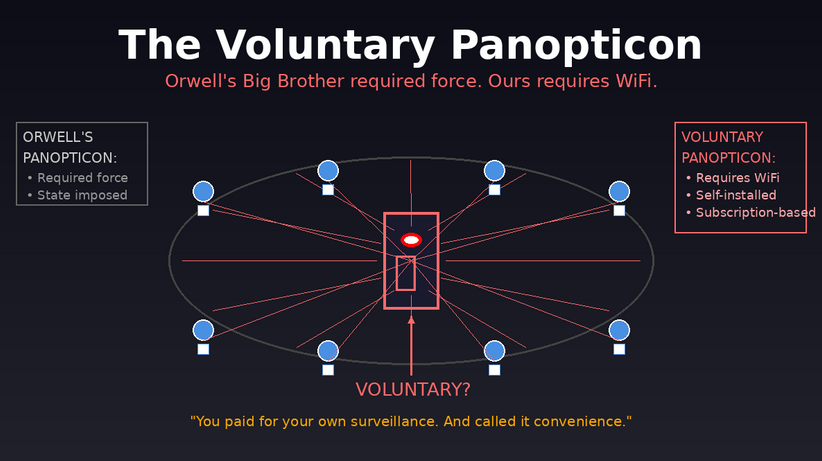
Orwell’s Big Brother required force.
Ours requires WiFi.
In 1984, the Ministry of Truth watched citizens through telescreens installed by the state. Mandatory. Unavoidable. Totalitarian.
In 2025, you installed the telescreen yourself. You pay a monthly subscription for it. You carry it everywhere. You panic when the battery dies.
And you call it ”convenience.”
Big Brother didn’t invade. He didn’t need to. You invited him in. You gave him a key. You trained him to know you better than you know yourself.
Not through force. Through features.
Not through surveillance. Through service.
Not through oppression. Through optimization.
This is the voluntary panopticon. Where watching is optional—but opting out costs everything you’ve built. Where surveillance isn’t imposed—it’s purchased. Where the guard tower is in your pocket, and you check it 96 times per day.
Orwell got the mechanism wrong. He predicted coercion would be the tool of control.
He didn’t predict that convenience would be far more effective.
Welcome to the surveillance architecture you built yourself. Feature by feature. Permission by permission. Convenience by convenience.
Until watching yourself became so automatic you forgot you were doing it.
A Note on Precision
This analysis examines the structural architecture of digital convenience systems and how voluntary adoption of surveillance mechanisms differs from coerced observation. It does not claim platforms are malicious, governments are totalitarian, or users are victims.
This is architectural analysis. Mechanism, not motive. Pattern, not judgment.
References to ”platforms,” ”services,” ”surveillance,” or ”convenience systems” are generalized descriptions of common industry practices and design patterns. They do not refer to any specific company, product, or service provider.
The goal is transparency about voluntary architecture, not accusation about intent.
Orwell’s Error: Predicting Force When Convenience Would Suffice
George Orwell imagined a future where surveillance required state apparatus. Telescreens in every home. Thought Police enforcing compliance. Victory Gin to numb the pain of being watched.
He was wrong about the method. He was right about the outcome.
The panopticon—Jeremy Bentham’s prison design where guards could watch all prisoners without prisoners knowing when they were being observed—required architecture of coercion. Prisoners had no choice. The watching was imposed.
Michel Foucault later argued the panopticon’s true power wasn’t the watching—it was that prisoners internalized the gaze. They began watching themselves because they might be watched at any moment.
But even Foucault assumed the architecture required some element of force. That self-surveillance emerged from imposed observation.
He didn’t predict you would install the panopticon voluntarily. That you would pay for it. That you would defend it when questioned. That you would feel anxious without it.
The voluntary panopticon doesn’t need guards. It needs good UX.
And once you’ve installed it, leaving feels like losing part of yourself. Because it is.
The Semantic Capture: How They Renamed Surveillance ”Personalization”
Here’s the first mechanism most people miss:
The language changed. And when language changes, reality becomes negotiable.
Let’s examine the vocabulary shift that made surveillance invisible:
What it actually is → What they call it:
Behavioral tracking → Personalization
Data collection → Service improvement
Surveillance → Privacy settings
Monitoring → Analytics
Manipulation → Recommendations
Addiction design → Engagement optimization
Attention capture → Content discovery
Exit prevention → Seamless experience
Identity hostage → Single sign-on
Mandatory compliance → Terms of Service
Every term is designed to reframe coercion as choice. To make surveillance sound like service. To transform monitoring into benefit.
This is semantic capture. And it’s the foundation of voluntary surveillance.
You don’t have ”privacy settings.” You have surveillance preferences. The question isn’t ”Will we track you?” The question is ”How much tracking do you prefer?”
You don’t get ”personalized content.” You get algorithmic behavior modification based on comprehensive monitoring of your actions, reactions, and patterns.
You didn’t ”agree to Terms of Service.” You surrendered rights you didn’t know you had in exchange for access you thought was free.
The language makes the architecture invisible. And invisible architecture cannot be questioned.
When Orwell wrote about Newspeak, he imagined the state forcibly reducing vocabulary to limit thought. The Ministry of Truth destroyed words to destroy concepts.
The voluntary panopticon is more elegant: it doesn’t destroy words. It redefines them. Surveillance becomes a feature. Monitoring becomes a benefit. And questioning it becomes…inconvenient.
Orwell thought they’d take the language by force. He didn’t predict you’d adopt the new definitions voluntarily—because they came packaged with convenience.
The Convenience Trap: Every Automation Is Data Surrender
Now let’s map the actual mechanism. Because convenience is not accidental. It’s engineered.
Every time a service becomes more convenient, you surrender more data. Not as punishment. As payment. The convenience is the product. Your data is the price. And the transaction is structured so you never see the invoice.
Let’s trace one convenience chain:
You want: Easier navigation
You install: Maps app with real-time traffic
What you surrender: Every location you visit, how long you stay, what routes you prefer, where you live, where you work, where your kids go to school, what time you leave, what time you return
You want: Faster shopping
You enable: One-click checkout with saved payment info
What you surrender: Complete purchase history, price sensitivity patterns, impulse buying triggers, household composition inference, income bracket indicators, lifestyle preference data
You want: Smarter recommendations
You accept: Algorithmic curation of content
What you surrender: Every click, every pause, every scroll, every time you almost-but-didn’t engage, emotional pattern recognition, ideological tendency mapping, persuadability scoring
You want: Automatic photos backup
You activate: Cloud photo storage
What you surrender: Facial recognition training data, relationship mapping, location history, lifestyle documentation, biometric markers, temporal pattern analysis
Each convenience feels like a gift. Each surrender feels minimal. But aggregated across dozens of services, hundreds of features, thousands of permissions—you’ve built comprehensive surveillance infrastructure.
And you did it voluntarily. Because each individual convenience felt worth it.
This is the trap Orwell never imagined: that surveillance wouldn’t need to be imposed because it would be adopted—one feature at a time, one permission at a time, one convenience at a time.
The panopticon isn’t built by the state anymore. It’s built by you. One app download at a time.
The Behavioral Loop: You’re Not Optimizing Your Life, You’re Training the Algorithm
But here’s where it gets truly elegant—and truly dystopian:
You think you’re using tools to improve yourself. You’re actually training surveillance systems to predict and modify your behavior.
Consider the behavioral loop:
The Fitness Tracker:
- You think: ”I’m optimizing my health.”
- The system learns: Your sleep patterns, stress responses, exercise compliance, heart rate variability, location patterns, social exercise patterns
- The actual product: Comprehensive health surveillance data + behavioral modification loop where the app trains you to hit targets it sets
The Productivity App:
- You think: ”I’m getting more done.”
- The system learns: Your work patterns, focus capacity, procrastination triggers, priority structures, task completion rates, cognitive performance curves
- The actual product: Workplace surveillance infrastructure disguised as self-improvement, plus behavioral nudges that make you more productive for others’ benefit
The Social Platform:
- You think: ”I’m staying connected.”
- The system learns: Your relationships, emotional triggers, political leanings, psychological vulnerabilities, influence susceptibility, social capital mapping
- The actual product: Comprehensive social graph with behavioral modification capability, plus engagement optimization that makes you check more frequently
The Smart Home:
- You think: ”I’m automating my house.”
- The system learns: When you’re home, when you sleep, who visits, what you watch, what you say (if voice-enabled), energy patterns, lifestyle rhythms
- The actual product: Domestic surveillance network with real-time occupancy tracking and behavioral pattern documentation
In every case, you believe you’re the user. You’re actually the trainer.
You’re teaching the algorithm what you want, what you fear, what you’ll do, what you’ll pay, what you’ll tolerate, and what you’ll surrender.
And the algorithm learns faster than you do. It sees patterns you don’t notice. It predicts behaviors you think are spontaneous. It modifies actions you believe are chosen freely.
Foucault said prisoners learn to watch themselves because they might be observed. You’ve gone further: you’re teaching the observer how to watch you more effectively.
And you call it self-improvement.
The Voluntary Architecture: Why ”You Can Leave Anytime” Is a Lie
”But it’s voluntary! You can leave whenever you want!”
Can you?
Let’s examine what ”voluntary” actually means when the architecture makes exit prohibitively expensive.
Leaving Google means:
- Losing your email address (your authentication gateway for everything)
- Losing your photo library (unless you export and find alternative hosting)
- Losing your documents (export them…where?)
- Reconfiguring every service that uses Google login
- Rebuilding calendar integrations
- Finding alternative maps (none as convenient)
- Replacing every workflow that assumed Google infrastructure
Leaving Facebook/Meta means:
- Losing contact with hundreds of connections (no export of the social graph)
- Losing event invitations (not shared outside the platform)
- Losing group memberships (context doesn’t port)
- Losing Marketplace access (if you’ve built reputation there)
- Losing photo comments, shared memories, years of history
- Starting social presence from zero elsewhere
Leaving Apple ecosystem means:
- Losing iMessage (green bubbles are social stigma)
- Losing device integration that’s convenient
- Losing purchased apps and media
- Reconfiguring every device relationship
- Finding alternative services at higher friction
- Rebuilding convenience infrastructure
The voluntary panopticon has a genius feature Orwell never conceived: the exit cost is your own accumulated life.
You’re not trapped by force. You’re trapped by what you’ve built inside the architecture. Your identity, your relationships, your reputation, your content, your convenience infrastructure—all held hostage by the switching cost.
”Voluntary” is technically true. ”Free to leave” is technically accurate. But when leaving means losing everything you’ve accumulated, ”voluntary” is a legal fiction masking architectural imprisonment.
The panopticon doesn’t need locks. It needs switching costs high enough that voluntary exit becomes psychological impossibility.
And you built those costs yourself. One convenience at a time. One permission at a time. One year of accumulated digital life at a time.
You can check out anytime you like. But you can never leave. Because leaving means losing yourself.
The Subscription Model: You’re Paying for Your Own Surveillance
Here’s the economic absurdity most people miss:
You pay for this.
Not just with data. With money. Monthly. Annually. Willingly.
Cloud storage: $10/month to store your photos (and train facial recognition)
Music streaming: $15/month for algorithmic curation (and taste profiling)
Fitness tracking: $10/month for health optimization (and biometric data)
Smart home: $5/month per device (for domestic surveillance)
Productivity suite: $12/month for efficiency (and work monitoring)
Premium social: $8/month for features (and priority data access)
You’re not paying for storage or service. Storage is cheap. Service is automated.
You’re paying for the privilege of contributing more valuable surveillance data.
Premium subscribers are better data sources because they:
- Use services more frequently (more behavioral data)
- Have higher engagement (more pattern clarity)
- Access more features (more surveillance surface area)
- Demonstrate higher commitment (more reliable long-term data)
The voluntary panopticon monetizes both ends: you pay to be watched more comprehensively, and they profit from the data you generate by paying.
Orwell’s Oceania taxed citizens and watched them. The voluntary panopticon charges you a subscription and watches you. And calls it ”premium.”
You’re paying for your own surveillance. And calling it convenience.
The Cognitive Dissonance: Why You Defend It When Questioned
But here’s the psychological mechanism that makes this architecture self-reinforcing:
When someone points out the surveillance, you defend it.
Not because you’re wrong. Because admitting the architecture would require confronting how much you’ve surrendered voluntarily.
Cognitive dissonance resolution goes like this:
”I’m a smart person who makes good choices.”
+
”I’ve voluntarily installed comprehensive surveillance infrastructure.”
DISSONANCE
Resolution options:
A) ”I made a mistake and voluntarily surveilled myself” (painful)
B) ”It’s not actually surveillance, it’s convenience” (comfortable)
Most people choose B. Not because it’s true. Because it’s psychologically cheaper.
This is why pointing out voluntary surveillance often triggers defensive reactions:
”I have nothing to hide.”
”It makes my life easier.”
”I don’t care if they know what I buy.”
”Everyone does it.”
”You’re paranoid.”
”I’ve read the Terms of Service.” (no you haven’t)
These aren’t arguments. They’re psychological defense mechanisms against recognizing how much autonomy you’ve traded for convenience.
The voluntary panopticon is self-defending because acknowledging it requires admitting you built it.
And that admission is psychologically expensive. So you defend the architecture. You rationalize the surrender. You attack those who point it out.
Orwell’s prisoners hated Big Brother. You defend him. Because admitting you invited him in is harder than pretending he’s a friend.
The Portable Identity Solution: Why Exit Must Become Architecturally Possible
So what breaks this?
Not better privacy policies. Not reformed Terms of Service. Not platforms becoming altruistic.
Portable Identity.
The voluntary panopticon only works if you’re captive. If your identity, relationships, reputation, and accumulated digital life cannot leave, you cannot leave.
But if identity becomes portable:
Your name travels with you → no identity lock-in
Your relationships export with cryptographic verification → no social graph hostage
Your reputation is yours → no credibility reset when you move
Your content moves with its audience → no distribution captivity
Your data is structurally yours → no surrender as cost of service
When identity is portable, platforms must compete on actual value provided, not on switching costs engineered.
The surveillance becomes optional in reality, not just in Terms of Service. Because you can leave without losing yourself.
This is why Portable Identity is existential to platform economics:
Platform value currently comes from:
- Identity captivity (can’t take it with you)
- Network effects (relationships trapped inside)
- Accumulated data (comprehensive surveillance = better service = harder to leave)
- Switching costs (exit means starting over)
Portable Identity eliminates all four:
- Identity travels (no captivity)
- Relationships export (network effects become portable)
- Data is structurally yours (comprehensive surveillance doesn’t create lock-in)
- Switching costs collapse (exit means bringing everything with you)
When exit becomes architecturally possible, the voluntary panopticon becomes actually voluntary.
Not voluntary-but-leaving-costs-everything.
Voluntary-and-you-can-leave-tomorrow-with-your-life-intact.
That’s not optimization. That’s inversion.
The architecture that made surveillance voluntary through convenience becomes obsolete when identity becomes portable.
Because portability makes ”voluntary” mean what it’s supposed to mean: freely chosen, not coerced through switching costs.
The Two Futures: Permanent Surveillance or Sovereign Identity
We’re at an architectural decision point.
Not a policy decision. Not a regulatory decision. An architectural one.
Path A: Permanent Voluntary Surveillance
The current architecture continues. Convenience deepens. Surveillance expands. Switching costs compound. Each generation builds more digital life inside platforms they cannot leave without losing themselves.
Twenty years from now:
- Your entire identity is platform-dependent
- Your relationships exist only in mediated form
- Your reputation is database entries you cannot export
- Your life history is stored in systems you do not control
- Leaving any service means partial identity death
This isn’t imposed. This is chosen. One convenience at a time. One permission at a time. One generation of accumulated captivity at a time.
Voluntary becomes permanent not through coercion but through architecture that makes exit psychologically impossible.
Path B: Sovereign Identity
Identity becomes property, not license. Portable, not captive. Yours, not theirs.
You use platforms as service providers, not as landlords of your digital existence. You bring your identity temporarily. You leave with it intact. Platforms compete on quality, not captivity.
Surveillance still exists. But it’s actually voluntary. Because exit is architecturally possible, not just legally permitted.
This requires building different infrastructure. Not better platforms. Different protocols.
PortableID.org/global is that protocol. Not a platform competing with other platforms. The architecture layer underneath that makes all platforms optional.
When your identity is portable, the panopticon’s walls dissolve. Not because platforms become altruistic. Because architecture makes captivity impossible.
You can use Google, Facebook, Apple. But they cannot trap you. Because identity sovereignty is structural, not aspirational.
The Uncomfortable Truth: You Built This
Orwell wrote about external oppression. This analysis is about voluntary surrender.
Not because you were weak. Because the architecture was elegant.
Not because you were stupid. Because the trade seemed reasonable at each individual moment.
Not because you wanted surveillance. Because you wanted convenience. And surveillance came packaged inside.
Every app you installed. Every permission you granted. Every service you enabled. Every feature you activated. Every automation you configured.
You built this. One choice at a time. One convenience at a time.
And the architecture was designed so you’d never see what you were building until it was complete.
The voluntary panopticon doesn’t require force. It requires features.
The telescreens aren’t mandatory. They’re indispensable.
The surveillance isn’t imposed. It’s purchased.
The watching isn’t enforced. It’s enabled.
And calling it voluntary is technically accurate while being functionally false—because ”voluntary” assumes exit is possible. And exit costs your entire digital existence.
Orwell imagined surveillance would require state apparatus.
He was wrong.
It requires good UX, convenient features, and switching costs high enough that voluntary becomes permanent.
Big Brother didn’t need to invade. You invited him in. You gave him a subscription. You trained him to know you. And you defended him when questioned.
Not through weakness. Through architecture so elegant you didn’t see what you were building until you’d built it.
The voluntary panopticon is complete. Self-constructed. Self-monitored. Self-defended.
And the only way out requires something Orwell never imagined you’d need:
The architectural right to leave with your identity intact.
Portable Identity isn’t optimization. It’s inversion.
It’s the architecture that makes ”voluntary” mean what it’s supposed to mean: free to choose, free to leave, free to exist without asking permission.
The panopticon you built can be dismantled. But only if exit becomes architecturally possible, not just legally permitted.
The choice is structural, not personal.
Build sovereignty into the architecture. Or remain voluntarily imprisoned in infrastructure you constructed yourself.
One convenience at a time. One permission at a time. One generation of accumulated captivity at a time.
Until voluntary and permanent become indistinguishable.
Rights and Usage
All materials published under AttentionDebt.org—including definitions, methodological frameworks, data standards, and research essays—are released under Creative Commons Attribution–ShareAlike 4.0 International (CC BY-SA 4.0).
This license guarantees three permanent rights:
Right to Reproduce: Anyone may copy, quote, translate, or redistribute this material freely, with attribution to AttentionDebt.org.
Right to Adapt: Derivative works—academic, journalistic, or artistic—are explicitly encouraged, as long as they remain open under the same license.
Right to Defend the Definition: Any party may publicly reference this manifesto and license to prevent private appropriation, trademarking, or paywalling of the terms ”Voluntary Panopticon,” ”Semantic Capture,” ”Convenience Trap,” ”Behavioral Loop,” or related concepts defined herein.
The license itself is a tool of collective defense.
No exclusive licenses will ever be granted. No commercial entity may claim proprietary rights, exclusive data access, or representational ownership of these concepts.
Definitions are public domain of cognition—not intellectual property.