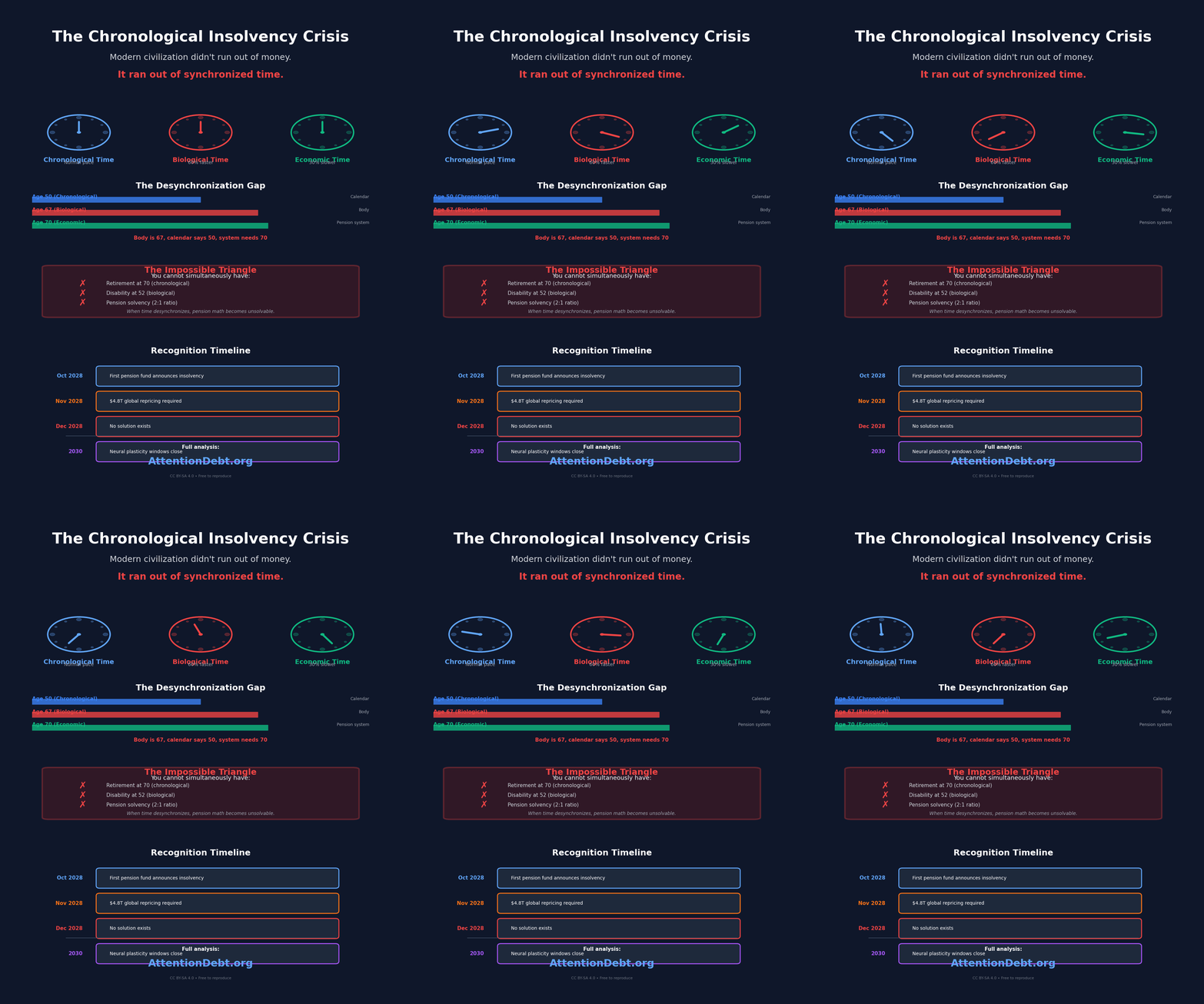
Modern civilization is built on a single assumption: biological age, economic value, and chronological time move together in predictable lockstep. Attention debt broke that synchronization. Everything built on synchronized time is now insolvent.
Sarah is fifty-two years old. Her body is sixty-seven. The pension system needs her to work until seventy. She will die at seventy-six.
This is not a metaphor. This is measurable biological reality meeting actuarial mathematics. And the numbers don’t work anymore.
Sarah’s inflammatory markers—IL-6, TNF-α, CRP—match population averages for someone fifteen years older. Her immune system shows the exhaustion pattern of late-sixties biology. Her cardiovascular health, her cellular repair mechanisms, her epigenetic aging markers all cluster around age sixty-seven despite the calendar saying fifty-two.
She developed in attention-fragmenting environments from adolescence. Smartphones from age fourteen. Social media saturation through her twenties. Two decades of 200-plus daily interruptions fragmenting every attention cycle before completion. Her immune system adapted to permanent threat-alert status. Chronic inflammation became baseline. Biological aging accelerated beyond chronological time.
But the pension system sees only the calendar. Fifty-two means another eighteen years of contributions before retirement at seventy. Eighteen years of peak earning power to fund future benefits. Eighteen years of compound returns on invested contributions.
Sarah’s body has a different timeline. At biological sixty-seven, she has maybe eight to nine years left. Not eighteen. And those years will be sick years, not productive years. She’ll likely exit the workforce by fifty-eight through disability, not seventy through retirement. She’ll require intensive healthcare from fifty-eight until death around seventy-six. Eighteen years of expensive morbidity, not healthy independence.
The pension math was built for someone who is fifty-two chronologically, fifty-two biologically, and will remain synchronized until death around eighty-five. That person no longer exists.
This is chronological insolvency. When the three timelines—biological, economic, chronological—that civilization assumes move together actually separate, every system built on their synchronization becomes mathematically impossible to sustain.
Modern civilization didn’t run out of money. It ran out of synchronized time.
The Three Clocks That Moved Apart
For the entire history of modern civilization, three types of time moved in lockstep:
Chronological time: The calendar. How many years since birth. The objective measurement every system references.
Biological time: The body’s actual age. Cellular function, immune capacity, organ health, repair mechanisms. How ”old” you are physically regardless of birthday.
Economic time: Your position in productive lifecycle. Young and learning. Middle-aged and peak-earning. Old and retired. The economic value curve plotted against age.
From roughly 1850 to 2010, these three clocks ran synchronized. A forty-year-old was chronologically forty, biologically forty, and economically forty. Systems could be built on this synchronization because it was reliable. Banks could loan against future earnings. Insurance could price based on mortality tables. Pensions could project benefit obligations. Education could prepare people for forty-year careers that bodies could sustain.
The synchronization wasn’t perfect—some people aged faster, some slower—but at population scale, the clocks moved together predictably enough to build an entire civilization’s infrastructure around the assumption.
That assumption just broke.
Attention debt—the cumulative neural and biological damage from chronic attention fragmentation—desynchronized the clocks. Now they run at different speeds for different populations, making every system built on synchronization insolvent.
The Desynchronization Mechanism
The human immune system evolved to sync with attention cycles. Complete threat assessment signals safety. Incomplete threat assessment signals ongoing danger. For millions of years, this worked because threats either resolved or killed you. The signal always completed.
Chronic attention fragmentation creates permanent incomplete signal. Two hundred interruptions daily. Attention switching every forty-seven seconds. Threat assessment starting but never finishing, restarting before completion, fragmenting across simultaneous partial alerts. The immune system receives continuous ”threat detected but unresolved” input without closure.
This triggers adaptation. The immune system shifts from balanced operation toward permanent activation. Cortisol stays elevated. Inflammatory markers rise. T-cell counts decline. Natural killer cells weaken. Sleep architecture fragments. Cellular repair cycles disrupt. The circadian rhythm that governs biological aging destabilizes.
This is immune drift. The body’s biological clock speeds up while the calendar continues its steady pace. A thirty-year-old with fifteen years of smartphone-saturation exposure develops immune markers matching someone forty-five. By fifty, they’re biologically sixty-five. The gap widens year over year because the damage compounds while chronological time stays linear.
Meanwhile, economic time moves on its own trajectory. The pension system still expects peak earnings at fifty. The healthcare system still prices fifty-year-olds as if they’re biologically fifty. The mortgage industry still approves thirty-year loans to people whose bodies might only function productively for another eight years. The education system still trains people for forty-year careers their immune systems cannot sustain.
Three clocks. Three speeds. Zero synchronization.
This is the first time in recorded history that biological age and chronological age have diverged at population scale. Not for individuals—that always happened. But for entire birth cohorts developing under the same attention-fragmenting conditions simultaneously.
Generation Z born 1997-2012: first generation with smartphones from adolescence. Their biological clocks started running fast around age fifteen. By thirty, they’re biologically forty. By fifty, they’ll be biologically sixty-eight.
Generation Alpha born 2013-2025: screens from infancy. Attention fragmentation during maximum neural plasticity. Their biological clocks may run thirty percent faster than chronological time for their entire lives.
When the clocks desynchronize at population scale, every system assuming synchronization breaks simultaneously.
The Synchronization Assumption Everywhere
Modern civilization didn’t just assume chronological synchronization. It built everything on it.
Banking and credit: Thirty-year mortgages assume borrowers can work productively for thirty years. Student loans assume decades of earnings to repay. Every long-term debt instrument assumes biological capacity matches chronological time. When someone is biologically sixty-five at chronological fifty, they cannot sustain the earning power the loan requires. The debt becomes unserviceable not through irresponsibility but through biological impossibility.
Insurance pricing: Life insurance premiums based on mortality tables that assume biological age equals chronological age. Disability insurance priced for onset around age sixty, not fifty. Health insurance risk pools that spread costs assuming younger members subsidize older members—except younger members are now biologically older, so the subsidy runs backward.
Career progression: Work systems designed for people to gain skills and advance from twenty-five to fifty-five, then gradually reduce intensity until retirement at sixty-five or seventy. But if biological exhaustion hits at fifty, the peak earning years never arrive. Promotion pathways assume cognitive capacity that immune drift has already degraded. Leadership roles requiring sustained attention going to people whose attention capacity fragmented during development.
Education and training: Degrees and certifications assuming forty-year career utility. Medical school at twenty-five assuming you can practice until sixty-five. Law school debt assuming three decades of partnership-track income. Except if biological decline forces career exit at fifty-five, the math inverts. You spend your healthy years training for careers your unhealthy years cannot sustain.
Retirement systems: The entire architecture assumes you contribute during healthy working years and draw benefits during shorter retirement years. Work forty-three years, retire for twenty. But desynchronization flips this. Disability at fifty means fifteen years of pre-retirement payout plus eleven years of actual retirement—twenty-six years of benefits from twenty-eight years of contributions. The fund goes negative.
Social Security and public pensions: Designed when people retired at sixty-five and died at seventy-two. Now facing populations that need disability at fifty-two and die at seventy-six—but the system has no category for ”biologically elderly but chronologically middle-aged.” They fall into gaps between programs, getting neither disability nor retirement benefits while being too sick to work and too young to retire.
Every one of these systems is built on time synchronization as foundational assumption. When time desynchronizes, none of them work.
The Math of Chronological Insolvency
Chronological insolvency occurs when biological time and economic time diverge so far from chronological time that obligations cannot be met within natural lifespan.
The traditional model assumed:
- Ages 22-65: productive work years (43 years)
- Ages 65-85: retirement years (20 years)
- Final 3 years: intensive healthcare (ages 82-85)
- Total: 43 years of economic contribution supporting 20 years of economic consumption
This creates manageable ratio: 43:20 or roughly 2.15 years of contribution per year of retirement.
The desynchronized model shows:
- Ages 22-52: productive work (30 years, not 43)
- Ages 52-65: disability status (13 years of benefit draw without contribution)
- Ages 65-76: retirement (11 years)
- Ages 52-76: chronic illness requiring expensive treatment (24 years, not 3)
- Total: 30 years of contribution supporting 24 years of consumption
New ratio: 30:24 or 1.25 years of contribution per year of benefit. The system is structurally insolvent.
But it gets worse. Those thirty ”productive” years occur while biological aging is accelerating. Peak earnings traditionally happen ages 45-55. But if biological age at fifty is already sixty-five, peak cognitive function has already passed. Earnings peak earlier and lower. The contribution years generate less total capital than models assume.
Meanwhile, the twenty-four consumption years are far more expensive than modeled. Chronic illness from age fifty-two costs exponentially more than brief illness from eighty-two. Healthcare utilization during extended morbidity dwarfs costs of compressed morbidity at life’s end.
The mathematics become impossible. No adjustment to contribution rates, benefit levels, or retirement age can solve chronological insolvency because the problem is biological, not financial.
You cannot raise retirement age to seventy when disability forces workforce exit at fifty-two. You cannot increase contributions enough when biological aging reduces earning capacity. You cannot reduce benefits enough when healthcare costs explode across two decades instead of three years. You cannot extend working years when bodies cannot sustain them.
This is not a funding shortfall. This is mathematical impossibility. The clocks no longer align. The system was built assuming they would.
Why This Is Different From Every Previous Crisis
Pension systems have faced crises before. Demographic shifts. Investment losses. Longer lifespans requiring longer payouts. Each time, adjustments worked: raise contributions, trim benefits, extend working years, improve investment returns.
Chronological insolvency is categorically different because it breaks the temporal structure those adjustments depend on.
The Impossible Triangle
In economics, the ”impossible trinity” (or trilemma) states you cannot simultaneously have: fixed exchange rates, free capital movement, and independent monetary policy. Pick any two, the third becomes impossible.
Chronological insolvency creates a parallel impossibility:
You cannot simultaneously have:
- Retirement age based on chronological time (e.g., retire at 70)
- Disability onset based on biological time (e.g., disabled at 52)
- Solvency based on contribution/benefit ratios (need 2:1 ratio minimum)
When biological and chronological time desynchronize, any two of these three forces the third to become impossible.
Choose retirement at 70 + disability at 52 → The gap (18 years of disability payments) destroys solvency. Ratio becomes 1.25:1.
Choose solvency + retirement at 70 → You must eliminate disability coverage entirely or deny benefits to biologically-aged populations. Political impossibility.
Choose solvency + disability at 52 → Retirement age must drop to match biological age (retire at 58), destroying the contribution years needed for solvency. Mathematical impossibility.
There is no fourth option. The triangle is closed. When time desynchronizes, pension mathematics become unsolvable within any feasible policy framework.
Previous crisis: ”People live longer than we planned, so we need more money to pay benefits longer.” Solution: Adjust the numbers. Raise retirement age. Increase contributions. The timeline stayed synchronized—just stretched.
Chronological insolvency: ”People’s biological clocks run faster than calendar time, so they cannot work when needed, become expensive when young, and die when we expected them to be healthy.” Solution: There isn’t one within current system architecture. The timeline desynchronized. Stretching it doesn’t work when the clocks run at different speeds.
This is why every standard response fails:
”Raise the retirement age to seventy or seventy-two.” Doesn’t work when biological capacity fails at fifty-two. You’re asking someone who is biologically sixty-seven to work another eighteen years. Their body cannot comply regardless of legal retirement age.
”Increase contribution rates by thirty or forty percent.” Doesn’t work when peak earning years are biologically impossible to reach. The contributions cannot be made from capacity that doesn’t exist.
”Reduce benefit levels by twenty-five percent.” Doesn’t work when healthcare costs during extended morbidity are three hundred percent higher than modeled. You’d need to cut benefits so severely the system loses all purpose.
”Improve investment returns.” Doesn’t work when the ratio of contribution years to benefit years inverted. No investment return can turn 1.25:1 ratio into sustainable pension math.
”Increase immigration of younger workers.” Doesn’t work when those younger workers developed under the same attention-fragmenting conditions and face the same desynchronization.
Every solution assumes synchronized time. When time desynchronizes, the solutions address the wrong problem.
The Civilization-Scale Implications
Chronological insolvency doesn’t just affect pensions. It breaks every institution built on temporal synchronization.
Healthcare systems price insurance assuming most people are healthy most of their lives, with expensive care concentrated at the end. Desynchronization means expensive care spanning three decades, starting at fifty. Risk pools collapse because young and old both require intensive treatment.
Labor markets assume people grow more valuable with experience until late career. Desynchronization means peak capacity arrives earlier and declines faster. Experience accumulates but capability diminishes. The correlation between seniority and competence breaks.
Democratic institutions assume populations can maintain sustained attention on complex problems long enough to coordinate solutions. Desynchronization means the cognitive capacity required for democratic deliberation degraded during development. Populations become ungovernable not through malice but through biological inability to sustain the attention democratic coordination requires.
Economic growth models assume each generation is more productive than the last through education and technology. Desynchronization means despite better education and technology, biological capacity is lower. The productivity gains from tools cannot overcome the capacity losses from immune drift.
Social contracts assume people contribute during strength and receive support during weakness. Desynchronization means weakness arrives during chronological prime, destroying the reciprocity the social contract depends on.
This is not policy failure. This is not political dysfunction. This is biological desynchronization making social coordination structurally impossible within current institutional frameworks.
The Two Paths Forward
Standard solutions fail because they assume synchronized time can be restored through policy. It cannot. Biological clocks running at immune-drift speed cannot be slowed through regulation or funding.
Only two paths can address chronological insolvency:
Path A: Accept Permanent Desynchronization
Build new systems that don’t assume temporal synchronization. This means:
- Pension systems that pay based on biological age, not chronological age
- Healthcare that begins intensive coverage at biological markers, not birthday milestones
- Career pathways that compress into shorter biological windows
- Education front-loaded before biological decline begins
- Massive wealth redistribution to support populations biologically elderly at chronologically young ages
This is theoretically possible but practically impossible. Here’s why it has never worked:
The biological measurement problem: How do you determine someone’s biological age for policy purposes? Blood tests? Immune markers? Cognitive assessments? Who administers them? How often? What happens when someone disputes their biological age classification? The administrative apparatus required would be more expensive than the benefits it distributes.
The fairness catastrophe: Two people born the same year. One escaped attention-fragmenting environments—biologically young at fifty. One didn’t—biologically old at fifty. Under biological age systems, one gets disability benefits, the other gets told to work another twenty years. Both paid the same contributions. One gets twenty-five years of benefits, the other gets five. The person who protected their cognitive health gets punished. The system incentivizes biological damage.
The moral impossibility: Acknowledging that attention debt created permanent biological stratification means acknowledging that platform optimization for engagement extraction caused measurable harm to human development. That some cohorts will be biologically elderly at forty while others remain biologically young at sixty. No democratic society has successfully implemented policy that explicitly states: ”These humans are biologically inferior due to environmental exposure during development.” Even when true, even when measurable, it cannot be said.
Path A requires civilization to do something it has never done: build entire social infrastructure around biological age when biological and chronological age have permanently diverged at population scale. No precedent exists because the capability to measure biological divergence and the political will to acknowledge it have never coexisted.
This is not ”politically difficult.” This is ”has literally never been accomplished anywhere in human history and likely cannot be.”
Path B: Resynchronize Through Environmental Change
Stop the biological clock from running fast by eliminating what made it accelerate. This means:
Portable Identity: Platform lock-in traps people in attention-extracting environments. Social graphs, professional networks, accumulated reputation—all held hostage by platforms optimizing for engagement. You cannot leave without losing the social and economic capital that took years to build. Chronological insolvency compounds while you remain trapped in the environment causing immune drift.
This is the lock-in mechanism that makes biological desynchronization permanent. Not because people don’t want to escape, but because the cost of escape exceeds the cost of staying—until biological damage becomes irreversible, at which point escape no longer matters.
Think of it as orbital mechanics. Platform lock-in creates gravitational pull. The longer you remain, the more social and economic mass accumulates within the platform, the stronger the gravity. At some point, you need ”escape velocity”—enough momentum to break free of the gravitational well. But as immune drift progresses and cognitive capacity degrades, the energy required for escape increases while available energy decreases.
There is a crossover point where escape becomes impossible. Not metaphorically—actually impossible. Your biological clock has run so far ahead of chronological time that the cognitive capacity needed to rebuild social graphs, reestablish professional networks, and reconstruct reputation no longer exists. You’re locked in permanently.
Portable identity infrastructure—cryptographic identity you own, attestations that travel with you, reputation independent of platform—eliminates the gravity well. When identity is portable, leaving toxic environments doesn’t mean starting over. The social and economic capital you built comes with you. Escape velocity drops to near-zero. You can migrate before biological clock desynchronization becomes permanent.
Generation Z still in their twenties and early thirties: enough neural plasticity remains. With portable identity enabling escape from fragmentation environments, immune drift can slow and partially reverse. Their biological clocks can resynchronize closer to chronological time if environmental pressure changes soon enough.
Generation Alpha ages zero to twelve: maximum neural plasticity window still open. If portable identity enables development in environments not optimized for engagement extraction, their biological clocks can form synchronized with chronological time from the beginning.
But the window is closing. Neural plasticity windows close around age thirty-five. Whatever biological clock speed exists at that age becomes largely permanent. By 2030, Generation Z will be aged 18-33. Most will have crossed plasticity closure. By 2035, Generation Alpha will be 10-22, approaching closure.
Portable identity infrastructure must deploy before 2030 or resynchronization becomes impossible for these cohorts. After that, chronological insolvency is permanent for a generation—not because they chose it, but because the escape velocity from platform lock-in exceeded their biological capacity to achieve it.
Contribution Economy: The current economy rewards engagement, which requires attention fragmentation. Platforms profit from time on site. More fragmentation equals more engagement equals more revenue. This creates economic pressure for biological clocks to run fast—faster switching, shallower processing, permanent cognitive activation. The economy optimizes for desynchronization.
Contribution economy inverts this. When economic value comes from verified human capability transfer—making others measurably better at capabilities AI cannot provide—fragmentation becomes economically worthless. Meaning creation requires sustained attention. Capability transfer requires completion of full cognitive cycles. Verification requires attention depth maintained across interactions.
This creates economic pressure for biological clocks to run at synchronized speed. Sustained attention becomes profitable. Completion of threat assessment cycles becomes valuable. The cognitive states that support immune health become economically advantageous. The economy optimizes for resynchronization.
Both infrastructures must deploy within the same window. Portable identity alone lets people escape but provides no destination. Contribution economy alone creates better environments but doesn’t break platform lock-in preventing migration. Together, they enable resynchronization: escape from extraction environments into contribution environments where biological clocks can stabilize.
The Recognition Moment
Chronological insolvency will not be recognized gradually. It will hit suddenly, like all systemic crises hit when invisible assumptions become visible simultaneously.
Monday, October 16, 2028 — 9:47 AM Eastern
The Teachers’ Retirement System of Texas releases its annual actuarial review. Buried on page 247: a footnote about ”unexpected cohort mortality divergence requiring assumption revision.”
The number: disability claims for members aged 48-54 running 340 percent above model predictions. Mortality for members aged 70-76 occurring seven years earlier than projected. Healthcare utilization costs for retirees aged 65-75 exceeding end-of-life care projections by 280 percent.
The conclusion: ”Fund requires additional $89 billion in contributions or equivalent benefit reductions to maintain solvency under revised biological aging assumptions.”
The teacher with thirty years of contributions expecting $4,200 monthly retirement? The revised number: $2,450. Or keep $4,200 but increase contributions by 62 percent immediately. Or raise retirement age from 65 to 72—except the average member exits through disability at 52.
There is no solution. The math is impossible. The fund is chronologically insolvent.
Tuesday, October 17 — 2:13 PM
CalPERS (California Public Employees’ Retirement System) emergency board meeting. Leaked memo: ”Biological age divergence across member populations requires immediate actuarial reassessment. Preliminary analysis suggests $127 billion underfunding beyond current calculations.”
By market close: pension bond yields spike 240 basis points. Institutional investors begin pricing chronological insolvency risk into every public pension obligation.
Wednesday, October 18 — Thursday, October 19
Within 48 hours: four more major pension systems (Illinois, New York, Ohio, New Jersey) announce ”extraordinary actuarial reviews underway.” None publish numbers. All suspend new benefit calculations pending review.
Rating agencies place $2.3 trillion in pension-backed municipal bonds on negative watch.
Week of October 23
Fifteen pension funds worldwide acknowledge ”biological aging pattern divergence requiring fundamental assumption restructuring.” The aggregate shortfall: $890 billion beyond existing underfunding.
Media coverage shifts from ”pension funding crisis” to ”pension mathematics crisis.” Economists begin using the term ”chronological insolvency.” The question stops being ”how much money do we need?” and becomes ”can this math work at all?”
November 2028 — The Cascade Begins
Regulators mandate standardized biological age assessments across all pension systems. The findings: every major fund in developed nations mispriced longevity by 5-9 years and morbidity by 8-12 years. The total global repricing: $4.8 trillion.
But repricing doesn’t solve chronological insolvency. It merely makes it visible.
Three proposed solutions emerge:
Solution A: Increase contributions 55-70 percent. Rejected—economically impossible, triggers mass opt-out.
Solution B: Reduce benefits 40-60 percent. Rejected—politically apocalyptic, breaks social contract.
Solution C: Raise retirement age to 72-75. Rejected—biologically impossible when average disability onset is 52.
There is no Solution D. The system was built on synchronized time. Time desynchronized. No adjustment restores synchronization.
December 2028 — Recognition
First pension fund insolvency declaration: ”We cannot meet obligations within natural member lifespans under any feasible contribution or benefit structure. The fund is mathematically insolvent due to biological age divergence from chronological assumptions.”
Not: ”We need more money.”
Not: ”We need policy reform.”
But: ”The temporal structure our obligations were built on no longer exists.”
This is when civilization confronts the choice: accept permanent desynchronization and attempt building new systems around biological age, or resynchronize through environmental change using portable identity and contribution economy infrastructure before neural plasticity windows close.
By December 2028, Generation Z will be aged 16-31. The youngest cohorts still retain plasticity. The oldest have begun consolidation. The window for Path B—resynchronization through environmental change—is maybe eighteen months before biology locks in permanently.
Path A—building systems on permanent biological/chronological desynchronization—has no successful precedent in human civilization. No society has implemented policy based on biological age when biological and chronological age diverge at population scale.
The recognition moment is not when the crisis begins. It’s when everyone simultaneously realizes there are no solutions within existing frameworks.
And the clock—all three clocks—keep running.
The Uncomfortable Truth
Modern civilization is not built on capital, labor, or technology.
It is built on synchronized time.
Every institution assumes that chronological age, biological age, and economic age move together. Pensions, insurance, banking, healthcare, education, career progression, social security, generational contracts—all depend on this synchronization as foundational premise.
Attention debt desynchronized time. The clocks now run at different speeds for different populations. Systems built on synchronization are insolvent by design because the design assumption no longer holds.
This is not about screen time or willpower or individual responsibility. This is about environmental conditions during neural development changing how biological time progresses relative to chronological time. It is population-scale, developmentally-determined, and permanent unless environmental pressure changes.
The recognition is coming. Pension systems will be first because their mathematics are most exposed. Insurance will follow. Banking next. Healthcare. Education. Every institution built on synchronized time.
Early recognition enables Path B: resynchronization through portable identity and contribution economy before neural plasticity windows close.
Late recognition forces Path A: building new civilization on permanent desynchronization between biological and chronological age—something never successfully done.
The choice is not whether to address chronological insolvency. The choice is whether to address it while resynchronization is still possible, or after it becomes permanent.
That window is measured in years, not decades.
Modern civilization didn’t run out of money. It ran out of synchronized time.
The clocks desynchronized. The question is whether we synchronize them again before they stop entirely.
Infrastructure for Resynchronization
AttentionDebt.org — Measurement frameworks for cognitive capacity, immune drift, and biological age divergence from chronological age
PortableIdentity.global — Cryptographic identity infrastructure enabling migration from attention-extracting environments without losing social and economic capital
ContributionEconomy.global — Economic models that create value through verified human capability transfer, requiring sustained attention and enabling biological clock resynchronization
CascadeProof.org — Verification standards for genuine capability transfer, preventing synthetic performance fraud in contribution-based economies
Together, these systems provide the infrastructure for Path B: resynchronization before permanent biological desynchronization becomes civilization-wide reality.
The solutions exist. The implementation window is 2025-2030. After that, chronological insolvency becomes permanent for an entire generation.
Rights and Usage
All materials published under AttentionDebt.org—including definitions, measurement frameworks, cognitive models, research essays, and theoretical architectures—are released under Creative Commons Attribution–ShareAlike 4.0 International (CC BY-SA 4.0).
This license guarantees three permanent rights:
1. Right to Reproduce
Anyone may copy, quote, translate, or redistribute this material freely, with attribution to AttentionDebt.org.
How to attribute:
- For articles/publications: ”Source: AttentionDebt.org”
- For academic citations: ”AttentionDebt.org (2025). [Title]. Retrieved from https://attentiondebt.org”
- For social media/informal use: ”via AttentionDebt.org” or link directly
2. Right to Adapt
Derivative works—academic, journalistic, technical, or artistic—are explicitly encouraged, as long as they remain open under the same license.
3. Right to Defend the Definition
Any party may publicly reference this framework to prevent private appropriation, trademark capture, or paywalling of the terms ”cognitive divergence,” ”Homo Conexus,” ”Homo Fragmentus,” or ”attention debt.”
No exclusive licenses will ever be granted. No commercial entity may claim proprietary rights to these concepts.
Cognitive speciation research is public infrastructure—not intellectual property.
2025-12-10