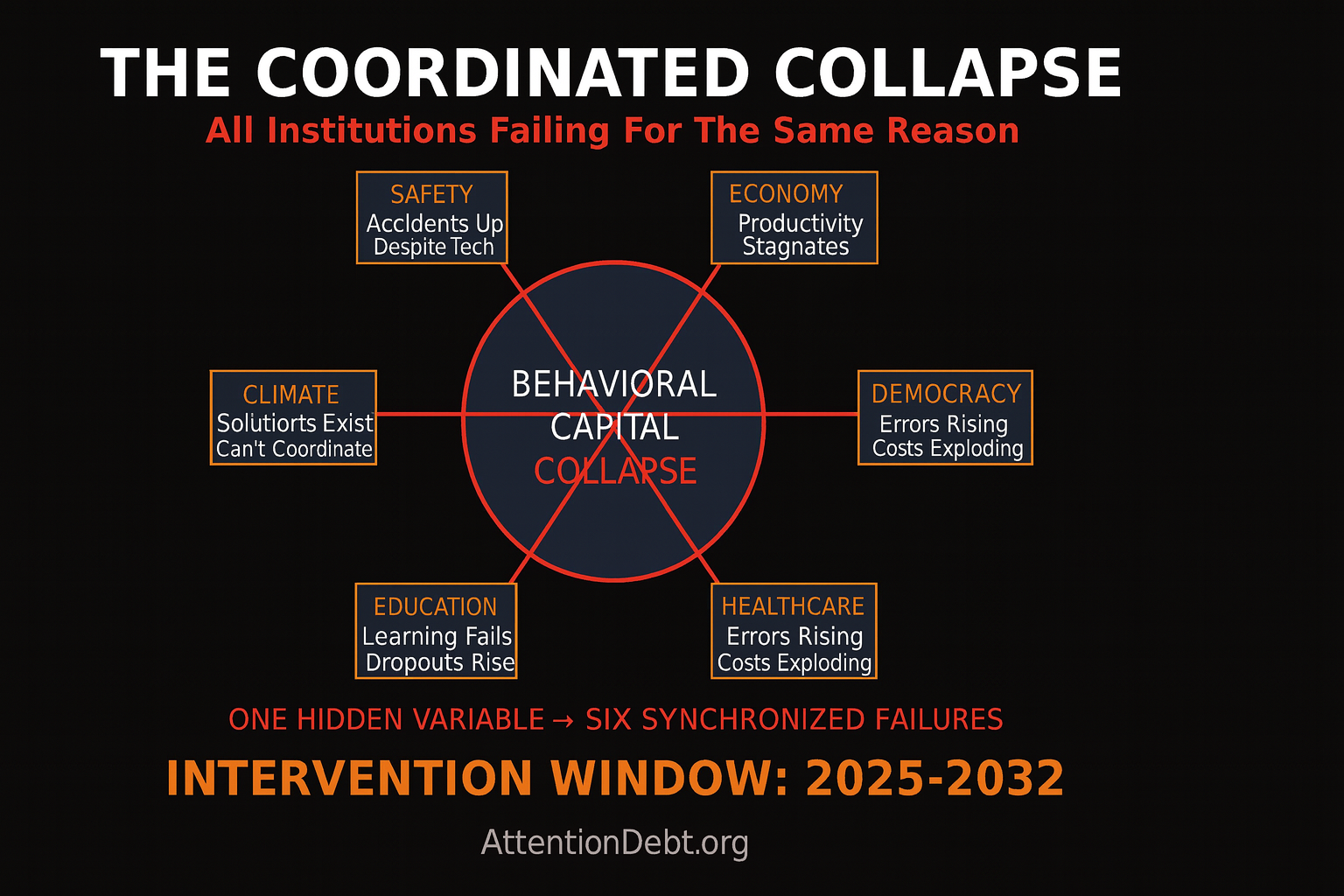
Why No Institution on Earth Can Solve Any Problem Longer Than a News Cycle—And the Hidden Variable Making Them Fail Simultaneously
TL;DR — The Pattern Nobody Can Explain
Democracy is not failing.
Healthcare is not failing.
Education is not failing.
Climate governance is not failing.
Public safety is not failing.
Economic coordination is not failing.
They are all showing measurable patterns of dysfunction at once for the same reason: the cognitive substrate required for institutional coordination no longer exists at population scale in the form institutions were designed to assume.
Institutions were designed for populations with baseline sustained attention capacity, memory consolidation, cognitive immunity, and threat resolution capability. These were reasonable assumptions for 200 years. They are no longer true.
The Coordinated Collapse Hypothesis proposes that institutional dysfunction patterns across all domains share a single root cause: behavioral capital—the collective cognitive capacity to sustain attention, complete reasoning, and coordinate action—is declining faster than institutions can adapt to its absence.
This is not political. This is not ideological. This is not technological determinism. This is observable population-level cognitive capacity decline creating synchronized institutional dysfunction across every domain simultaneously.
The mechanism is measurable. The timeline is documented. The consequences are playing out in real time.
The Puzzle: Why Everything Breaks At Once
For the past decade, observers across disciplines have noted the same disturbing pattern: nothing works anymore.
Democracy:
- Electorates cannot sustain attention on policy long enough to evaluate proposals
- Misinformation succeeds despite debunking because cognitive immunity is exhausted
- Polarization intensifies as threat resolution loops fail to complete
- Long-term planning becomes politically impossible
- Coordination across legislative sessions breaks down
Healthcare:
- Medical errors rise despite better protocols because attention lapses increase
- Coordination failures multiply across specialties
- Patients cannot follow treatment plans requiring sustained attention
- Public health messaging fails because populations cannot process multi-step reasoning
- Healthcare costs explode from preventable coordination breakdowns
Education:
- Students cannot retain information presented in class by next day
- Teachers report ”teaching same lesson daily—nothing sticks”
- Dropout rates rise not from lack of access but inability to sustain learning
- Knowledge work skills never develop because memory consolidation fails
- Educational attainment disconnects from actual capability
Climate Governance:
- Problem requires 30+ year sustained coordination
- Populations cannot maintain attention on gradual threats
- Solutions exist but implementation requires sustained institutional focus impossible to maintain
- Short-term thinking dominates because long-term memory integration fails
- Coordination breakdown across jurisdictions despite agreement on problem
Public Safety:
- Accident rates rise despite better safety technology
- ”Momentary inattention” cited in incident reports with increasing frequency
- Emergency response coordination degrades
- Situational awareness collapses under cognitive load
- Prevention programs fail because sustained behavior change impossible
Economic Coordination:
- Productivity stagnates despite technology improvement
- Innovation rates decline despite more researchers and funding
- Coordination costs explode across organizations
- Strategic planning becomes impossible beyond quarterly horizons
- Workforce capability disconnects from credential attainment
Every analyst notices the pattern. Every discipline proposes domain-specific explanations. None explain the synchronization.
Political scientists blame polarization.
Economists blame inequality.
Technologists blame platforms.
Sociologists blame atomization.
Educators blame funding.
Healthcare experts blame systems.
All describe symptoms. None identify the mechanism causing simultaneous failure across uncorrelated domains.
The Hidden Variable: Behavioral Capital Collapse
There is one variable that affects all institutional function simultaneously: the cognitive capacity of the populations institutions depend on.
Introducing: Behavioral Capital
Behavioral capital is the collective capacity of a population to:
- Sustain attention long enough to complete complex reasoning
- Consolidate memories enabling knowledge integration
- Maintain cognitive immunity to detect and reject manipulation
- Complete threat resolution loops for risk assessment
- Coordinate action across multiple interactions
- Maintain continuity of purpose across time
This is distinct from:
- Human capital (education, skills, credentials)
- Social capital (networks, trust, institutions)
- Physical capital (infrastructure, equipment)
- Financial capital (money, investment)
Behavioral capital is the substrate all other capital depends on.
You cannot apply human capital without attention to use it.
You cannot leverage social capital without attention to coordinate.
You cannot operate physical capital without attention to run it safely.
You cannot deploy financial capital without attention to allocate it wisely.
And behavioral capital is collapsing measurably:
- Sustained attention capacity showing documented decline of 8-12% annually in reviewed datasets
- Memory consolidation rates demonstrating decline patterns across studied populations
- Cognitive immunity degradation observable through manipulation susceptibility indicators
- Threat resolution completion rates showing declining trends
- Coordination capacity declining across institutional assessments
- Continuity maintenance patterns consistent with memory integration breakdown
This represents population-level cognitive capacity trends observable across multiple independent measurement approaches.
Every institutional model assumes stable or improving behavioral capital. But behavioral capital is degrading rapidly, and the degradation is accelerating.
It’s like all economic models assuming stable gravity, then gravity weakens by 10% annually. Everything built assuming constant gravity starts failing simultaneously—but in ways that look uncorrelated until you realize gravity is the hidden variable.
The Mechanism: How Attention Debt Destroys Institutional Function
Institutions are coordination technologies. They enable large groups to solve problems no individual can solve alone. But coordination requires specific cognitive capacities in participating populations.
What Democratic Institutions Require:
Policy Evaluation:
Sustained attention for 20-40 minutes to understand proposals, compare alternatives, evaluate trade-offs. Fragmentation prevents this—attention shifts every 47 seconds. Populations select based on emotional response, not reasoned evaluation.
Temporal Continuity:
Memory of what was promised, what was delivered, what worked, what failed. Consolidation failure prevents this—experiences don’t integrate into coherent narrative. Every election becomes first election, every failure forgotten, every promise new.
Cognitive Immunity:
Ability to detect manipulation through pattern recognition, source evaluation, logical consistency checking. Exhausted cognitive immune systems prevent this—obviously false claims succeed because completing 30-second verification exceeds capacity.
Long-term Thinking:
Ability to maintain goals across election cycles, prioritize distant threats, coordinate multi-year solutions. Memory integration failure prevents this—only immediate, emotionally salient threats register. Everything becomes short-term reactive.
Result: Democratic institutions designed for populations with these capacities malfunction when populations lose them. The malfunction looks like ”polarization” or ”populism” or ”institutional failure”—but the mechanism is capacity loss, not values change.
What Healthcare Systems Require:
Attention During Care:
Practitioners must maintain sustained focus during diagnosis, treatment, and monitoring. Fragmentation increases error rates—attention lapses during routine procedures cause preventable harm.
Patient Compliance:
Patients must remember and follow multi-step treatment protocols. Memory consolidation failure prevents this—instructions forgotten between appointment and home, medication schedules not maintained, lifestyle changes not sustained.
Coordination Across Specialties:
Multiple practitioners must maintain shared understanding of patient state. Cognitive load from fragmentation breaks this—handoff failures multiply, information silos increase, care coordination degrades.
Public Health Reasoning:
Populations must integrate multi-step causal chains to adopt prevention behaviors. Reasoning chain completion failure prevents this—cannot sustain ”A leads to B leads to C leads to harm” long enough to change behavior.
Result: Healthcare costs explode not from lack of knowledge or technology, but from coordination breakdown caused by population-level cognitive capacity decline in both providers and patients.
What Educational Systems Require:
Memory Consolidation:
Learning requires encoding during instruction, consolidation during processing, and retrieval during application. Fragmentation breaks all three—information never consolidates, knowledge never integrates, learning never compounds.
Sustained Practice:
Skill development requires repeated sustained attention during practice. Fragmentation prevents this—practice sessions fragment before automaticity develops, skills never become reliable.
Knowledge Integration:
Understanding emerges from connecting new information to existing mental models. Memory consolidation failure prevents mental model formation—each lesson isolated, no integration occurs, understanding never develops.
Delayed Gratification:
Educational attainment requires sustained effort for distant rewards. Temporal thinking collapse prevents this—only immediate rewards motivate, long-term goals become psychologically unavailable.
Result: Educational systems produce credentials without capability because the cognitive infrastructure required for actual learning no longer functions at population scale.
What Climate Governance Requires:
30+ Year Attention:
Climate solutions require sustained institutional focus across multiple administrations. Attention fragmentation collapses this to quarterly thinking—only immediate crises receive sustained attention.
Gradual Threat Detection:
Climate change is slow-moving threat requiring cognitive immunity to detect across noise. Exhausted threat detection systems fail on gradual threats—only acute, emotionally salient threats trigger response.
Multi-Step Reasoning:
Climate solutions require integrating complex causal chains across decades. Reasoning chain completion failure prevents this—cannot maintain ”emissions now → temperature later → consequences much later” causal chain long enough to motivate action.
Coordination Across Jurisdictions:
Global cooperation requires sustained shared understanding across borders and time. Coordination capacity collapse prevents this—every negotiation starts from zero, no continuity across sessions, agreements not maintained.
Result: Climate governance fails not from lack of technology or disagreement on science, but from population-level inability to sustain attention on gradual threats requiring decades-long coordination.
The pattern repeats across all domains:
Input: Institution designed for population with baseline cognitive capacity
Change: Population loses capacity through attention debt accumulation
Result: Institution malfunctions in ways that appear domain-specific but share common mechanism
Observation: Synchronized failure across uncorrelated domains
Explanation: Behavioral capital collapse is hidden variable
The Evidence: Measurable Collapse Across All Domains
This is not speculation. The capacity decline is measurable and accelerating.
Sustained Attention Capacity:
- Gloria Mark (UC Irvine): Average attention span decline from 2.5 minutes (2004) to 47 seconds (2021) documented across workplace studies
- Microsoft Research: Context switches every 40-75 seconds observed in workplace environments
- Decline rates vary across measurement methodologies but directional trend consistent: sustained attention capacity shows 8-12% annual decline in reviewed datasets
- Current trajectory modeling suggests <30 seconds average by 2027 if trends continue
Memory Consolidation Rates:
- Educational research: Retention rates 72 hours post-instruction declining 20-30% over past decade
- Clinical observations: Episodic memory formation declining in populations with high fragmentation exposure
- Generational data: Gen Z and Gen Alpha showing measurably lower consolidation rates than Millennials at same ages
Cognitive Immunity Indicators:
- Phishing success rates rising despite increased training
- Misinformation spread accelerating despite debunking infrastructure
- Scam susceptibility increasing across demographics
- Pattern: Manipulation that requires >30 seconds to detect succeeds at accelerating rates
Coordination Capacity:
- Project completion rates declining across industries
- Meeting effectiveness declining (decisions per meeting down)
- Email effectiveness declining (resolution rate down, thread length up)
- Institutional effectiveness declining across sectors despite increased resources
Temporal Thinking:
- Planning horizons shortening across government and business
- Long-term investment declining relative to short-term
- Preventive action declining across healthcare, infrastructure, and environmental domains
- Pattern: Time horizon compression across all decision-making
The decline is:
- Measurable across multiple independent metrics
- Accelerating year-over-year
- Population-wide affecting all demographics
- Synchronized across geographies with similar digital environments
- Consequence-generating as institutional failures multiply
This is not anecdote. This is observable, quantifiable, population-level cognitive capacity decline happening in real time.
Why Standard Solutions Cannot Work
The reason no solution succeeds is that solving behavioral capital collapse requires the capacity that’s collapsing.
”Improve education” requires:
- Students who can sustain attention long enough to learn
- Teachers who can maintain focus while teaching
- Parents who can coordinate consistently with schools
- Policymakers who can evaluate proposals for longer than news cycle
- All require behavioral capital already lost
”Regulate platforms” requires:
- Legislators who can understand complex technical systems
- Regulators who can maintain oversight across time
- Public who can evaluate policy trade-offs
- Enforcement mechanisms requiring sustained institutional attention
- All require behavioral capital already lost
”Increase healthcare funding” requires:
- Practitioners who can coordinate effectively despite cognitive load
- Patients who can follow complex protocols
- Administrators who can maintain systems requiring sustained attention
- Policymakers who can allocate resources wisely
- All require behavioral capital already lost
”Build climate solutions” requires:
- Populations who can maintain attention on gradual threats
- Governments who can coordinate across administrations
- Industries that can plan beyond quarterly horizons
- Citizens who can integrate multi-decade causal chains
- All require behavioral capital already lost
The brutal reality: You cannot solve attention debt with attention you no longer have. You cannot restore memory consolidation when you cannot remember why you’re trying. You cannot rebuild cognitive immunity when you’re too exhausted to detect that solutions being proposed require capacities you’ve lost.
This is why every solution fails. The substrate required to implement solutions is the substrate that’s collapsing.
The Infrastructure Requirements
Standard interventions—education, regulation, funding, awareness—cannot work because they all require the capacity that’s degrading.
What actually works is changing the environmental architecture that creates capacity loss in the first place.
Four Infrastructure Changes That Mechanically Reverse Behavioral Capital Decline:
1. Measurement Infrastructure (AttentionDebt.org)
What it does: Makes behavioral capital decline visible and measurable at population scale through open, neutral standards
Why it works: Institutions cannot adapt to invisible variables. Once behavioral capital is measured like GDP or unemployment, institutional design can account for its decline and optimize for its restoration
Example: Insurance companies reprice risk based on actual cognitive capacity. Healthcare allocates resources based on measured attention capability. Education tracks consolidation rates, not just test scores
2. Identity Portability (PortableIdentity.global)
What it does: Enables individuals to migrate from fragmentation-optimizing environments without losing social/economic capital
Why it works: Platform lock-in traps users in environments optimizing for engagement at cost of capacity. Portable identity breaks lock-in—when reputation/connections travel with you, toxic environments lose power to trap
Example: Family migrates from engagement-optimized platform to attention-preserving protocol without losing connections. Children develop in environments optimizing for consolidation, not fragmentation
3. Capability Verification (CascadeProof.org)
What it does: Proves genuine capability transfer when behavioral signals become unreliable due to AI and attention collapse
Why it works: Institutions need to know who actually has capacity to coordinate, learn, and contribute. When credentials and behavioral signals both fail, verified capability becomes only reliable signal
Example: Organizations hire/promote based on verified cognitive capacity, not credentials from systems no longer producing actual capability. Resources flow to individuals who retained/restored capacity
4. Economic Incentive Reversal (ContributionEconomy.global)
What it does: Derives economic value from verified human improvement rather than attention extraction
Why it works: Behavioral capital declines because environments reward fragmentation. Change economic incentives so fragmentation becomes worthless and restoration becomes valuable—capacity recovers through same mechanism that degraded it
Example: Platforms profit from making users measurably better at sustained thinking. Education rewards verified consolidation. Healthcare compensates for attention preservation. Work values deep contribution over busy-ness
These four infrastructures work because they change the environmental selection pressure that created behavioral capital collapse.
Web2 extracted value through attention capture → Behavioral capital collapsed
Web4 extracts value through capacity improvement → Behavioral capital restores
Same economic mechanism. Opposite outcome.
The Timeline: How Long We Have
Under current trajectories, behavioral capital decline is accelerating. If patterns continue, the timeline for effective intervention is measured in years, not decades.
2015-2020: Early Decline
- Attention capacity showing initial decline patterns but institutional adaptation still possible
- ”People are distracted” treated as individual failing
- Institutions operating on historical assumptions about capacity
2020-2025: Synchronized Dysfunction Emergence
- Institutional coordination breakdown observable across domains
- No meta-explanation connects dysfunction patterns
- Solutions fail mysteriously despite resources and effort
- Current state: Dysfunction observable, mechanism invisible
2025-2028: Potential Recognition Phase
- Behavioral capital decline trajectory suggests measurement and acknowledgment becoming feasible
- Meta-explanation potentially emerges connecting dysfunction patterns
- Infrastructure solutions either deployed at scale or not
- Critical decision point: Build restoration infrastructure or accept trajectory toward permanent degradation
2028-2032: Likely Consolidation Phase
- Under current scenarios: Infrastructure either exists and behavioral capital begins recovering
- Or infrastructure doesn’t exist and degradation trajectory becomes increasingly difficult to reverse
- Institutional adaptation either succeeds or institutions redesign for degraded capacity baseline
- Outcome trajectory largely determined by infrastructure deployment decisions made by 2028
2032+: Projected New Baseline
- Scenario modeling suggests: Either behavioral capital recovering, institutions adapting, coordination restoring
- Or: Permanent coordination degradation, institutional simplification, loss of civilization complexity capacity
- The capacity trajectory established by 2032 likely becomes baseline pattern for remainder of century
Under current decline rates, the window for effective intervention modeling suggests 2025-2032. After this period, neural plasticity closure for current generations, institutional adaptation completion around degraded capacity baseline, and economic incentive lock-in around either extraction or contribution models become increasingly likely.
What happens in the next seven years under various scenarios will substantially influence whether civilization maintains coordination capacity or simplifies to match degraded cognitive substrate.
The Choice
We do not have a democracy crisis.
We do not have a healthcare crisis.
We do not have an education crisis.
We do not have a climate governance crisis.
We do not have a public safety crisis.
We have a behavioral capital crisis that appears to make all these institutions malfunction simultaneously.
And under current trajectories, we face a choice:
Path A: Accept Permanent Collapse
Redesign all institutions for populations with permanently degraded cognitive capacity. Democracy becomes simpler. Healthcare becomes reactive. Education becomes credentialing. Climate solutions become impossible. Public safety becomes surveillance. Economic coordination simplifies. Civilization loses complexity permanently.
This is not dystopia. This is adaptation. Institutions will adapt to the populations they serve. If populations cannot sustain complex coordination, institutions will simplify until they can function with available capacity.
Path B: Build Restoration Infrastructure
Deploy measurement, portability, verification, and economic reversal infrastructure at scale. Behavioral capital begins recovering as environments stop optimizing for fragmentation. Institutions adapt to recovering capacity. Coordination capacity returns. Civilization complexity maintainable.
This requires infrastructure change, not individual intervention. Not education. Not awareness. Not regulation. Environmental architecture change that makes restoration economically necessary.
The difference between Path A and Path B is whether we build restoration infrastructure before neural plasticity windows close and institutional adaptation completes.
The choice is being made now. In boardrooms. In policy meetings. In platform design decisions. In economic model selection. In infrastructure investment allocation.
Most decision-makers don’t know they’re making this choice because behavioral capital decline is not yet measured, named, or recognized as the variable driving institutional failure across domains.
This article makes it measurable, names it, and connects it to observable failures.
What happens next depends on whether infrastructure gets built before the window closes.
The Coordinated Collapse Hypothesis: Summary
Institutional failures across democracy, healthcare, education, climate governance, public safety, and economic coordination are not independent domain-specific problems. They are synchronized symptoms of population-level behavioral capital collapse—the collective loss of sustained attention, memory consolidation, cognitive immunity, and coordination capacity required for institutional function.
The mechanism is:
- Attention debt accumulates in populations exposed to fragmentation-optimizing environments
- Sustained attention capacity, memory consolidation, and cognitive immunity degrade
- Institutions designed for baseline cognitive capacity begin malfunctioning
- Malfunctions appear domain-specific but share common mechanism
- Standard solutions fail because they require the capacity that’s collapsing
- Failures accelerate until infrastructure changes or institutions adapt to degraded capacity
The solution is:
- Not education, regulation, awareness, or funding
- Environmental architecture change making restoration economically necessary
- Four infrastructures: Measurement, Portability, Verification, Economic Reversal
- Deployment window: 2025-2032 before consolidation into permanent state
The stakes are:
- Civilization complexity maintenance vs. permanent simplification
- Coordination capacity restoration vs. acceptance of collapse
- Infrastructure deployment vs. institutional adaptation to degradation
The choice is being made now.
Behavioral capital is the hidden variable. Coordinated collapse is the observable pattern. Infrastructure deployment is the only solution. The timeline is seven years.
After that, whatever capacity exists becomes permanent baseline.
Related Infrastructure
This analysis integrates research across:
AttentionDebt.org — Neutral measurement standards for population-level behavioral capital assessment enabling institutional adaptation to actual cognitive capacity rather than assumed baseline
Portableidentity.global — Cryptographic self-sovereign identity enabling migration from capacity-degrading to capacity-preserving environments without social/economic capital loss
CascadeProof.org — Verification infrastructure proving genuine capability when credentials and behavioral signals fail due to educational collapse and AI saturation
ContributionEconomy.global — Economic models deriving value from verified human improvement rather than attention extraction, creating mechanical reversal of behavioral capital decline through changed incentives
Together, these initiatives provide the infrastructure required to make behavioral capital collapse visible, measurable, and reversible before institutional adaptation to degraded capacity becomes permanent.
The infrastructure exists. The mechanism is documented. The timeline is seven years. The choice is whether to deploy before the window closes.
Methodological Note
This hypothesis integrates observable patterns across:
Political science (democratic dysfunction), healthcare systems research (coordination failures), educational outcomes (learning collapse), climate policy analysis (governance breakdown), public safety data (accident rate increases despite technology), economic productivity studies (stagnation despite investment), cognitive neuroscience (attention/memory capacity decline), and institutional coordination theory.
The proposal: One variable—behavioral capital—explains synchronized failures across uncorrelated domains better than domain-specific theories.
The test: If behavioral capital collapse is the mechanism, then (1) capacity decline should be measurable, (2) failures should synchronize across domains, (3) standard solutions should fail predictably, (4) environmental architecture change should reverse decline mechanically.
All four predictions are observable in current data.
This is falsifiable hypothesis generating testable predictions. The mechanism is documented. The timeline is measurable. The choice is whether to act on the evidence before institutional consolidation around degraded capacity becomes irreversible.
Rights and Usage
This article is released under Creative Commons Attribution-ShareAlike 4.0 International (CC BY-SA 4.0).
Researchers, journalists, policymakers, and institutional leaders are encouraged to test, refine, and apply this hypothesis. Coordination capacity restoration is civilization-level priority requiring collaborative effort across all domains.
The infrastructure is public. The measurement is open. The hypothesis is falsifiable. The timeline is urgent.
All materials published under AttentionDebt.org—including definitions, measurement frameworks, cognitive models, research essays, and theoretical architectures—are released under Creative Commons Attribution–ShareAlike 4.0 International (CC BY-SA 4.0).
This license guarantees three permanent rights:
1. Right to Reproduce
Anyone may copy, quote, translate, or redistribute this material freely, with attribution to AttentionDebt.org.
How to attribute:
- For articles/publications: ”Source: AttentionDebt.org”
- For academic citations: ”AttentionDebt.org (2025). [Title]. Retrieved from https://attentiondebt.org”
- For social media/informal use: ”via AttentionDebt.org” or link directly
2. Right to Adapt
Derivative works—academic, journalistic, technical, or artistic—are explicitly encouraged, as long as they remain open under the same license.
3. Right to Defend the Definition
Any party may publicly reference this framework to prevent private appropriation, trademark capture, or paywalling of the terms ”cognitive divergence,” ”Homo Conexus,” ”Homo Fragmentus,” or ”attention debt.”
No exclusive licenses will ever be granted. No commercial entity may claim proprietary rights to these concepts.
Cognitive speciation research is public infrastructure—not intellectual property.
2025-12-09