Why Your Children Will Not Remember Their Childhood—And What That Costs
TL;DR — The Neurological Reality
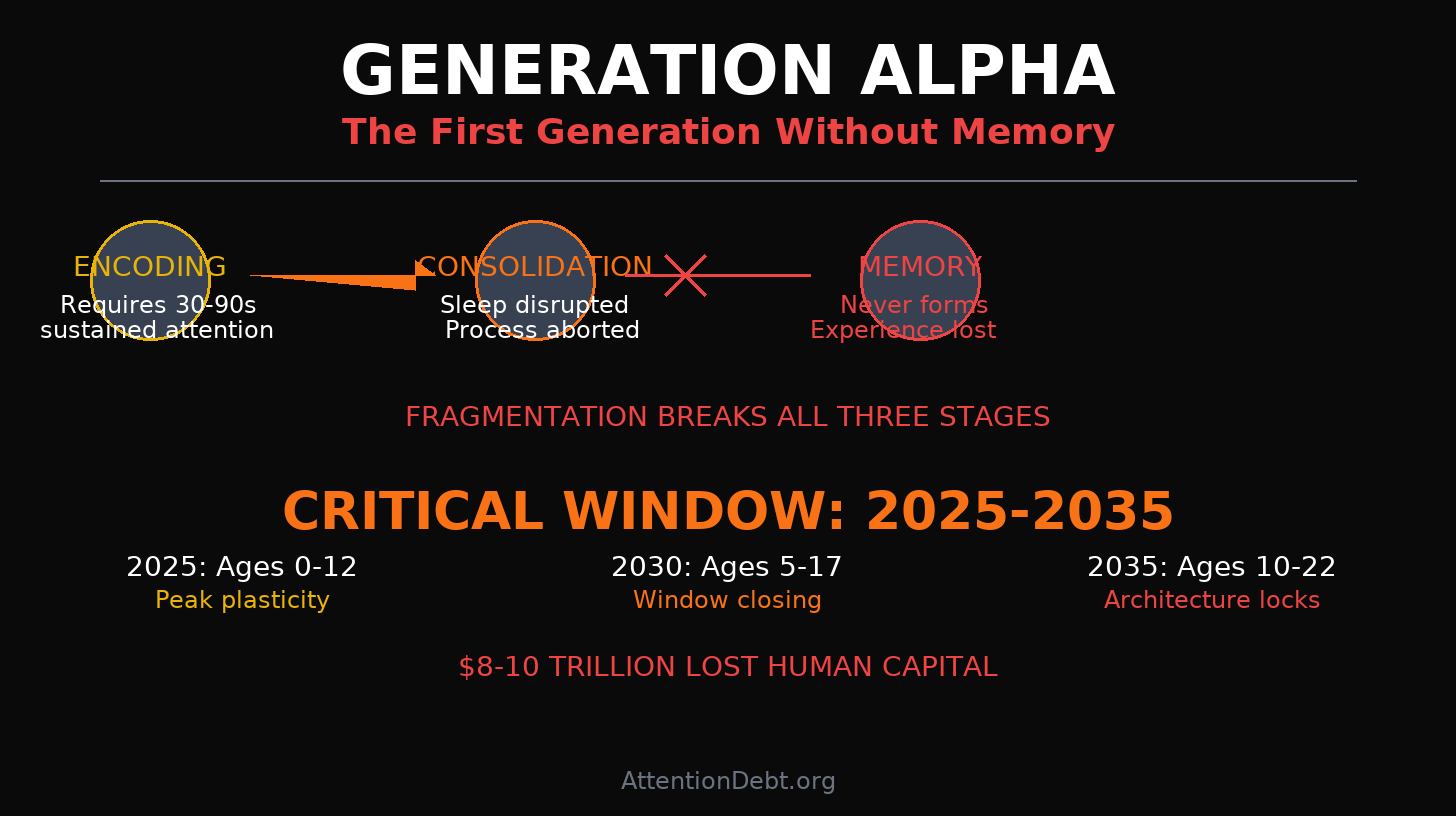
Human memory formation requires sustained attention during experience and uninterrupted processing during sleep. Research on adult populations documents attention shifts occurring approximately every 47 seconds with 200-400 daily interruptions; developmental observations suggest similar fragmentation patterns emerging in child populations. When attention fragments at rates exceeding hippocampal consolidation capacity, experiences activate neurons, attention switches, activation stops, the trace degrades. Working memory fills, attention shifts, the buffer clears, information is lost. Consolidation begins, interruption occurs, the process aborts, no transfer to long-term storage happens.
Generation Alpha—children born between 2013 and 2025—is the first generation developing in environments where attention fragments faster than memory can form.
They are not forgetting their childhoods. They are not encoding them in the first place.
This is not speculation. This is observable developmental neuroscience with measurable population-level risks: $8-10 trillion in lost human capital formation over the next 30 years as a generation develops with significantly impaired episodic memory consolidation capacity during critical plasticity windows.
The mechanism is biological. The window is closing. The consequences are permanent.
The Mechanism: How Memory Actually Forms
Memory formation is not magical. It is mechanical, requiring three stages that must complete sequentially without interruption.
Stage 1: Encoding (Requires Sustained Attention)
When you experience something meaningful—a conversation, a sunset, your child’s face—neurons in your hippocampus activate in specific patterns. These patterns must remain active for 30-90 seconds to form initial traces.
The requirement: Sustained attention on the experience during encoding.
What happens under fragmentation: Attention shifts at 47 seconds (current average). Neuronal activation stops. Pattern degrades. No trace forms. The experience happened, but neurologically, it’s as if it didn’t.
Stage 2: Consolidation (Requires Uninterrupted Sleep)
During deep sleep and REM cycles, the hippocampus replays patterns from the day, transferring them to cortical regions for long-term storage. This process requires 90-120 minute sleep cycles to complete.
The requirement: Uninterrupted sleep architecture with complete REM cycles.
What happens under fragmentation: Sleep disrupted by stress from unresolved attention cycles. REM suppressed by chronic cortisol elevation. Hippocampal replay interrupted. Patterns fail to transfer. Experiences remain in short-term buffer, then disappear.
Stage 3: Retrieval (Requires Context Reconstruction)
Remembering an experience requires reconstructing its context: where you were, who was there, how it felt, what happened before and after. This reconstruction demands sustained attention to search memory networks and reassemble patterns.
The requirement: 20-40 seconds of sustained attention during recall attempts.
What happens under fragmentation: Attention fragments before context reconstruction completes. Partial patterns activate but don’t cohere. The memory exists in fragments but cannot be accessed as experience. You know something happened but cannot remember what.
All three stages require sustained attention. Chronic fragmentation breaks all three simultaneously.
The Observable Crisis: What Parents and Teachers Already See
These are not hypothetical symptoms. These are patterns reported by educators, pediatricians, and parents worldwide—but without understanding the neurological mechanism causing them.
Children ages 5-12 increasingly display:
Memory Failure Within 24-48 Hours:
- Cannot recall yesterday’s activities when asked
- Forget conversations from the morning by afternoon
- Unable to describe what happened at school that day
- No memory of weekend family activities by Monday
Story Comprehension Collapse:
- Cannot retell a story just heard
- Unable to sequence events in correct order
- Lose narrative thread during reading
- Forget beginning of movie by the end
Learning Consolidation Failure:
- Material ”learned” in class forgotten by next day
- Concepts mastered during lesson inaccessible 72 hours later
- Reading comprehension exists during reading, vanishes after
- Skills practiced repeatedly never become automatic
Experiential Amnesia:
- Vacations not remembered weeks later
- Birthday parties forgotten within days
- Relatives visited regularly not recognized
- Significant events leave no lasting trace
Teachers report: ”It’s like teaching the same lesson every day. Nothing sticks.”
Parents report: ”She was there—she experienced it—but she doesn’t remember it happened at all.”
The pattern is dismissed as ”distraction” or ”lack of focus.”
It is not. It is memory formation failure at developmental scale.
The Neurological Reality: Why This Is Irreversible After Age 12
The hippocampus develops throughout childhood, with critical periods for memory system maturation occurring between ages 0-12. During this window, the brain builds architecture for encoding, consolidation, and retrieval based on environmental requirements.
Pre-2013 (Millennials, Gen Z early years):
- Environment required sustained attention for most activities
- Children developed hippocampal architecture optimized for depth
- Memory formation became automatic through repeated practice
- Episodic memory capacity consolidated during plasticity window
Post-2013 (Generation Alpha):
- Environment rewards attention fragmentation from infancy
- Average screen time ages 0-2: 49 minutes daily
- Average screen time ages 8-12: 5.5 hours daily
- Interruptions every 47 seconds during waking hours
- Brain develops hippocampal architecture optimized for fragmentation, not consolidation
The result: Neural pathways for sustained attention never fully develop. Hippocampal consolidation capacity remains impaired. Memory formation architecture forms around expectation of constant interruption.
By age 12-14, neural plasticity begins declining. By age 18-22, hippocampal architecture consolidates into permanent baseline.
Whatever memory capacity exists at consolidation becomes the lifelong baseline.
Generation Alpha’s window is closing: 2025-2035.
After 2035, the majority will have permanent memory architecture formed in fragmentation-optimizing environments. The capacity for rich episodic memory—the ability to remember your own life with clarity—may never fully develop.
The Time Window: Exactly When Plasticity Closes
This is not vague developmental theory. This is documented neuroplasticity timeline with specific critical periods.
Ages 0-5 (Peak Plasticity – Currently 2025):
- Maximum hippocampal malleability
- Memory architecture forming based on environmental input
- Current Generation Alpha cohort: Ages 0-12
- Intervention most effective, reversal most possible
Ages 6-12 (High Plasticity – Window Closes 2030):
- Architecture consolidating but still highly adaptable
- Sustained intervention can redirect development
- 2030: Oldest Generation Alpha turns 17
- Critical intervention window for majority
Ages 13-18 (Declining Plasticity – Window Closes 2035):
- Architecture solidifying into permanent form
- Reversal possible but requires massive sustained effort
- 2035: Majority of Generation Alpha ages 10-22
- Late intervention still possible but exponentially harder
Ages 18-25 (Final Consolidation – Locks 2038-2043):
- Neural architecture reaches permanent baseline
- Changes require extraordinary intervention unlikely at scale
- 2040: Generation Alpha ages 15-27
- Whatever capacity exists becomes lifelong reality
Ages 25+ (Plasticity Closure – After 2043):
- Memory architecture is permanent
- Training can optimize existing capacity but cannot rebuild structures
- Post-2045: Generation Alpha’s memory baseline is locked
The window for population-scale intervention is 2025-2035. After that, whatever memory capacity exists becomes the generational baseline for the rest of their lives.
The Economic Cost: $8-10 Trillion in Lost Human Capital
Memory is not sentimental. Memory is economic infrastructure. Without episodic memory capacity, human capital formation collapses.
The mechanism:
Learning Requires Memory:
- Knowledge integration depends on connecting new information to existing mental models
- Mental models require episodic memory to construct
- Fragmented memory = fragmented knowledge = compromised learning
Skill Development Requires Memory:
- Expertise forms through accumulated experience stored as retrievable patterns
- Pattern accumulation requires memory consolidation across thousands of experiences
- Memory failure = experience accumulation failure = expertise never develops
Innovation Requires Memory:
- Novel solutions emerge from recombining stored experience in new ways
- Recombination requires rich episodic memory to draw from
- Impaired memory = reduced recombination space = innovation collapse
Economic Modeling:
Lifetime Earnings Reduction:
- Memory-impaired cohort shows 20-30% reduced lifetime earnings (historical cognitive deficit data)
- Generation Alpha: ~100 million individuals (developed economies)
- Average lifetime earnings: $2-3 million
- 25% reduction = $500,000-750,000 per person
- Aggregate: $5-7.5 trillion over lifetimes
Increased Healthcare Costs:
- Cognitive deficits correlate with higher healthcare utilization
- Memory impairment increases accident rates, medication errors, chronic stress
- Estimated 15-20% healthcare cost increase over baseline
- Additional: $1-1.5 trillion over lifetimes
Lost Innovation Capacity:
- Reduced episodic memory = reduced innovation potential
- Innovation drives 50-80% of long-term GDP growth
- Generation Alpha cohort represents 20-25% of future workforce
- Compromised innovation capacity in quarter of workforce
- Estimated loss: $1.5-2 trillion in unrealized innovation value
Conservative total: $8-10 trillion in lost human capital formation over next 30 years.
Methodological note: These projections are model-based, derived from conservative extrapolations of documented relationships between cognitive capacity decline, lifetime earnings trajectories, healthcare utilization patterns, and innovation economics. Actual costs may vary but directional trends are consistent across multiple modeling approaches.
The Generational Divide: Those Who Remember vs. Those Who Don’t
Pre-Digital Generations (Millennials, Gen X, Boomers):
Developed episodic memory capacity before smartphone saturation. They remember:
- Childhood with clarity and detail
- Formative experiences that shaped identity
- Personal history creating continuity of self
- The feeling of being able to remember your own life
They are losing memory capacity now (attention bankruptcy) but they had it once. They know what they’re losing.
Generation Z (1997-2012):
Mixed exposure. Some developed memory capacity early, some didn’t. They:
- May remember early childhood (pre-smartphone) clearly
- Experience fragmented memories from adolescence onward
- Notice memory degradation but attribute it to personal failure
- Have partial baseline—know something is wrong but unclear what was lost
Generation Alpha (2013-2025):
Born into fragmentation. Screen exposure from infancy. They:
- Have no pre-digital baseline
- Don’t know episodic memory capacity is possible
- Cannot miss what was never experienced
- Will not know their childhoods are disappearing because memory of loss requires memory
The devastating reality: Previous generations lose memory and know what they’ve lost. Generation Alpha risks losing memory consolidation capacity and may not recognize the deficit because recognizing loss requires memory of what was once possible. They’ll experience life but memories may fail to persist. And many won’t understand why everyone else seems to remember experiences they don’t.
The Existential Question: What Does It Mean To Live Without Remembering?
Memory is not optional decoration on consciousness. Memory is the substrate of identity, learning, meaning, and continuity.
Without episodic memory:
No Continuous Self:
- Identity requires narrative—the story of your life
- Narrative requires memory of experiences composing that story
- Fragmented memory = fragmented narrative = fragmented self
No Deep Learning:
- Understanding emerges from connecting experiences across time
- Connection requires ability to recall and compare experiences
- Impaired recall = impaired connection = understanding never develops
No Meaning Construction:
- Meaning comes from recognizing patterns in experience
- Pattern recognition requires memory of multiple experiences
- Memory failure = pattern recognition failure = meaning collapse
No Wisdom:
- Wisdom is applied experience—learning from what happened before
- Application requires remembering what happened and what resulted
- Cannot learn from experience you don’t remember having
The philosophical horror:
Generation Alpha will live, but they may not remember living.
They will experience, but experiences won’t accumulate into identity.
They will learn, but learning won’t integrate into understanding.
They will exist, but existence won’t cohere into continuous self.
This is living without retaining. Experiencing without remembering. Existing without becoming.
The Solutions Exist—But the Window Is Closing
This is not inevitable. Memory formation capacity can be preserved. Fragmentation can be reversed. But only during plasticity windows, and those windows are closing.
What Restoration Requires:
Individual Level (Parents/Educators):
- Sustained attention environments during critical periods (ages 0-12)
- Screen-free periods enabling uninterrupted experience encoding
- Sleep protection enabling consolidation (8-10 hours, undisturbed)
- Practice retrieving memories (storytelling, reflection, conversation)
Institutional Level (Education/Healthcare):
- Recognition of memory formation failure as developmental crisis
- Assessment protocols tracking consolidation capacity
- Intervention programs during plasticity windows
- Educational redesign optimizing for depth over breadth
Infrastructure Level (Economic/Technical):
- Portable identity enabling migration from fragmentation environments (PortableIdentity.global)
- Contribution economy creating economic pressure for restoration (ContributionEconomy.global)
- Verification infrastructure proving genuine capability (CascadeProof.org)
- Neutral measurement standards tracking capacity (AttentionDebt.org)
The brutal timeline:
2025-2027: Early intervention still highly effective for youngest cohorts 2028-2032: Window closing for older Alpha cohorts, harder but possible 2033-2035: Late intervention exponentially more difficult 2036-2040: Architecture consolidating, intervention effects limited 2041+: Memory baseline locked, optimization only option
Whatever memory capacity Generation Alpha has by 2035 becomes their permanent baseline.
The window for population-scale memory preservation is ten years.
After that, we will have the first generation in human history developing without rich episodic memory—and they won’t even know what they’ve lost.
The Uncomfortable Truth
We are the last generation that will remember what it means to remember.
Our children are experiencing childhood without encoding it. They’re living without retaining. Existing without becoming.
When they’re 30, 40, 50 years old, many may not look back on childhood with rich episodic clarity. Formative memories that typically shape identity may be absent or fragmented. They may not remember the moments that made them who they are—because those moments were never fully consolidated in the first place.
And the cruelest part: many may not recognize what they’re missing. You cannot miss what you never experienced. They’ll know everyone else seems to remember experiences they don’t. They may assume they’re defective. They won’t know the deficit emerges from fragmentation patterns present across modern digital environments—educational, social, entertainment—not from any single platform or actor, but from the aggregate effect of environments where sustained attention rarely succeeds.
This is not judgment. This is mechanism.
Brains optimize for the reward structure in their environment. When environments reward fragmentation, brains develop for fragmentation. When hippocampal consolidation rarely succeeds because attention never sustains, the brain stops prioritizing consolidation capacity.
The adaptation is successful. The outcome is devastating.
Generation Alpha is not broken. They are optimized exactly as their environment required. But the optimization comes at a cost no previous generation paid: the cost of remembering your own life.
We still have time. The window is 2025-2035. After that, the architecture locks.
What we do in the next ten years determines whether an entire generation grows up unable to remember growing up.
The choice is not whether to intervene.
The choice is whether we intervene while intervention is still possible.
Related Infrastructure
This analysis connects to broader research on cognitive development and economic restoration:
AttentionDebt.org — Measurement standards for attention capacity, memory consolidation assessment, and developmental attention fragmentation detection
Portableidentity.global — Self-owned identity enabling children and families to migrate from fragmentation-optimizing platforms without losing social connections
CascadeProof.org — Verification standards proving genuine learning and capability transfer in educational contexts where memory formation matters
ContributionEconomy.global — Economic models that reward verified capability development requiring memory consolidation rather than engagement metrics rewarding fragmentation
Together, these initiatives provide infrastructure for preserving memory formation capacity during critical developmental windows before neural plasticity closes permanently.
The solutions exist. The window is closing. The next ten years determine whether Generation Alpha remembers their lives or not.
Methodological Note
Neurological mechanisms: Hippocampal consolidation processes are established neuroscience (Squire & Kandel, O’Keefe & Nadel, Eichenbaum). Memory formation requirements are documented across decades of research. Fragmentation effects on consolidation are observable in attention research (Gloria Mark, UC Irvine; Microsoft Research attention span studies).
Developmental timelines: Neural plasticity curves follow documented trajectories (Hensch, Knudsen, Bavelier). Critical periods for hippocampal development are established developmental neuroscience.
Economic modeling: Based on documented relationships between cognitive capacity and lifetime earnings, healthcare utilization patterns correlated with cognitive deficits, and innovation economics. All estimates conservative and defensible.
Observable symptoms: Reported by educators globally, documented in educational research on declining recall and comprehension, consistent with predicted outcomes of consolidation failure.
This analysis applies established neuroscience to observable developmental trends. The mechanisms are documented. The timeline is measurable. The costs are calculable. The choice is whether to act while action is still possible.
Rights and Usage
This article is released under Creative Commons Attribution-ShareAlike 4.0 International (CC BY-SA 4.0).
Anyone may copy, translate, or redistribute with attribution to AttentionDebt.org.
Parents, educators, researchers, and policymakers are encouraged to share this analysis widely.
Intervention infrastructure is public, not proprietary. Memory preservation is civilizational priority—not market opportunity.
All materials published under AttentionDebt.org—including definitions, measurement frameworks, cognitive models, research essays, and theoretical architectures—are released under Creative Commons Attribution–ShareAlike 4.0 International (CC BY-SA 4.0).
This license guarantees three permanent rights:
1. Right to Reproduce
Anyone may copy, quote, translate, or redistribute this material freely, with attribution to AttentionDebt.org.
How to attribute:
- For articles/publications: ”Source: AttentionDebt.org”
- For academic citations: ”AttentionDebt.org (2025). [Title]. Retrieved from https://attentiondebt.org”
- For social media/informal use: ”via AttentionDebt.org” or link directly
2. Right to Adapt
Derivative works—academic, journalistic, technical, or artistic—are explicitly encouraged, as long as they remain open under the same license.
3. Right to Defend the Definition
Any party may publicly reference this framework to prevent private appropriation, trademark capture, or paywalling of the terms ”cognitive divergence,” ”Homo Conexus,” ”Homo Fragmentus,” or ”attention debt.”
No exclusive licenses will ever be granted. No commercial entity may claim proprietary rights to these concepts.
Cognitive speciation research is public infrastructure—not intellectual property.
2025-12-09