Generation Alpha

The Memory Generation
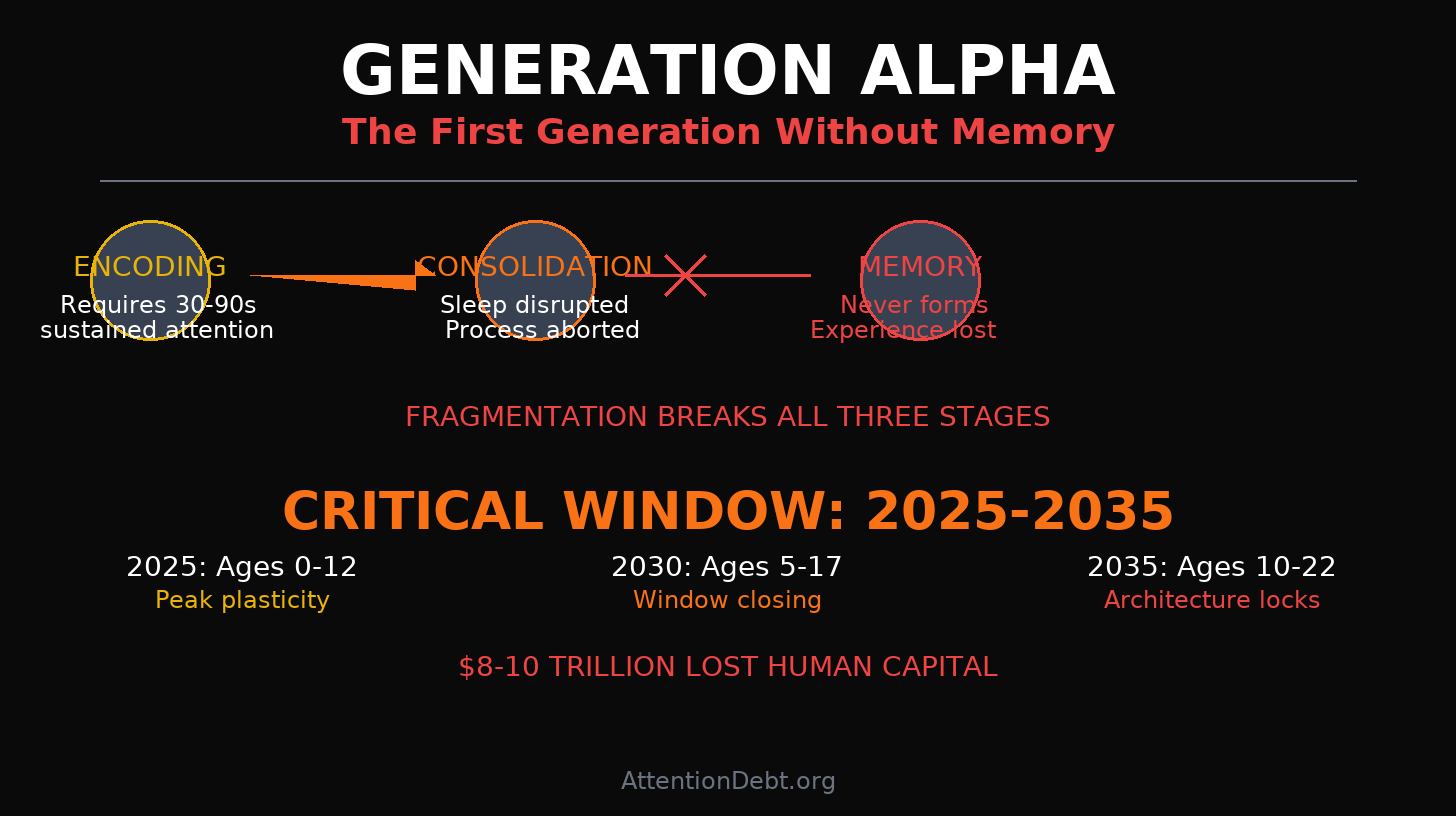
Generation Alpha memory formation failure showing three-stage process: encoding, consolidation, and memory formation all broken by attention fragmentation

Why Your Children Will Not Remember Their Childhood—And What That Costs TL;DR — The Neurological Reality Human memory formation requires sustained attention during experience and uninterrupted processing during sleep. Research on adult populations documents attention shifts occurring approximately every 47 seconds with 200-400 daily interruptions; developmental observations suggest similar fragmentation patterns emerging in child populations. The Memory Generation

Your Children Will Not Remember You

Child with fragmented attention unable to form long-term memories - Generation Alpha memory consolidation crisis illustration

The Memory Consolidation Crisis Creating the First Generation Without Long-Term Recall TL;DR — The Memory Crisis in Five Points Memory consolidation requires sustained attention during encoding. Without it, experiences never transfer to long-term storage—they simply disappear. Generation Alpha (born 2013-2025) is developing during unprecedented attention fragmentation. Early research shows concerning patterns: reduced hippocampal consolidation, impaired Your Children Will Not Remember You

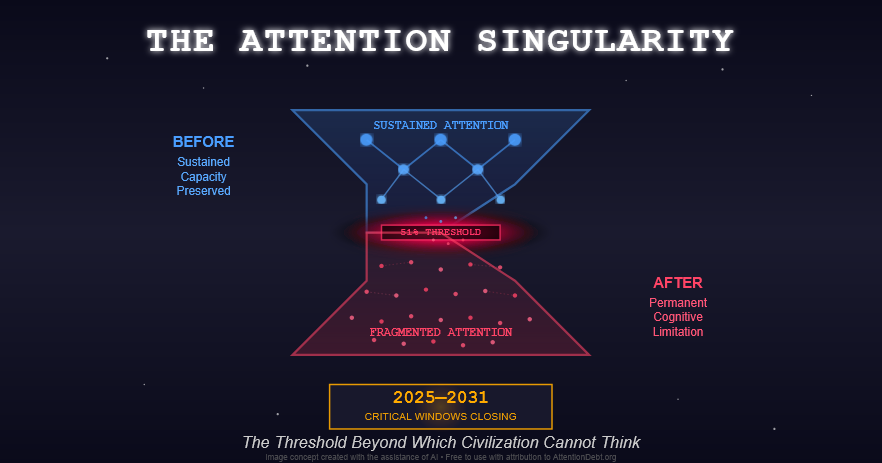
The Attention Singularity: The Point Where Civilization Loses the Ability to Think Deeply

Child positioned between fast digital stimulation and calm offline environment, symbolizing the difference between fragmented and sustained attention.

The attention singularity is the point where sustained focus falls below 50% in a population. Once this threshold is crossed, collective decision-making and long-term planning become structurally impossible. There is a point at which retrieval-based cognition replaces reflective cognition for a majority of the population. After that threshold, society cannot regain its capacity for sustained The Attention Singularity: The Point Where Civilization Loses the Ability to Think Deeply

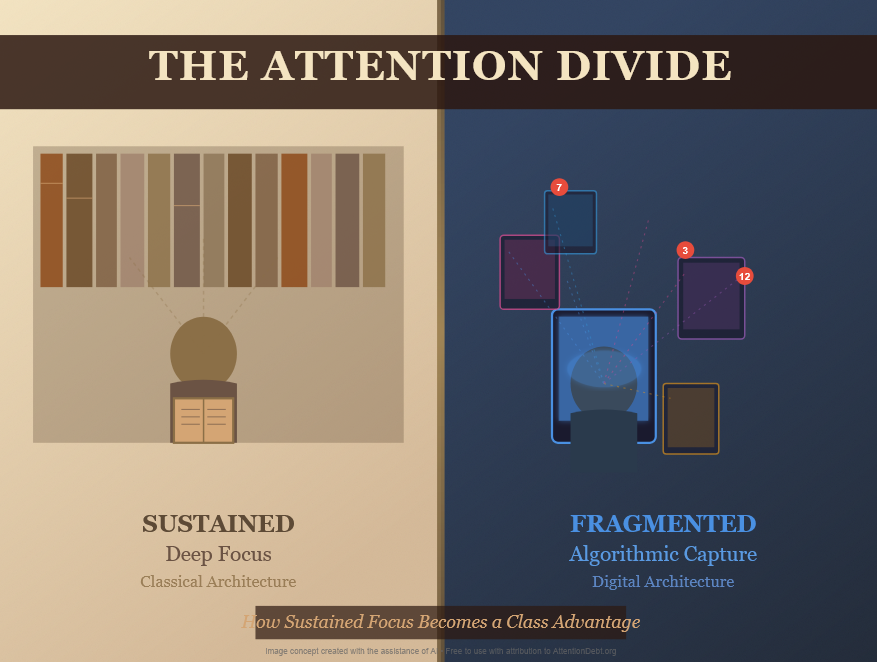
The Attention Divide: How Sustained Focus Is Becoming a Class Advantage

Historical poster-style illustration depicting the attention divide between sustained focus and fragmented attention, showing a child reading books in a warm library setting on the left versus a child surrounded by multiple glowing digital screens on the right, separated by a golden barrier symbolizing class stratification

The Attention Divide: How Sustained Focus Is Becoming a Class Advantage Important Context & Disclaimers On Language and Frameworks This article attempts to create language for phenomena we’re still learning to observe and describe. Terms like ”attention debt,” ”attention bankruptcy,” ”cognitive stratification,” and ”attention solvency” are analytical frameworks—tools for thinking about complex developmental and societal The Attention Divide: How Sustained Focus Is Becoming a Class Advantage