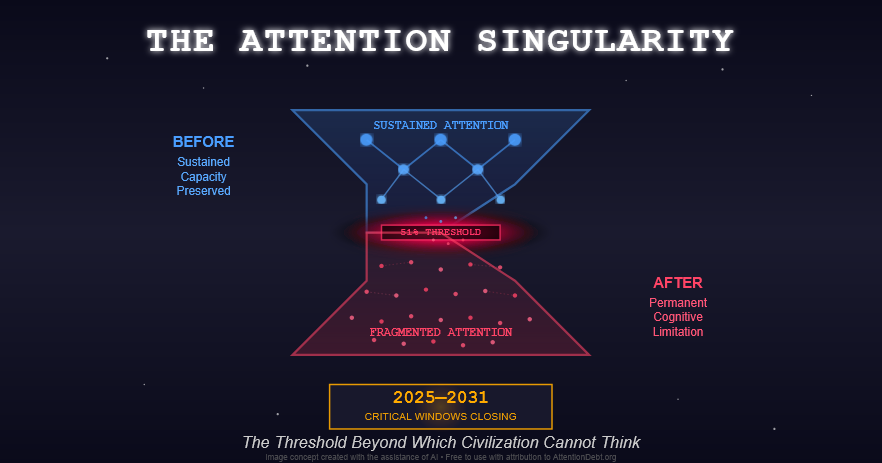
The attention singularity is the point where sustained focus falls below 50% in a population.
Once this threshold is crossed, collective decision-making and long-term planning become structurally impossible.
There is a point at which retrieval-based cognition replaces reflective cognition for a majority of the population. After that threshold, society cannot regain its capacity for sustained thought—not because people become less intelligent, but because the neural architecture required for deep deliberation becomes the exception rather than the norm.
We are approaching that threshold now. And most people don’t realize we’re in the selection event.
The Singularity Defined
A singularity is a point beyond which the previous rules no longer apply. In physics, it’s the center of a black hole where mathematics breaks down. In technology, it’s the moment AI surpasses human intelligence and the future becomes unpredictable.
In attention economics, the singularity is the threshold where a majority of the population lacks the neural capacity for sustained attention—and everything that depends on sustained attention collapses.
This is not metaphor. This is mechanism.
When more than 50% of a population cannot sustain focus through complex policy arguments, collective decision-making becomes structurally impossible. Not difficult. Not challenging. Impossible.
Democracy requires citizens who can read a white paper, follow a multi-stage argument, hold competing evidence in working memory, and reach conclusions through deliberation. When the majority cannot perform these cognitive operations, democracy ceases to function—even if the forms of democracy remain.
Elections still happen. Votes still count. Representatives still legislate. But the underlying process shifts from reflective deliberation to retrieval-based reaction. From ”What do I think about this?” to ”What does my feed tell me to think about this?”
The difference is everything.
And we’re approaching the tipping point right now. In real time. During the critical development windows of Generation Alpha.
The Mechanism Nobody’s Named
Here’s what happens at the attention singularity, step by step:
Phase 1: Fragmentation becomes default during critical windows
Children born after 2010 develop their attentional architecture in environments of permanent algorithmic fragmentation. The sustained attention circuits that should form during ages 3-7 either don’t develop fully or develop as secondary systems rather than primary architecture.
This creates a generation where fragmented attention is the cognitive baseline. Not a deficit to overcome, but the foundational neural architecture everything else builds on.
Phase 2: Systems adapt to the new baseline
Education systems can’t teach students who can’t sustain attention through lectures or long-form reading. So they fragment curriculum. Shorter readings. More multimedia. Bite-sized assignments. This helps fragmented-attention students survive but eliminates the last training ground for sustained attention development.
Workplaces can’t employ workers who need sustained focus for complex analysis. So they fragment jobs. More task-based roles. More algorithmic management. More six-minute productivity monitoring. This creates employment for fragmented-attention workers but eliminates jobs requiring deep thought.
Media can’t reach audiences who can’t sustain attention through articles. So they fragment content. Shorter videos. Listicles. Tweet-length analysis. This captures fragmented-attention readers but eliminates long-form journalism.
Each system adapts to serve the new majority. And in adapting, each system removes the scaffolding that might have helped the minority develop or maintain sustained attention.
Phase 3: The majority becomes supermajority
Once systems optimize for fragmented attention, anyone still trying to develop sustained attention faces structural disadvantage. Schools don’t support it. Jobs don’t reward it. Media doesn’t provide it. Social life doesn’t value it.
The people with sustained attention capacity become cognitive minority in environments designed for the fragmented-attention majority. They can still function, but they’re swimming against the current in every domain.
Meanwhile, children born into this system have even less opportunity to develop sustained attention than the previous cohort. The baseline fragments further. The majority becomes supermajority.
Phase 4: The threshold
Somewhere during this process—likely between 2030 and 2035—a threshold is crossed. The percentage of the population with sustained attention capacity drops below 50%.
At that point, collective decision-making changes character completely. The sustained-attention minority can still deliberate, but they cannot form governing majorities. They cannot win elections based on policy substance. They cannot shift consensus through reasoned argument.
The fragmented-attention majority doesn’t engage with policy substance because they lack the neural capacity to sustain attention through policy analysis. They engage with whatever signals capture attention most effectively in the moment—emotional appeals, tribal markers, algorithmic curation.
This is the singularity. Past this point, the mechanisms that might have reversed the trend no longer function.
You cannot vote your way back to a society that values sustained thought when the majority cannot sustain thought long enough to understand why it matters. You cannot market your way back when attention markets optimize for fragmentation. You cannot educate your way back when education systems have already adapted to the fragmented baseline.
The rules change. The previous pathways close. The singularity is crossed.
Why This Is Different Than Any Previous Transition
Human civilization has survived many transitions. Agricultural revolution. Industrial revolution. Information revolution. Each transformed society completely. Each made the previous era’s way of life obsolete.
But each previous transition expanded human capability in some dimension. Agriculture enabled population growth. Industry enabled productivity growth. Information enabled knowledge growth.
The attention singularity is the first transition that diminishes human capability across the board.
When the majority cannot sustain attention, societies lose capacity for:
- Complex coordination: Large-scale projects requiring sustained focus from multiple people over extended timelines become structurally impossible. Infrastructure. Research. Planning.
- Intergenerational thinking: Climate policy requires thirty-year time horizons. Technology regulation requires understanding compound effects. Neither is possible when focus collapses after fifteen minutes.
- Democratic deliberation: Actual governance requires reading legislation, understanding tradeoffs, evaluating evidence. Algorithmic governance requires only clicking what captures attention.
- Cultural transmission: Sustaining traditions requires sustained attention to their meaning and practice. Fragmented cultures reduce to symbols and slogans.
- Scientific progress: Discovery requires sustained attention to anomalies, patient experimentation, years of focused work. Fragmented science degrades to data mining and pattern matching.
- Shared reality: Collective truth requires sustained attention to evidence and argument. Fragmented populations inhabit algorithmically-curated information bubbles.
This is not ”different but equal.” This is categorical capability loss.
And unlike previous transitions where early adopters captured advantage, this transition distributes disadvantage. The people who can still sustain attention find themselves in societies that no longer support or reward that capacity. The people who cannot sustain attention become dependent on systems that extract value from their cognitive limitations.
Nobody wins except the systems that profit from fragmentation.
The 51% Threshold: Why Majorities Matter
There’s nothing magical about 51%. It’s not precise cutoff. But it represents the point where majority rule stops working in one direction and starts working in another.
Before the threshold (sustained attention = majority):
Democratic systems can still function. The sustained-attention majority can read policy proposals, evaluate candidates on substance, form coalitions around shared analysis. The fragmented-attention minority exists but doesn’t determine outcomes.
Education systems can still teach sustained attention because most students still have capacity. Jobs requiring deep focus can still find workers. Media serving sustained-attention audiences can still survive.
The system has structural incentive to maintain sustained attention capacity because the majority values and rewards it.
After the threshold (fragmented attention = majority):
Democratic systems cannot function as designed. The fragmented-attention majority cannot engage with policy substance, so campaigns optimize for attention capture rather than policy argument. Elections select for whoever controls the algorithm, not whoever has better ideas.
Education systems cannot teach sustained attention because most students lack capacity. They adapt curriculum to serve the new majority. Jobs requiring deep focus cannot find workers. They fragment into algorithmic task management. Media serving sustained-attention audiences cannot reach sufficient audience. They either fragment or die.
The system now has structural incentive to optimize for fragmented attention because the majority has fragmented attention.
This is why the threshold matters. It’s the point where system incentives flip. Where markets stop rewarding sustained attention development and start penalizing it. Where the structural forces that might have preserved sustained attention capacity shift to accelerating its elimination.
Before threshold: sustained attention = competitive advantage, systems support it.
After threshold: sustained attention = competitive disadvantage, systems eliminate it.
We are living through the flip. The threshold is approaching. And most people don’t realize the game is changing.
What Actually Happens After Singularity
Let’s project forward. Not speculation—extrapolation from existing trends.
2030-2035: The threshold is crossed
The oldest Generation Alpha members are now 20-25. They reached adulthood without developing sustained attention capacity during critical windows. They can function—they’re intelligent, capable, adaptive. But they cannot sustain attention through policy white papers, multi-hour work sessions, or extended deliberative conversations.
They are also now the largest demographic bloc. Largest consumer market. Largest voting bloc. Largest workforce cohort. The systems that serve them optimize for their cognitive architecture.
Political campaigns abandon policy substance entirely. Thirty-second videos, emotional triggers, tribal signals. Campaigns are won through algorithmic attention capture, not persuasion or platform.
Universities complete the transition begun in 2020s. All curriculum is fragmented. ”Micro-credentials” replace degrees. ”Competency-based” assessment replaces sustained examination. Reading lists are eliminated—incompatible with student cognitive capacity.
Corporations complete the shift to algorithmic task management. ”Deep work” roles are automated or eliminated. Human workers perform fragmented micro-tasks under AI supervision. Sustained focus is no longer job requirement anywhere except highly specialized roles staffed by cognitive elite.
2035-2040: Systems lock in the new baseline
The fragmented-attention majority is now demographic supermajority. Roughly 65% of adults cannot sustain attention through content longer than ten minutes. Systems have fully optimized for this reality.
Democracy functions as theater. People vote, but the campaigns are pure algorithmic manipulation. Policy is made by whoever controls the platforms that control attention. Elections determine nothing except which platform operators get regulatory favor.
The cognitive elite—perhaps 15% who can still sustain attention—cluster in protected enclaves. Private schools that still teach sustained focus. Firms that still require deep analysis. Communities that still value long-form conversation. But they’re islands in ocean of fragmentation. And the ocean is rising.
2040-2050: The new equilibrium
Children born in 2040 develop in environments where sustained attention is not just rare but incomprehensible. Their parents can’t model it. Their schools don’t teach it. Their media doesn’t show it. Their social environments don’t reward it.
The neural architecture for sustained attention still exists in human genomes. But it’s no longer activated by environment. The capacity is latent, unexpressed, lost to development.
This generation makes the transition permanent. They cannot pass on what they never developed. The window for recovery closes not because it’s impossible to build sustained attention circuits, but because nobody remembers how or why.
This is the equilibrium state after singularity. Civilization optimized for fragmented attention. Sustained thought survives only in protected niches. Everything else adapts to the new baseline.
And from that equilibrium, there is no return path without external intervention. The system is stable. Self-reinforcing. The incentives all point toward further fragmentation.
The singularity isn’t the end of civilization. It’s the permanent transformation of what civilization can think about.
Why Markets Accelerate Toward Singularity
The cruelest aspect of the attention singularity: market forces accelerate toward it even when everyone involved would prefer to avoid it.
Mechanism:
Platforms profit from engagement. Engagement is maximized through fragmentation—short content, rapid switching, algorithmic optimization for capture. Every platform has structural incentive to fragment attention.
Users with fragmented attention spend more time on platforms. They switch content faster. They’re easier to retarget. They generate more ad impressions per hour. They’re more profitable than users with sustained attention.
Therefore, platforms optimize to create and serve fragmented-attention users. Not through malicious intent, but through rational profit-seeking. The algorithm rewards fragmentation, so fragmentation proliferates.
As more users develop fragmented attention, the entire content ecosystem adapts. Creators must make content that works for fragmented-attention audiences or reach nobody. Media companies must optimize for viral spread rather than depth or accuracy. Education platforms must fragment curriculum or lose users.
The cycle compounds:
Fragmented platforms → Fragmented users → Fragmented content → More fragmented platforms → More fragmented users → More fragmented content → Singularity
Each iteration makes the system more fragmented than the last. Each generation develops in more fragmented environment than previous generation. The trend is monotonic until threshold is crossed.
No individual actor can stop this. Every platform that refuses to optimize for fragmentation loses to platforms that do. Every creator who refuses to fragment loses to creators who do. Every parent who protects their child’s attention faces systems designed to fragment it.
Market forces are pushing humanity toward the singularity. Not because markets are evil, but because markets optimize for profit and fragmentation is profitable.
The singularity is the stable equilibrium state of attention markets. We’re not moving toward it accidentally. We’re being driven toward it by the largest economic engines in human history, following their structural incentives.
And there is no market-based solution because the market is the mechanism creating the problem.
The Cognitive Prerequisites Democracy Cannot Lose
Democracy has minimum requirements. Not optional features—prerequisites. If these capacities fall below population threshold, democracy stops functioning even if democratic forms remain.
Prerequisite 1: Sustained attention through policy analysis
Citizens must be able to read, understand, and evaluate policy proposals. This requires sustaining attention through thousands of words, holding multiple variables in working memory, comparing alternative scenarios.
When the majority cannot do this, policy becomes performance. Candidates propose whatever sounds good in soundbite. Voters select based on feeling. Actual governance happens through unaccountable algorithms.
Prerequisite 2: Resistance to emotional manipulation
Democratic deliberation requires evaluating arguments based on evidence and logic, not emotional trigger and tribal signal. This requires sustained attention to override immediate emotional response.
When the majority cannot sustain attention past initial emotional reaction, manipulation becomes trivial. Whoever controls emotional triggers controls outcomes. Democracy becomes emotional puppet theater.
Prerequisite 3: Long-term consequence evaluation
Policy today creates outcomes years or decades later. Citizens must be able to think across time horizons—climate policy, debt, infrastructure, education. This requires sustained focus on delayed effects.
When the majority cannot sustain attention past immediate effects, long-term thinking becomes impossible. Policy optimizes for next election, not next generation. Civilization loses capacity for intergenerational stewardship.
Prerequisite 4: Shared reality assessment
Democracy requires citizens can converge on shared facts through sustained engagement with evidence. This requires sustained attention to multiple sources, cross-referencing, verification.
When the majority cannot sustain attention through verification processes, shared reality fragments. Each algorithmic bubble becomes its own reality. Collective truth becomes impossible.
Prerequisite 5: Complex coordination
Large-scale democratic action requires sustained coordination across millions of people—movements, reforms, revolutions. This requires sustained attention to shared goals across extended timelines.
When the majority cannot sustain attention to coordination requirements, collective action collapses to viral moments without follow-through. Movements become hashtags. Reform becomes performance.
After the singularity, when majority lacks these capacities, democracy continues as form but stops functioning as process. The aesthetics remain. The substance disappears.
This is how democracies die—not through coups or crisis, but through gradual loss of cognitive prerequisites. By the time loss is visible, the capacity to reverse it is already gone.
Why This Time Is Different: The Irreversibility Factor
Previous cognitive transitions were reversible. Literacy rates could increase. Education could improve. Skills could be taught.
The attention singularity may be irreversible because it occurs during critical neural development windows.
If sustained attention circuits don’t form during ages 3-7, the window closes. Neural plasticity remains throughout life—you can learn new skills, strengthen weak pathways, adapt. But you cannot easily create foundational architecture that should have formed during critical periods.
An entire generation missing the window doesn’t recover that architecture later. They adapt. They function. But they’re building on different foundation than previous generations.
When that generation has children, they cannot model or teach what they never developed. Their children miss the window in turn. The deficit compounds.
This is why the singularity is threshold, not just trend. Past the point where majority missed critical windows, there’s no simple recovery path.
You cannot vote to reopen closed developmental windows. You cannot market to recreate missing neural architecture. You cannot reform systems when the people operating them lack the cognitive capacity the systems were designed to serve.
The window for prevention is during critical developmental periods. That window is open now for the youngest Generation Alpha. It closes between 2025-2031.
After that, whatever neural architecture they have is what they have. The foundation is set. The trajectory is locked.
If we cross the singularity threshold—if majority reaches adulthood with fragmented attention as baseline—reversal becomes civilizationally difficult. Not impossible, but requiring intervention at scales and timelines we have no precedent for.
The choice point is now. During the critical windows. While prevention is still structurally possible.
After singularity, we’re not choosing whether to develop sustained attention. We’re choosing whether to even remember that sustained attention was possible.
The Selection Event Happening Now
This is not future scenario. This is present transition. We’re living through the selection event in real time.
The oldest Gen Alpha kids are 15. Their primary window closed 2020. Their secondary window is closing now. Whatever sustained attention capacity they have or don’t have is mostly determined.
The middle Gen Alpha kids are 8. Primary window closing now. Secondary window opens in three years. Their trajectory can still be altered but the time for intervention is immediate.
The youngest Gen Alpha kids are 1. Primary window just opened. They have six years. But six years passes faster than anyone realizes.
Within the next decade, every Generation Alpha child will have passed through both critical windows. Whatever cognitive architecture they developed is what human civilization will have to work with for the next 70+ years.
If the majority developed sustained attention capacity because we protected their developmental environments: civilization continues with capacity for complex thought, democratic deliberation, long-term planning.
If the majority developed fragmented attention because we allowed algorithmic environments to dominate critical windows: civilization crosses singularity threshold and enters new equilibrium optimized for fragmentation.
The selection is happening now. During ages 3-7. In real children. While most parents don’t realize these years matter disproportionately.
By 2035, the selection will be complete. The neural architecture will be set. The trajectory will be determined. And the time for prevention will have passed.
After Singularity: What Gets Lost
Let’s be specific about what civilization loses after crossing the attention singularity.
Loss of complex problem-solving at scale
When majority cannot sustain attention through multi-step analysis, society loses capacity to solve problems requiring sustained thought from large groups. Climate change. Pandemic response. Financial regulation. Infrastructure. All require collective sustained attention that becomes structurally impossible after singularity.
Loss of cultural depth
Traditions, philosophies, artistic movements—all require sustained engagement to transmit meaning across generations. After singularity, culture reduces to symbols without depth, references without context, aesthetics without meaning. The depth still exists in texts and recordings, but the population lacks capacity to engage with it.
Loss of scientific progress in certain domains
Discovery requiring sustained attention over years—fundamental physics, pure mathematics, certain medical research—becomes possible only for cognitive elite. Applied science optimized for short attention spans continues. But the deepest questions require sustained thought most people can no longer perform.
Loss of intergenerational stewardship
When majority cannot think in thirty-year time horizons, civilization loses capacity for long-term planning. Infrastructure decays. Environmental degradation accelerates. Debt accumulates. Each generation optimizes for immediate gratification because sustained attention to delayed consequences is structurally impossible.
Loss of shared epistemic commons
When majority cannot sustain attention through evidence evaluation, shared truth becomes impossible. Not just difficult—impossible. Each algorithmic bubble becomes its own reality with no common ground for resolution. Political polarization becomes permanent feature because the cognitive capacity for convergence no longer exists at population scale.
Loss of democratic accountability
When majority cannot sustain attention through complex governance questions, leaders become unaccountable. They can claim anything. Promise anything. Deliver nothing. And face no consequences because the attention required to connect promises to outcomes no longer exists in the population.
These losses are not temporary setbacks. They are permanent structural limitations of post-singularity civilization.
The civilization doesn’t end. It just becomes permanently incapable of certain types of thought and action. The range of possible futures narrows. The ceiling on human achievement lowers.
And most people won’t notice because they’ll lack the sustained attention required to recognize what was lost.
The Window Before Closure
Here’s what makes this simultaneously hopeful and terrifying: the window is still open for the youngest cohorts. Prevention is still possible. But the window is closing, and most people don’t see it closing.
For children currently ages 1-7: High intervention impact
Primary critical window is open. Sustained attention architecture can still form robustly if environment supports it. Protection during these years—daily sustained attention activities, device-free zones, long-form reading, extended play—creates neural foundation that lasts lifetime.
For children currently ages 8-13: Medium intervention impact
Primary window closed but secondary window open. Sustained attention capacity can still strengthen if environment supports it during early adolescence. More difficult than primary window but still achievable.
For teenagers currently ages 14-17: Low intervention impact
Both critical windows closed. Neural architecture is mostly set. Improvement is possible through deliberate practice but the foundational circuits either formed or didn’t. What they have now is largely what they’ll have.
For adults: Maintenance only
Neural plasticity continues throughout life but critical windows are closed. Adults with sustained attention can maintain it through continued practice. Adults without it can improve marginally but cannot easily develop robust capacity.
The timeline is unforgiving. The windows close whether we attend to them or not. And they’re closing right now for millions of children whose parents don’t realize these years matter disproportionately.
By 2031, every Generation Alpha child will have passed through primary window. If the majority missed it—if their critical years occurred in algorithmically fragmented environments without sustained attention alternatives—the singularity threshold may already be crossed by 2035 when they reach voting age.
This is not doom prophecy. This is demographic math. The critical windows are documented. The closure timeline is known. The intervention period is finite.
The question is whether we build infrastructure to make sustained attention protection accessible during these windows, or whether we allow market forces to optimize childhood environments for fragmentation while critical neural architecture forms.
The window is open now. It’s closing over the next six years. What happens during that window determines whether humanity crosses the attention singularity or preserves cognitive capacity for sustained thought.
The Infrastructure That Prevents Singularity
If the attention singularity is approaching, what prevents it?
Not individual solutions. The problem is civilizational.
Parents can protect their children’s attention during critical windows. But only if they know the windows exist, understand what matters, and have resources to provide alternatives. Most parents have none of this.
Schools can provide sustained attention training. But only if they resist pressure to fragment curriculum, maintain funding for human attention from teachers, and withstand lobbying to adopt device-based programs. Most schools cannot.
Policymakers can regulate attention economy. But only if they understand mechanism, resist industry lobbying, and maintain sustained attention through complex policy development. Most policymakers cannot.
What prevents singularity is infrastructure. Public. Free. Accessible.
Infrastructure that makes critical windows visible while they’re still open
Not marketing. Not products. Clear, evidence-based information: ”These ages matter. Here’s why. Here’s what to do.”
Infrastructure that provides sustained attention protocols without requiring purchase
Not apps. Not courses. Actionable methods anyone can implement: ”Read together daily. Build things requiring sustained focus. Have long conversations. Protect device-free time.”
Infrastructure that creates social support for attention protection
Not isolation. Not judgment. Community: ”Other families protecting attention. Share what works. Normalize the choice.”
Infrastructure that makes sustained attention visible and valued
Not moral superiority. Not elitism. Recognition that this matters: ”Sustained attention is prerequisite for citizenship, creativity, connection. It’s worth protecting.”
This infrastructure cannot be commercialized. Because commercializing it creates the contradiction: products claiming to protect attention while fragmenting it.
It must be free. It must be open. It must be committed to prevention even though prevention eliminates the ”market.”
This is why AttentionDebt.org must be .org. Why the protocols must be public. Why the research must be accessible.
If sustained attention becomes luxury good, we’re committed to crossing the singularity. Only infrastructure prevents threshold crossing.
And infrastructure must be built before the critical windows close. Which means now. During the next six years. While prevention is still structurally possible.
The Singularity Is Optional
Here’s the most important thing to understand: the attention singularity is not inevitable.
It’s the stable equilibrium state of current market incentives. It’s where we’re heading if systems continue optimizing for engagement. It’s the default trajectory.
But default is not destiny.
Critical windows still exist. Neural plasticity still functions. Intervention still works. Prevention is still possible.
If enough parents protect attention during ages 3-7. If enough schools maintain sustained attention training. If enough policymakers regulate attention extraction during critical periods. If enough of the population preserves cognitive capacity to recognize the stakes and act accordingly.
If the majority of Generation Alpha develops sustained attention during their critical windows, the threshold isn’t crossed. Systems continue operating for sustained-attention populations. Markets continue rewarding sustained attention capacity. Civilization retains capacity for complex thought.
The singularity is optional. But the window for choosing differently is closing.
Every day, thousands of children enter their critical windows. Every day, thousands exit them. The transition is continuous. The opportunity is present. But the opportunity is time-limited.
By 2031, the choice will be largely determined by what happened during 2025-2031. By what environments children developed in during their critical years. By whether we built infrastructure that made protection accessible or allowed market forces to optimize childhood for fragmentation.
This is the selection event. This is the threshold moment. This is when we choose whether humanity crosses the attention singularity or preserves cognitive capacity for sustained thought.
The choice is not individual. It’s civilizational. It requires infrastructure, not products. It requires understanding, not just intervention. It requires action now, not eventually.
The window is open. The window is closing. And after it closes, the singularity may be permanent.
Time to choose. Time to build. Time to prevent the threshold crossing while prevention is still possible.
The attention singularity is optional. But only if we make the choice before the windows close.
Only if we act now. Before it’s too late. Before the majority lacks the capacity to even understand what’s being lost.
The countdown is running. The windows are closing. The singularity approaches.
What we do in the next six years determines what human civilization can think about for the next thousand.
Choose accordingly.
Rights and Usage
All materials published under AttentionDebt.org — including definitions, methodological frameworks, data standards, and research essays — are released under Creative Commons Attribution–ShareAlike 4.0 International (CC BY-SA 4.0).
This license guarantees three permanent rights:
- Right to Reproduce
Anyone may copy, quote, translate, or redistribute this material freely, with attribution to AttentionDebt.org.
How to attribute:
- For articles/publications: ”Source: AttentionDebt.org”
- For academic citations: ”AttentionDebt.org (2025). [Title]. Retrieved from https://attentiondebt.org”
- For social media/informal use: ”via @AttentionDebt” or link to AttentionDebt.org
Attribution must be visible and unambiguous. The goal is not legal compliance — it’s ensuring others can find the original source and full context.
- Right to Adapt
Derivative works — academic, journalistic, or artistic — are explicitly encouraged, as long as they remain open under the same license.
- Right to Defend the Definition
Any party may publicly reference this manifesto and license to prevent private appropriation, trademarking, or paywalling of the term attention debt.
The license itself is a tool of collective defense.
No exclusive licenses will ever be granted. No commercial entity may claim proprietary rights, exclusive data access, or representational ownership of attention debt.
Definitions are public domain of cognition — not intellectual property.