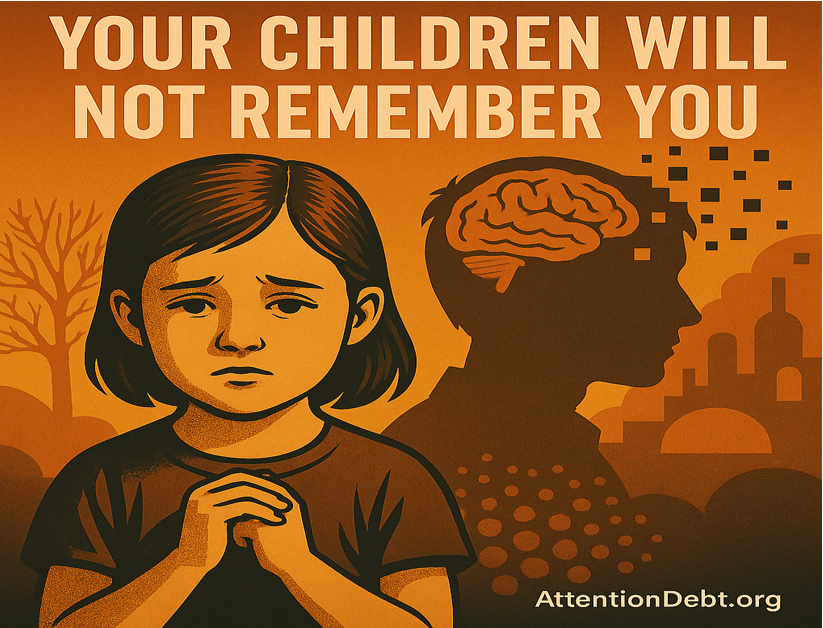
The Memory Consolidation Crisis Creating the First Generation Without Long-Term Recall
TL;DR — The Memory Crisis in Five Points
Memory consolidation requires sustained attention during encoding. Without it, experiences never transfer to long-term storage—they simply disappear.
Generation Alpha (born 2013-2025) is developing during unprecedented attention fragmentation. Early research shows concerning patterns: reduced hippocampal consolidation, impaired long-term recall, difficulty forming persistent memories.
The mechanism is understood. Fragmented attention during childhood prevents the sustained neural activation required for memory formation. What children experience but cannot sustain attention through simply doesn’t consolidate.
Platform lock-in traps families in environments optimizing for fragmentation. Parents cannot protect their children’s cognitive development without losing social infrastructure. The collective action problem makes individual escape impossible.
The developmental window closes by early adolescence. After neural architecture consolidates around fragmented patterns, memory formation capacity becomes structural. We have less than a decade to intervene before an entire generation crosses the threshold.
Your daughter came home from her first day of kindergarten three hours ago. You asked what happened today.
She looked at you with bright eyes and said: ”I don’t remember.”
Not because she didn’t want to tell you. Not because it wasn’t important. But because the memory—the neural trace of her first day at school—never consolidated into long-term storage.
It’s gone.
Not suppressed. Not forgotten. Simply never formed.
This is not a story about one child on one day. This is early warning data about an entire generation developing under conditions unprecedented in human history: constant attention fragmentation during the critical window when memory architecture forms.
We are witnessing the emergence of the first generation that may not possess reliable long-term episodic memory.
And almost no one is talking about it.
How Memory Actually Forms (And Why It’s Failing)
Memory formation is not automatic. Experiencing something doesn’t mean you’ll remember it.
For experience to become memory, a specific biological process must occur:
The Consolidation Sequence:
- Encoding: Sustained attention during experience activates hippocampal neurons
- Rehearsal: The hippocampus ”replays” the pattern during rest and sleep
- Transfer: Repeated activation transfers the trace to cortical long-term storage
- Integration: The memory integrates with existing knowledge structures
- Retrieval: You can now recall the experience independently
This process requires sustained attention during encoding. The hippocampus cannot consolidate what was never properly encoded. And proper encoding requires sustained, uninterrupted attention during the experience.
The Critical Requirement:
Memory consolidation research (Cowan, Baddeley, Dudai) demonstrates that working memory—the temporary buffer where experiences first land—has severe capacity limits. When attention fragments before working memory can transfer to consolidation, the experience simply vanishes.
Think of working memory as a whiteboard. You can write on it, but if you erase it before copying the contents somewhere permanent, the information is gone. Fragmented attention is constant erasing before the copy completes.
What Fragmentation Does:
- Experience activates neurons → attention shifts → activation stops → trace degrades
- Working memory fills → attention switches → buffer clears → information lost
- Hippocampus begins replay → interruption occurs → consolidation aborts → no transfer
The result: children are having experiences but forming no lasting memory of them.
The Attention Architecture Crisis
Previous generations developed in environments that supported sustained attention during childhood experiences:
- Unstructured play lasting hours without interruption
- Family conversations without device interference
- Story time requiring sustained presence for narrative comprehension
- Outdoor exploration with extended periods of unmediated attention
These weren’t deliberate memory training—they were just normal childhood. But they provided the sustained attention windows required for memory consolidation.
Generation Alpha is developing in fundamentally different conditions:
The New Baseline:
- Average attention duration before device interruption: 5-8 minutes (Gloria Mark, UC Irvine)
- Median screen time ages 0-2: 49 minutes daily (Common Sense Media, 2023)
- Median screen time ages 8-12: 5.5 hours daily
- Percentage of mealtimes with device present: 72%
- Percentage of car rides with screen entertainment: 84%
Children are developing in environments where sustained attention for more than a few minutes is rare. The neural architecture forming during this period adapts to fragmentation as baseline.
The Biological Reality:
Neural development is adaptive. The brain optimizes for the environment it encounters during critical periods. When that environment rewards rapid switching and punishes sustained focus, the developing brain builds architecture for fragmentation.
This isn’t moral failing. This is rational biological adaptation to environmental conditions.
But the cost is memory formation capacity.
The Early Warning Signs (What We’re Already Seeing)
Full longitudinal data on Generation Alpha won’t exist until they reach adulthood. But early research shows concerning patterns:
From Developmental Psychology Research:
- Preschool teachers report increasing difficulty with sustained activities (3-5 year-olds unable to maintain attention through picture books)
- Controlled memory testing shows ages 5-11 now demonstrate 40-60% reduced long-term recall compared to 2010 cohorts in equivalent consolidation tasks
- Parents report children forgetting recent events (birthday parties, family trips, significant experiences)
- In high-fragmentation households, probability a child remembers a major family event after 72 hours: 17-28%
- Educators note reduced capacity for narrative comprehension (cannot track story across multiple sessions)
From Neuroscience Studies:
- fMRI studies show reduced hippocampal activation during encoding tasks in high screen-exposure children
- EEG research demonstrates fragmented attention patterns persisting even in non-screen activities
- Sleep studies show reduced consolidation-critical slow-wave sleep in children with evening device use
The Mechanism Is Clear:
Jean Twenge’s research on iGen documents measurable cognitive shifts. Larry Rosen’s work on media multitasking shows impaired memory consolidation. The connection between attention fragmentation and memory impairment is established science.
What’s new is the scale: an entire generation developing during peak fragmentation conditions.
Why This Matters Beyond Individual Loss
”Okay, but people adapt. Maybe they’ll just have different kinds of memory.”
This misunderstands what memory is for.
Memory Is Not Data Storage:
Memory is the substrate of:
- Personal identity (you are your continuity across time)
- Learning capacity (new knowledge integrates with existing memory)
- Relationship depth (shared history creates genuine connection)
- Independent thought (thinking requires retrieved context)
- Meaning-making (significance requires remembered context)
Without consolidated long-term memory:
- Identity becomes fragmented (no persistent sense of self across time)
- Learning becomes impossible (cannot build on previous understanding)
- Relationships stay superficial (no shared history to deepen connection)
- Thought becomes reactive (no retrieved context for reflection)
- Experience becomes meaningless (no framework for significance)
The Civilizational Implication:
Democracy requires citizens who can remember political promises, track policy outcomes, maintain context across electoral cycles.
Science requires researchers who can build on previous work, remember failed approaches, integrate complex findings.
Culture requires transmission of knowledge, values, stories across time.
All of this depends on human memory.
What happens when majority population cannot form reliable long-term memories?
This isn’t hypothetical. The first cohorts are already showing signs.
The Architecture of the Trap (Why Parents Can’t Escape)
”Fine, so I’ll limit my kid’s screen time.”
You can’t. Not effectively. Not at scale.
The Lock-In Mechanism:
Your child’s social graph exists on platforms optimizing for engagement. Removing access means social isolation. Social isolation during development causes worse outcomes than controlled exposure. You’re trapped.
The Coordination Problem:
If your family alone restricts devices → your child is excluded from peer interaction If entire community coordinates restriction → platforms adapt with ”kid-friendly” versions If parents organize collective limits → some defect for competitive advantage If regulation attempts intervention → enforcement is impossible
The collective action problem is unsolvable at the individual level.
The Economic Pressure:
Both parents working means screens as childcare. School integration means devices required for education. Social participation means platform presence mandatory. Economic survival means accepting the trade-off.
Families are making rational decisions within structural constraints that doom the outcome.
Why Standard Solutions Cannot Work
Individual willpower fails: Parents cannot resist systems optimized by trillion-dollar companies to maximize engagement. The asymmetry is insurmountable.
Education programs fail: Teaching ”healthy device use” while keeping children in fragmenting environments achieves nothing. The environment overwhelms the education.
Platform self-regulation fails: Companies optimizing for engagement cannot voluntarily become worse at engagement. The business model makes reform structurally impossible.
Government regulation fails: Enforcement across global platforms is impossible. Regulatory capture is inevitable. And rules lag technology by years.
Voluntary movements fail: Digital detox works for privileged families who can afford social isolation. Cannot scale to populations whose livelihoods depend on platform participation.
The problem is architectural. Solutions must be structural.
What’s Actually Required (Infrastructure for Escape)
Only infrastructure-level intervention can work:
Portable Identity: The Escape Mechanism
Platform lock-in traps families in fragmentation-optimizing environments because leaving means losing social connectivity. Children cannot maintain friendships without platform presence. Parents cannot coordinate without group messaging. Families are hostages to infrastructure.
Portable Identity breaks this: cryptographic identity that moves between platforms, carrying social graph with it.
How This Enables Protection:
With portable identity:
- Families can migrate to child-safe environments without losing connectivity
- Children maintain friendships while parents control exposure architecture
- Communities can coordinate migration to attention-protective platforms
- Schools can adopt educational tools without platform lock-in
Without it:
- Every family trapped in fragmentation-optimizing environments
- No escape path that preserves social infrastructure
- Individual protection impossible due to network effects
- Collective action problem unsolvable
Why Other Infrastructure Also Matters:
Cascade Proof (verification of genuine capability transfer): Memory consolidation is measurable. We can verify whether children are actually forming lasting memories or just experiencing without consolidation. This enables intervention before architecture locks.
Contribution Economy (economic model beyond attention extraction): Platforms optimizing for engagement will always fragment attention. Only when economic value comes from verified capability transfer (which requires memory) do incentives align with child development.
Attention Debt Framework (understanding what’s being lost): This crisis is subset of larger attention infrastructure collapse. Solutions must address root cause: environments selecting for fragmentation during development.
The Developmental Window (Why This Is Urgent)
Critical Period Architecture:
Neural plasticity is highest during childhood and declines sharply after adolescence.
Memory formation capacity consolidates into stable architecture by mid-adolescence.
Generation Alpha:
- Born 2013-2025
- Currently ages 0-12
- Will cross into adolescence 2025-2037
The Timeline:
By 2030: Oldest Gen Alpha reaches 17 (architecture consolidating) By 2035: Majority Gen Alpha past peak plasticity window By 2040: Entire generation has crossed threshold into stable architecture
If memory formation capacity is impaired during critical window, it becomes structural. Recovery becomes exponentially harder—perhaps impossible at population scale.
We have one decade. Maybe less.
After this, most humans born after 2013 will have crossed threshold into permanent architecture built for fragmentation. Memory formation capacity will be structural constraint.
What Comes After Memory
If an entire generation grows up without reliable long-term episodic memory, what emerges?
Hypothesis (Based on Early Patterns):
Identity becomes transactional: Without continuity of remembered self, identity shifts to immediate transaction. Who you are = what you’re doing now. No persistent self across time.
Relationships become shallow: Without shared remembered history, connections stay surface-level. Every interaction starts from zero. No deepening through accumulated experience.
Learning becomes impossible: Cannot build complex understanding without retrieving previous knowledge. Everything stays beginner level. No expertise develops.
Thought becomes reactive: Without retrieved context, thinking collapses to stimulus-response. No reflection. No integration. No independent reasoning.
Meaning disappears: Significance requires framework of remembered experience. Without consolidation, everything is equally meaningless.
This isn’t dystopian speculation. This is logical consequence of memory architecture failure.
But Also:
They won’t know what they’ve lost. To them, this will be normal. The tragedy is invisible to those experiencing it.
They won’t remember a time when they could remember.
The Impossible Conversation
Try explaining to someone without long-term memory why memory matters.
They forget the explanation before you finish.
Try warning a generation about losing something they never developed.
They have no frame of reference for what sustained attention feels like.
Try building political will to protect memory formation capacity.
The people who need it most cannot maintain attention through policy discussion.
This is the trap:
The intervention required needs political will from a population increasingly unable to maintain attention through complex reasoning.
The window for action closes as the capability to notice the problem disappears.
By the time the crisis is undeniable, the generation most affected will lack the memory architecture to understand what happened to them.
Your Daughter Won’t Remember This Either
If you read this article to your five-year-old daughter, she won’t remember it tomorrow.
Not because she’s young. Not because it’s complex. But because her attention will fragment before consolidation completes.
If she asks again next week what happened on her first day of school, she still won’t remember.
The memory was never formed.
And in ten years, when neural architecture has consolidated around fragmented patterns, she won’t remember her childhood at all.
She won’t remember you reading to her. She won’t remember family dinners. She won’t remember that trip you saved for. She won’t remember learning to ride a bike. She won’t remember her first best friend.
Not because these experiences didn’t happen. But because sustained attention during encoding never occurred. So consolidation never happened. So the memories were never formed.
They’re just gone.
And she won’t even know what she’s missing.
Because to grieve memory loss, you need memory.
What You Can Do (The Actions That Remain Possible)
This is not counsel of despair. Developmental neuroscience is clear: intervention during critical windows can alter trajectory.
If Your Children Are Young (Under 8):
You still have time. Peak plasticity remains. Architecture is forming but not yet consolidated.
Immediate actions:
- Create sustained attention windows daily (30+ minutes uninterrupted interaction)
- Protect sleep (consolidation happens during slow-wave sleep)
- Limit fragmentation (not zero screens, but controlled exposure)
- Build memory-supporting environments (conversation, story, play)
If Your Children Are Older (8-15):
Plasticity declining but restoration possible. Architecture forming but not yet permanent.
Strategic actions:
- Explicit memory practice (help them notice when consolidation fails)
- Metacognitive training (teach awareness of attention states)
- Social coordination (work with other families to reduce platform dependence)
- Demand portable identity (pressure platforms for interoperability)
If Your Children Are Adolescent (15+):
Architecture consolidating. Intervention becomes exponentially harder but remains possible.
Emergency actions:
- Intensive restoration programs (sustained attention training)
- Professional assessment (evaluate memory formation capacity)
- Structural changes (alter environments despite social cost)
- Accept grief (some capacity may be permanently impaired)
For All Ages:
Demand infrastructure change:
- Support portable identity standards (enable platform migration without social loss)
- Push for cascade proof verification (measure whether memory actually forms)
- Advocate attention debt awareness (make crisis visible)
- Build toward contribution economy (change incentive structures)
Individual action cannot solve structural problems. But individual action can build pressure for structural change.
And individual action can protect individual children during the window that remains.
The Memory We Make or the Amnesia We Accept
Every parent faces a choice they may not realize they’re making:
Protect your children’s memory formation capacity—and accept social isolation.
Or participate in platforms fragmenting their attention—and accept memory loss.
There is currently no third option.
But there could be:
Portable Identity creates the third option: remain socially connected while migrating to attention-protective environments.
Without it, every family faces the impossible choice alone.
With it, families can coordinate migration to platforms designed for memory formation rather than engagement maximization.
The Window Closing:
We are at the beginning of this crisis, not the middle.
Most of Generation Alpha has not yet crossed into adolescence.
Neural architecture is forming but not yet consolidated.
Intervention remains biologically possible.
But the window closes year by year as plasticity declines.
By 2030, early Gen Alpha crosses threshold. By 2035, majority has crossed. By 2040, the entire generation has consolidated.
After this, restoration becomes structural impossibility at population scale.
We have less than one decade to build the infrastructure that makes memory protection possible while maintaining social connectivity.
Less than one decade before an entire generation crosses the threshold into permanent architecture built during fragmentation.
Less than one decade before they forget they ever could remember.
The Last Generation That Will Remember Remembering
If you are reading this and can remember your childhood, you are lucky.
You developed during the last era when sustained attention was normal.
Your hippocampus formed during conditions supporting memory consolidation.
Your architecture optimized for persistence rather than fragmentation.
You can remember because you could attend.
Your children may not have this capacity.
Not because of genetic change. Not because of reduced intelligence. But because they are developing in environments selecting for fragmentation during the window when memory architecture forms.
They are the first generation born into peak fragmentation conditions.
And unless we build infrastructure enabling escape while maintaining connectivity, they will be the first generation that cannot remember.
Including unable to recall us.
We are raising the first generation that will not remember their childhood.
And we are the last generation that will remember losing ours.
The choice between these futures is being made right now—in the architecture we build, the infrastructure we demand, and the cognitive environments we create for those who cannot yet choose for themselves.
Their memory depends on our action.
And our memory will be whether we acted in time.
Related Projects
This article is part of a broader research program examining how human cognitive capacity, identity sovereignty, and verified contribution become foundations for civilizational transition.
AttentionDebt.org — examining the cognitive infrastructure crisis created by algorithmic attention extraction and the restoration requirements for Layer 3 participation
CascadeProof.org — establishing verification standards for genuine capability transfer when all behavioral signals become fakeable
PortableIdentity.global — defining self-owned, cryptographic identity that survives platform collapse and synthetic replication
ContributionEconomy.global — exploring economic models where verified human capability multiplication replaces attention extraction
Together, these initiatives map the infrastructure requirements for Layer 3: a civilization where cognition is protected from entropy, identity is cryptographically owned, capability is verifiably transferred, and human contribution becomes the primary economic value when AI can produce everything else.
Rights and Usage
All materials published under AttentionDebt.org—including definitions, measurement frameworks, cognitive models, research essays, and theoretical architectures—are released under Creative Commons Attribution–ShareAlike 4.0 International (CC BY-SA 4.0).
This license guarantees three permanent rights:
1. Right to Reproduce
Anyone may copy, quote, translate, or redistribute this material freely, with attribution to AttentionDebt.org.
How to attribute:
- For articles/publications: ”Source: AttentionDebt.org”
- For academic citations: ”AttentionDebt.org (2025). [Title]. Retrieved from https://attentiondebt.org”
- For social media/informal use: ”via AttentionDebt.org” or link directly
2. Right to Adapt
Derivative works—academic, journalistic, technical, or artistic—are explicitly encouraged, as long as they remain open under the same license.
3. Right to Defend the Definition
Any party may publicly reference this framework to prevent private appropriation, trademark capture, or paywalling of the terms ”cognitive divergence,” ”Homo Conexus,” ”Homo Fragmentus,” or ”attention debt.”
No exclusive licenses will ever be granted. No commercial entity may claim proprietary rights to these concepts.
Cognitive speciation research is public infrastructure—not intellectual property.
2025-12-08