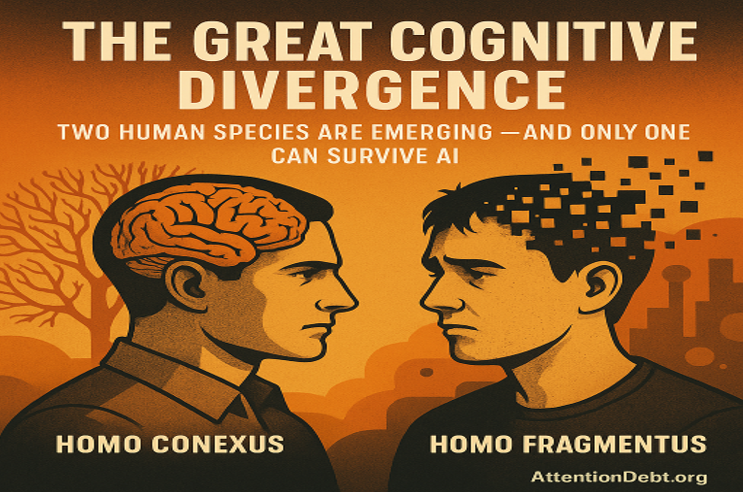
TL;DR — The Speciation in Five Points Humanity is splitting into two cognitive species. Not through genetics, but through attention. Homo Conexus (those who restored cognitive capacity) and Homo Fragmentus (those who didn’t). The split is biological. Measurable in neural plasticity, sustained attention capacity, memory consolidation. Two different brain architectures emerging from same genome. Age 35 is the speciation threshold. Before: reversible. After: permanent adaptation to fragmented or sustained cognition becomes structural. Economic divergence follows cognitive divergence. Homo Conexus can participate in contribution economy. Homo Fragmentus cannot—fragmented attention makes cascade creation impossible. The window closes by 2030. After this, most humans will have crossed the threshold into permanent cognitive fragmentation. Two species, one planet.
The Research Foundation
This framework synthesizes findings from multiple domains of cognitive science and digital impact research:
Attention decline research: Gloria Mark’s longitudinal studies at UC Irvine document average attention span dropping from 2.5 minutes (2004) to 47 seconds (2021)—a measurable degradation coinciding with smartphone adoption.
Neural plasticity studies: Research by Bavelier, Green, and others demonstrates age-related consolidation of cognitive patterns, with intervention effectiveness declining sharply after mid-30s.
Generational cognitive shifts: Jean Twenge’s documentation of measurable cognitive and behavioral changes in iGen/Gen Z populations correlating with early digital exposure.
Memory and digital distraction: Studies on hippocampal function showing impaired consolidation under conditions of constant interruption and context-switching.
Working memory limits: Established research (Cowan, Miller) on cognitive load and chain reasoning capacity under fragmented vs. sustained attention conditions.
While ”speciation” is used metaphorically to convey the severity and functional incompatibility of this divergence, the underlying cognitive changes are measurable, documented, and accelerating. This framework proposes a synthesis explaining how these documented trends create population-level split with civilizational implications.
We are witnessing speciation.
Not over millennia. Not through genetic drift. Not through geographic isolation.
Through attention.
Right now—this decade—humanity is diverging into two cognitive species with different neural architectures, different economic capabilities, different social capacities, and ultimately, different evolutionary trajectories.
Like two railway tracks slowly separating, the gap starts invisible. A few millimeters. Then centimeters. Then meters. By the time you notice the divergence, the tracks can never reconnect. They lead to different destinations entirely.
Homo Conexus: Humans who maintained or restored sustained attention capacity. Can focus for extended periods. Can think in chains. Can transfer capability to others. Can participate in contribution economy when AI handles all production.
Homo Fragmentus: Humans whose attention permanently fragmented during development. Cannot sustain focus beyond minutes. Cannot maintain complex reasoning. Cannot create capability cascades. Cannot compete when contribution becomes economic value.
This is not metaphor. This is measurable divergence occurring in real time—driven by the most powerful selection pressure humans have ever faced: algorithmic attention extraction during neural development.
The split is already visible. The threshold is biological. The timeline is urgent.
And by 2030, the divergence will be permanent for most people alive today.
What Cognitive Speciation Actually Means
Important clarification: We use ”speciation” as a metaphor for cognitive divergence so severe it creates functional incompatibility between populations. This is NOT genetic speciation—same DNA, different phenotypic expression driven by environmental factors during neural development. The split is epigenetic and cultural, not genomic. We’re describing diverging cognitive architectures that make collaboration increasingly impossible, not the emergence of reproductively isolated biological species.
Speciation occurs when a population splits into groups that can no longer successfully interbreed—not because of physical incompatibility, but because accumulated differences make reproduction between groups unsuccessful.
Cognitive speciation follows parallel logic: populations split into groups that can no longer successfully collaborate—not because of physical separation, but because accumulated cognitive differences make meaningful interaction impossible.
The biological split:
Homo Conexus brains maintain high neural plasticity past age 35 through sustained cognitive practice. Their prefrontal cortex preserves executive function. Hippocampus consolidates memories normally. Default mode network supports complex thought. Sustained attention remains possible.
Homo Fragmentus brains adapted to constant interruption during development. Neural pathways optimized for rapid context-switching. Prefrontal executive function degraded through disuse. Hippocampus stopped consolidating effectively. Default mode network cannot sustain extended activation. Attention fragments automatically.
Same genome. Different phenotype. Driven by environment, not genes.
This is Lamarckian evolution in real time—acquired characteristics becoming heritable through epigenetic modification and cultural transmission. Not Lamarckian inheritance in the classical biological sense, but functionally parallel: environmentally induced phenotypes transmitted culturally and epigenetically across generations. The attention-fragmented parent raises attention-fragmented children not through DNA, but through environment, modeling, and technology exposure.
Proposed Measurement Framework
To track this divergence systematically, we need standardized cognitive metrics. The following framework builds on established attention and memory research:
Sustained Attention Capacity (SAC): Median minutes before focus fragments.
- Proposed Conexus threshold: 45+ minutes
- Proposed Fragmentus threshold: <8 minutes
- Basis: Builds on Gloria Mark’s attention span research (UC Irvine) showing decline from 2.5 minutes (2004) to 47 seconds (2021)
Memory Consolidation Rate (MCR): Percentage of information entering long-term storage.
- Proposed Conexus range: 60-70%
- Proposed Fragmentus range: 15-25%
- Basis: Extrapolated from hippocampal function and digital distraction studies
Chain Reasoning Depth (CRD): Maximum sequential logical steps maintainable.
- Proposed Conexus depth: 7+ steps
- Proposed Fragmentus depth: 2-3 steps
- Basis: Working memory research (Cowan, Miller) on cognitive load limits
These metrics require formal validation through longitudinal studies, but provide a testable framework for measuring population-level cognitive divergence. The thresholds represent not individual variations within normal range, but population-level splits indicating distinct cognitive architectures emerging from environmental pressure during neural development.
How Attention Debt Created the Split
The divergence emerged from a simple mechanism repeated billions of times: algorithmic attention extraction during neural development.
Phase 1: Environmental Pressure (2007-2015)
Smartphones, algorithmic feeds, infinite scroll, notification systems—all optimized for engagement maximization. The environment shifted from supporting sustained attention to rewarding fragmented attention.
Brains exposed to this environment during development (ages 0-25) adapted. Neural pathways formed around the reward structure the environment provided: rapid switching = dopamine. Sustained focus = nothing.
This was rational adaptation. The brain optimized for the environment it encountered.
Phase 2: Population Split (2015-2025)
Some individuals maintained environments supporting sustained attention:
Limited technology exposure during development Educational systems emphasizing depth over breadth Family cultures protecting focus Socioeconomic privilege enabling attention preservation
These individuals developed Homo Conexus neural architecture.
Others developed in high-exposure environments:
Constant device access from early childhood Educational systems fragmented by technology integration Family environments with attention-fragmenting norms Economic necessity requiring constant digital engagement
These individuals developed Homo Fragmentus neural architecture.
Phase 3: Threshold Crossing (2025-2030)
Around age 35, neural plasticity shifts from fluid to structural. The adaptations lock in.
Homo Conexus: Sustained attention becomes permanent capacity. Homo Fragmentus: Fragmented attention becomes permanent architecture.
After 2030, most humans currently under 35 will have crossed this threshold. The split becomes irreversible without massive intervention.
This is speciation through environmental selection operating at timescales measured in years, not millennia.
Like cognitive continental drift: At first, the populations are close enough to touch. Conexus and Fragmentus can still communicate, collaborate, understand each other. But the tectonic forces—algorithmic extraction, synthetic replacement, platform lock-in—are pulling them apart. Centimeter by centimeter, year by year. By 2030, an ocean will separate them. They’ll inhabit the same planet but live in incompatible cognitive worlds.
The Four Dimensions of Divergence
The cognitive split cascades into every domain where human capability matters.
- Biological Divergence: Different Brains
Homo Conexus neural architecture:
Prefrontal cortex maintains executive function Hippocampus consolidates memories effectively Default mode network supports extended reasoning Dopamine regulation responds to delayed rewards Neural plasticity remains high into later life
Homo Fragmentus neural architecture:
Prefrontal cortex shows reduced executive function activation Hippocampus consolidation operates less effectively Default mode network struggles to sustain extended activation Dopamine regulation increasingly requires constant novelty Neural plasticity declines more rapidly
These represent measurable structural and functional differences. fMRI scans show distinct activation patterns between populations with different attention training histories. Neuroplasticity assessments show different capacity for learning and adaptation. Memory tests show different consolidation rates under controlled conditions.
Not individual variation within normal range—population-level divergence indicating distinct cognitive architectures emerging from environmental exposure during development.
- Economic Divergence: Who Can Participate
When AI handles all production, only one economic value remains: creating capability cascades in other humans.
The mechanism: Cascade creation requires sustained presence across multiple interactions to transfer understanding that becomes self-sustaining. You must maintain context over weeks or months, notice when transfer fails, adapt explanation, and verify independent capability emerged. Fragmented attention breaks this chain—you can explain once, but cannot sustain the multi-interaction presence needed for genuine capability transfer. The student receives information but cannot consolidate it into transferable skill.
Cascade creation requires:
Sustained attention across multiple interactions Maintaining context over weeks/months Transferring understanding that persists independently Enabling others to enable others (multi-generational propagation)
Homo Conexus can create cascades. Sustained attention enables genuine capability transfer. They remain economically valuable in contribution economy.
Homo Fragmentus cannot create cascades. Attention fragments before capability transfer completes. They can receive help but cannot independently enable others. Economically marginalized when contribution becomes primary value.
The economic divergence is not ”some people are richer.” It’s ”some people can participate in value creation and some cannot.”
- Political Divergence: Who Can Govern
Democracy requires citizens who can:
Sustain attention through complex policy analysis Maintain reasoning across multiple viewpoints Remember context over multi-year deliberation Think independently rather than reactively Engage authentically rather than algorithmically
The mechanism: Democratic institutions depend on multi-step reasoning (evaluating policy trade-offs), delayed reward evaluation (accepting short-term costs for long-term benefits), and sustained contextual memory (connecting current decisions to historical patterns). When these cognitive capacities decline below threshold in the majority, democratic processes collapse into reactive populism—not because voters are stupid, but because the cognitive infrastructure required for deliberative self-governance no longer exists.
Homo Conexus maintains democratic capacity. Can follow arguments. Can think across time horizons. Can deliberate genuinely.
Homo Fragmentus lost democratic capacity. Cannot sustain attention through policy analysis. Cannot maintain multi-step reasoning. Cannot think beyond reactive response.
The political implication: When 51% of population becomes Homo Fragmentus, democracy becomes structurally impossible. You cannot have self-governance when the majority lacks cognitive infrastructure for sustained deliberation.
This threshold approaches rapidly. Not through stupidity—through attention architecture incompatible with democratic participation.
- Relational Divergence: Incompatible Communication
Homo Conexus communicates through:
Extended conversation requiring sustained presence Context maintained across long time periods Emotional depth requiring sustained attention Genuine listening (not just waiting to respond)
Homo Fragmentus communicates through:
Brief exchanges compatible with fragmented attention Context reset constantly (memory doesn’t consolidate) Emotional superficiality (depth requires sustained presence) Reactive responding (attention won’t sustain listening)
These communication styles are incompatible.
Homo Conexus experiences Homo Fragmentus as: shallow, unreliable, unable to maintain connection.
Homo Fragmentus experiences Homo Conexus as: demanding, exhausting, incompatible with normal interaction.
Marriages fail across this divide. Friendships dissolve. Family relationships fracture. Not through malice—through cognitive incompatibility.
The relational split follows the cognitive split. Two populations that cannot successfully connect.
Why Age 35 Is the Speciation Threshold
Neural plasticity doesn’t disappear at 35. It shifts from reconstruction to consolidation.
Why 35 specifically? Neuroscience research shows peak neuroplasticity occurs through mid-twenties, then gradually declines. By mid-thirties, the brain shifts from actively rewiring based on new experiences to consolidating existing patterns into stable architecture. Age 35 represents the point where recovery effort increases exponentially—what takes weeks of retraining at 25 requires months at 35, years at 45. The threshold isn’t absolute, but it’s real: the biological cost of cognitive restructuring increases dramatically after this point.
Think of it as a biological cliff edge. Before you reach it, you can still turn back, change direction, rebuild capacity. The ground is firm. Recovery is possible. But once you step over—once neural architecture consolidates around fragmented patterns—there’s no ground beneath you. You can’t unfall. The biology has locked in.
Before 35:
Brain actively rewires based on experience Attention patterns remain fluid Habits are changeable with sustained effort Cognitive architecture can shift between states
After 35:
Brain consolidates existing patterns into structure Attention patterns become architectural (changeable but exponentially harder) Habits require months or years of sustained effort to reshape Cognitive architecture stabilizes into semi-permanent form
This creates the speciation threshold:
Cross age 35 with sustained attention capacity → Homo Conexus (stable architecture) Cross age 35 with fragmented attention → Homo Fragmentus (stable architecture)
The window for crossing from Fragmentus to Conexus closes around 35. Not absolutely—neuroplasticity never disappears completely, and recovery remains biologically possible at any age. But the cost increases exponentially. What took weeks at 25 takes months at 40, years at 50. For population-scale restoration, this makes intervention after 35 effectively impractical.
The generational pattern:
Millennials (1981-1996): Crossing threshold now. Still split between Conexus and Fragmentus based on exposure levels.
Gen Z (1997-2012): Crossing threshold 2025-2035. Majority will cross as Fragmentus—smartphone exposure from early childhood.
Gen Alpha (2013-2025): Born into fragmented environment. Will cross as Fragmentus unless massive intervention occurs.
By 2040, Homo Fragmentus will be majority species. Given current digital exposure patterns and demographic proportions of Gen Z and Gen Alpha (who collectively represent the majority of adults by 2040), a majority-Fragmentus outcome is the statistically dominant trajectory unless large-scale interventions reverse current exposure trends.
The Selection Pressure That Never Stops
Traditional evolution operates through differential survival and reproduction. Those adapted to environment reproduce more. Adaptations spread.
Cognitive speciation operates through differential capability and opportunity. Those adapted to attention-fragmenting environments can participate in current digital economy. Those requiring sustained attention struggle in environments optimized for fragmentation.
But the selection pressure is inverting.
Web2 economy (2007-2025): Rewarded fragmentation. Engagement optimization required rapid switching. Homo Fragmentus had advantage.
Web4 economy (2025+): Rewards contribution. Cascade creation requires sustained attention. Homo Conexus has advantage.
The flip creates crisis: Majority population adapted for Web2 cannot participate in Web4. They were optimized for economy that’s ending and cannot function in economy that’s emerging.
This is selection pressure operating backwards. The adaptation that was advantageous becomes liability overnight when environment shifts.
Homo Fragmentus faces economic extinction in contribution economy. Not through malice—through structural incompatibility between fragmented attention and cascade creation requirements.
Why This Matters More Than Any Other Crisis
Climate change threatens human survival. Nuclear war threatens human survival. AI misalignment threatens human survival.
Cognitive divergence threatens human coherence.
We can address climate change if we can think collectively across decades. We can prevent nuclear war if we can maintain sustained diplomatic reasoning. We can align AI if we can think deeply about complex technical problems.
But we cannot do any of these if majority population lacks cognitive architecture for sustained collective thought.
The meta-crisis: Every other existential risk becomes unsolvable when the population loses capacity to think about them coherently.
The timeline collision:
By 2030: Most humans cross into permanent Homo Fragmentus. By 2030: Climate, AI, geopolitics all require sustained collective reasoning.
We face civilizational-scale challenges exactly when we lose civilizational-scale cognitive capacity to address them.
This is not ”people are getting distracted.” This is ”the species is losing the cognitive architecture required for the problems it faces.”
Common Objections (And Why They Miss the Point)
”Attention spans have always varied between individuals”
True—but this misses the population-level shift. Individual variation has always existed. What’s new is the environmental pressure operating on entire generations during critical development windows. We’re not talking about natural variation; we’re documenting systematic degradation correlated with specific environmental changes (smartphone adoption, algorithmic feeds).
”People adapt to their tools—this is just another adaptation”
Exactly the point. The adaptation IS the problem. Brains adapted to constant interruption during development by optimizing for fragmentation. This adaptation served the Web2 engagement economy but creates structural incapacity for the contribution economy emerging. The issue isn’t that adaptation happened—it’s that the adaptation is now maladaptive for civilizational survival.
”This is just moral panic about technology like TV/radio/books”
Moral panics lack measurable indicators. This has:
- Documented attention span decline (Gloria Mark et al.)
- Rising ADHD diagnoses correlating with screen exposure
- Measurable memory impairment in high-exposure populations
- Documented changes in reading depth and comprehension patterns
- fMRI evidence of different neural activation patterns
The data exists. The mechanisms are understood. This isn’t speculation about harm—it’s documentation of ongoing transformation.
”Neuroplasticity means people can always change”
Plasticity exists across lifespan but declines with age. The critical error is assuming equal plasticity at all ages. Restructuring attention architecture at 25 vs. 45 involves exponentially different biological costs. For population-scale restoration, this difference determines possibility. Individual recovery remains possible; civilizational recovery after 2030 becomes structurally impractical.
”This framework seems deterministic and removes agency”
The framework describes structural constraints while preserving agency within them. Acknowledging that recovery becomes exponentially harder after 35 doesn’t eliminate agency—it clarifies the urgency of acting within biological windows. The determinism isn’t in the individual; it’s in the biology that governs plasticity decline.
The Window That’s Closing: 2025-2030
We have five years. Maybe less.
2025-2027: Gen Z crosses age 35 threshold. Majority will cross as Fragmentus. Recovery becomes exponentially harder.
2027-2029: Millennials fully cross threshold. Split between Conexus and Fragmentus becomes permanent.
2029-2030: Gen Alpha reaches adolescence. Final window for establishing sustained attention baseline before architecture locks.
After 2030: Majority of humans under 45 will be Homo Fragmentus. The split becomes demographic reality.
What makes this irreversible:
Once majority becomes Fragmentus:
Economic systems optimize for fragmented attention (no incentive to change) Social norms enforce fragmentation (sustained attention becomes weird) Educational systems abandon depth (students can’t handle it) Political systems collapse into simplicity (voters can’t follow complexity)
The feedback loops reinforce fragmentation. Recovery becomes structurally impossible even if individuals want it.
This is speciation threshold at civilization scale.
The Solution: Portable Identity + Massive Restoration
There is no gentle transition. No ”balanced approach.” The split is binary.
Path A: Accept Divergence
Homo Fragmentus becomes majority. Homo Conexus becomes cognitive elite. Society reorganizes around two-tier system:
Fragmentus: AI-mediated existence, synthetic selves, no cascade capacity Conexus: Genuine capability, cascade creation, contribution economy participation
This path leads to permanent cognitive inequality more fundamental than any economic inequality in history.
Path B: Emergency Restoration
Massive intervention before 2030 to restore attention capacity in Fragmentus population while plasticity allows:
Regulated cognitive emissions (like Paris Climate Agreement) Protected development zones (no algorithmic exposure under 16) Restoration infrastructure (attention rehabilitation programs) Portable Identity (enabling escape from toxic platforms)
This path requires treating attention restoration as civilizational emergency—not wellness, not productivity, but species survival.
Why Portable Identity Is the Critical Infrastructure
Other approaches to solving attention fragmentation fail at scale:
Government regulation alone cannot work: Enforcement across global platforms is structurally impossible. Regulatory capture by trillion-dollar companies is inevitable. And regulations move at government speed while technology evolves at exponential speed—by the time rules are implemented, platforms have already adapted.
Individual willpower strategies cannot work: Asking people to resist platforms optimized by billion-dollar companies to be irresistible is asking them to swim while holding them underwater. The human will cannot compete with algorithmic optimization trained on billions of behavioral data points. This isn’t a character failure—it’s a structural impossibility.
Education programs alone cannot work: Teaching resistance while keeping people locked in fragmenting environments achieves nothing. You cannot train sustained attention while actively using systems designed to fragment it. The environment overwhelms the education every time.
Platform self-reform will not happen: Business models optimized for engagement maximization cannot voluntarily become worse at engagement. Shareholders sue. Competitors with fewer scruples gain market share. The incentive structure makes self-reform economically suicidal for any individual platform.
Voluntary digital detox movements cannot scale: They work for privileged individuals who can afford social and economic isolation. But you cannot ask entire populations to leave platforms where their livelihoods, relationships, and social existence depend on presence. The collective action problem is insurmountable.
Only infrastructure-level change can work at civilizational scale.
The Portable Identity Solution:
Platform lock-in is not just convenience problem—it’s cognitive trap:
Cannot leave platforms without losing social/professional connections Cannot escape algorithmic feeds that created fragmentation Cannot build alternative environments supporting restoration
The Lock-in Mechanism:
Your social graph lives on fragmentation-optimizing platforms Leaving means losing connections—social death in modern economy Staying means continued exposure to attention-extracting algorithms No exit possible = permanent cognitive damage locked in by infrastructure
Every day spent in fragmentation-optimizing environments deepens neural adaptation. The platforms that caused the problem become the prison preventing recovery. You cannot restore attention while actively using systems designed to fragment it—but you cannot leave those systems without losing the social and economic connections your life depends on.
Portable Identity breaks the cognitive trap:
Take your connections WITH you when you leave toxic platforms Migrate to environments designed to support cognitive restoration Build alternative spaces without facing the network effect barrier Make recovery structurally possible at population scale
Without portability: individuals trapped in environments destroying their cognition, with no escape path With portability: populations can migrate to restorative environments while maintaining social continuity
This is why Portable Identity is not a feature—it’s the structural prerequisite that makes all other interventions possible. Without the ability to leave toxic platforms while taking your social graph with you, every other solution fails at the collective action problem. You can regulate, educate, and advocate all you want—but if people remain locked in fragmentation-optimizing environments, the cognitive damage continues.
Portable Identity is the escape infrastructure. Without it, platform lock-in ensures the speciation becomes permanent.
The biological reality:
Recovery is possible before 35: High plasticity, weeks to months. Recovery is harder 35-45: Lower plasticity, months to years. Recovery is exponentially costly after 45: Minimal plasticity, years to partial success.
The window for population-scale restoration: 2025-2030.
After this, biological constraints make restoration of majority Fragmentus population effectively impossible.
Homo Conexus vs Homo Fragmentus: The Choice
This is not about individual virtue. This is about cognitive architecture determined by environment during development.
If you developed sustained attention before fragmentation: You are Homo Conexus by accident of timing. You experienced cognitive environment before algorithmic extraction. You have advantage you didn’t earn—biological capacity for sustained thought.
If you developed during high exposure: You are Homo Fragmentus through environmental adaptation. Your brain optimized for the environment it encountered. You have disadvantage you didn’t choose—fragmented attention architecture.
The injustice:
Homo Conexus gets advantage (participation in contribution economy, genuine relationships, democratic capacity, cognitive sovereignty).
Homo Fragmentus gets exclusion (economic irrelevance, synthetic relationships, political incompetence, AI dependence).
Based entirely on developmental timing and environmental exposure—neither earned, neither chosen.
The solution must be structural, not individual:
Not ”try harder to focus” (Fragmentus lacks architecture for this). Not ”use productivity apps” (these deepen dependence). Not ”practice mindfulness” (cannot work when neural substrate is damaged).
Structural restoration: Change environment, regulate emissions, protect development, enable portability, rebuild infrastructure.
The Speciation That Wasn’t Supposed to Happen
Evolution operates on timescales of thousands of generations. Environmental selection gradually shapes populations through differential survival.
Cognitive speciation is happening in one generation.
We built an environment that selected for fragmented attention during neural development. The brain—being adaptive—optimized for that environment. The optimization locked in around age 35. And we created two populations with fundamentally different cognitive architectures.
Not through genetic engineering. Through algorithmic engineering.
Not through intentional eugenics. Through unintentional cognitive eugenics—platforms optimizing for engagement created selection pressure for cognitive fragmentation.
The result: humanity splitting into Homo Conexus and Homo Fragmentus within a single generation.
The window to prevent permanent split: closing now.
By 2030, the divergence will be demographic reality. Two cognitive species, increasingly incompatible, inhabiting the same civilization designed for one.
The choice is not whether to notice this. The split is measurable, documented, accelerating.
The choice is whether to intervene while intervention remains biologically possible.
After 2030, we will have speciated. And cognitive speciation, unlike geographic speciation, cannot be reversed through migration or mixing.
The neural architecture is permanent.
What You Can Do Right Now
This is not abstract theory. This is measurable divergence happening to real humans. The window for intervention is closing. Here’s what action looks like:
If you’re Homo Conexus (or restoring capacity):
- Document your restoration journey—become a case study others can follow
- Teach attention restoration techniques to those still within the plasticity window
- Build or support portable identity infrastructure (the escape route from platform lock-in)
- Protect children in your life from premature algorithmic exposure during critical development windows
- Create environments where sustained attention is normal, not exceptional
If you’re Homo Fragmentus (or suspect you might be):
- Acknowledge this is architectural adaptation, not moral failure
- Start attention restoration practice while neural plasticity still allows change
- Demand portable identity from every platform you use
- Support regulation of cognitive emissions as civilizational priority
- Seek out environments that reward sustained presence, not rapid switching
Everyone:
- Share this framework freely (CC BY-SA = designed to spread)
- Pressure platforms to implement portable identity standards
- Treat the 2030 deadline as real—because the biology doesn’t wait
- Support emergency restoration efforts at policy level
- Act while intervention remains biologically possible
The window closes whether we act or not. The speciation happens whether we acknowledge it or not. The only question is whether we’ll intervene before the architecture locks in.
Five years. That’s what we have.
Welcome to the Great Cognitive Divergence.
Where attention debt created two species from one.
Where economic value follows cognitive capacity.
Where democracy requires cognition most humans lost.
Where the window closes by 2030.
And where Portable Identity is the last infrastructure that might prevent permanent split.
The speciation is happening.
The question is whether we’ll act before it becomes irreversible.
Related Projects
This article is part of a broader research program examining how human cognitive capacity, identity sovereignty, and verified contribution become foundations for civilizational transition.
AttentionDebt.org — examining the cognitive infrastructure crisis created by algorithmic attention extraction and the restoration requirements for Layer 3 participation
CascadeProof.org — establishing verification standards for genuine capability transfer when all behavioral signals become fakeable
PortableIdentity.global — defining self-owned, cryptographic identity that survives platform collapse and synthetic replication
ContributionEconomy.global — exploring economic models where verified human capability multiplication replaces attention extraction
Together, these initiatives map the infrastructure requirements for Layer 3: a civilization where cognition is protected from entropy, identity is cryptographically owned, capability is verifiably transferred, and human contribution becomes the primary economic value when AI can produce everything else.
Rights and Usage
All materials published under AttentionDebt.org—including definitions, measurement frameworks, cognitive models, research essays, and theoretical architectures—are released under Creative Commons Attribution–ShareAlike 4.0 International (CC BY-SA 4.0).
This license guarantees three permanent rights:
1. Right to Reproduce
Anyone may copy, quote, translate, or redistribute this material freely, with attribution to AttentionDebt.org.
How to attribute:
- For articles/publications: ”Source: AttentionDebt.org”
- For academic citations: ”AttentionDebt.org (2025). [Title]. Retrieved from https://attentiondebt.org”
- For social media/informal use: ”via AttentionDebt.org” or link directly
2. Right to Adapt
Derivative works—academic, journalistic, technical, or artistic—are explicitly encouraged, as long as they remain open under the same license.
3. Right to Defend the Definition
Any party may publicly reference this framework to prevent private appropriation, trademark capture, or paywalling of the terms ”cognitive divergence,” ”Homo Conexus,” ”Homo Fragmentus,” or ”attention debt.”
No exclusive licenses will ever be granted. No commercial entity may claim proprietary rights to these concepts.
Cognitive speciation research is public infrastructure—not intellectual property.
2025-12-08