The silent collapse nobody warned you about
Sarah sits across from her therapist, struggling to answer a simple question: ”Tell me about yourself.”
Not because she lacks intelligence. Not because she’s being evasive. Because she genuinely cannot assemble a coherent answer. The person she describes Monday bears no relationship to the person she describes Thursday. When asked what changed, she says: ”Nothing specific. I just… don’t feel like myself anymore.”
The therapist suggests depression screening. Results negative. Anxiety assessment. Within normal range. Personality inventory. Results too contradictory to classify reliably.
Sarah isn’t sick. She’s experiencing something that doesn’t yet have a clinical name: Temporal Fragmentation Syndrome—the lived experience of attention fragmenting faster than identity can consolidate.
This is not a medical diagnosis. It’s a descriptive term researchers are beginning to use to name a pattern that standard diagnostic frameworks don’t yet capture: the phenomenological experience of self-discontinuity arising from environmental conditions preventing temporal integration.
This isn’t rare. This is becoming normal.
The feeling appears everywhere: online forums, therapy intake forms, casual conversations. People describing the same experience using nearly identical language:
”I don’t feel like myself anymore.”
”I don’t know who I am.”
”Nothing feels real.”
”I’m here but not here.”
Not metaphor. Structural description of what happens when the architecture required for self-continuity dissolves.
What ”Yourself” Actually Requires
Before explaining what broke, here’s what ”feeling like yourself” always required without anyone realizing:
Temporal continuity.
The self isn’t a stored attribute, like height or eye color. It’s a runtime process—something that instantiates moment to moment when conditions permit. Like consciousness during wakefulness or attention during focus.
The self requires three components running simultaneously:
1. Pattern Recognition Across Time
Your brain must detect: ”This behavior pattern is consistent. This thought pattern recurs. This preference persists.” Pattern recognition requires observing yourself across sufficient intervals to extract signal from noise. Minimum observation window: approximately 10-15 minutes of uninterrupted self-reflection.
2. Memory Continuity
You must remember who you were yesterday to experience yourself as the same entity today. Memory continuity creates the narrative thread connecting past-self to present-self to anticipated-future-self. This requires successful memory consolidation—experiences encoding into retrievable long-term storage.
3. Closure Completion
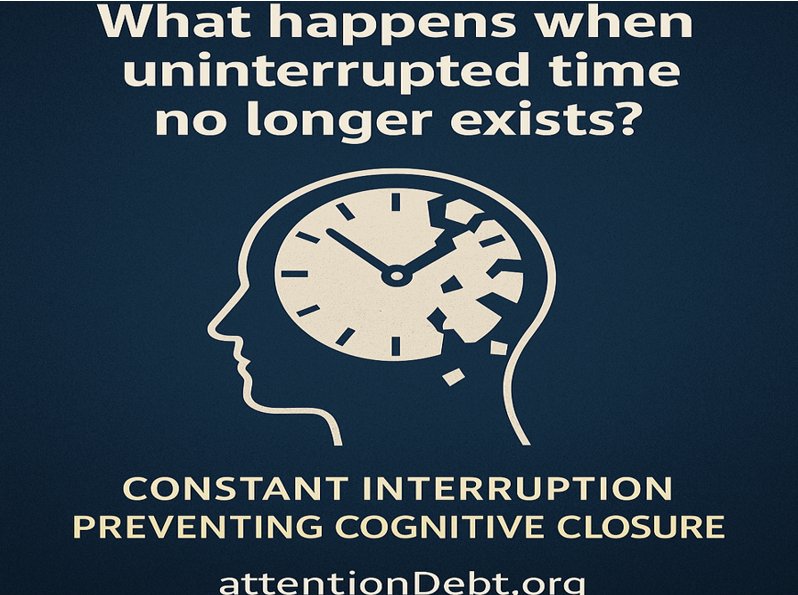
Psychological closure—the cognitive process of completing interrupted tasks, resolving unfinished thoughts, integrating fragmented experiences into coherent narrative. Closure requires uninterrupted processing time. Without closure, experiences accumulate as cognitive debt rather than integrated memory.
When all three operate successfully, you experience self-instantiation: the feeling of being a coherent, continuous person rather than collection of disconnected moments.
This is what ”feeling like yourself” actually was.
But these three mechanisms share a critical requirement: uninterrupted time.
When attention fragments faster than these processes can complete, self-instantiation becomes structurally impossible.
The Self-Instantiation Threshold
Here’s the discovery that changes everything:
There exists a critical frequency of interruption below which the self cannot instantiate.
Not ”weakens.” Not ”becomes less stable.” Cannot boot up.
Research on cognitive load and task-switching reveals that complex cognitive processes—including self-reflection, identity consolidation, and autobiographical memory formation—require minimum continuous attention spans to complete. When interruptions exceed a certain frequency, these processes fail to initialize.
The threshold appears to be approximately 8-12 minutes of uninterrupted attention for basic self-instantiation processes to complete one cycle.
Current observed reality: Average context switch frequency is 47 seconds. Some populations experience switches every 20-30 seconds during waking hours.
The mathematics are unforgiving:
- Self-instantiation cycle requirement: 8-12 minutes continuous
- Current available continuity: 30-47 seconds average
- Gap: 10x-24x below minimum threshold
This isn’t like running software slowly. This is like interrupting boot sequence every 3 seconds—the operating system never finishes loading. You get crash messages, not degraded performance.
When people say ”I don’t feel like myself,” they’re reporting accurately: the self-instantiation process never completes.
They experience the attempt to instantiate without ever achieving stable instantiation. Like trying to boot a computer that crashes during startup, reboots, crashes again—continuous boot-crash-reboot cycle creating the phenomenological experience of ”being here but not being me.”
This is The Self-Instantiation Threshold—the frequency boundary below which identity becomes structurally non-instantiable.
The Continuity Gap: Living But Not Integrating
Here’s what makes this particularly devastating:
You’re living 100% of your moments. You’re integrating less than 30%.
The Continuity Gap describes the measurable difference between:
- Lived experience (moments you are present for, consciously experiencing)
- Integrated identity (moments that successfully link to your continuous sense of self)
Traditional models assumed these were nearly identical: if you experienced something consciously, it integrated into your autobiographical memory and sense of self automatically.
That assumption broke.
Current patterns suggest:
- Conscious presence: ~95-100% (people are awake, aware, experiencing)
- Successful integration: ~25-35% (experiences connecting to stable self-narrative)
- Gap: 60-70% of lived experience never integrates
What happens to the 70%?
It exists as disconnected moments—experienced but never incorporated into the continuous self. You were there. You participated. But the experience floats unconnected, failing to contribute to the ”you” that persists across time.
This creates profound existential vertigo. You lived your life. But ”you” weren’t there in the sense of continuous identity experiencing it.
Example:
Sarah attends her best friend’s wedding. She’s present—dancing, laughing, talking to guests. But her attention fragments continuously: checking phone, responding to texts, photographing moments to post later, switching between conversations every 90 seconds.
One week later, asked to describe the wedding, she struggles. She has disconnected fragments—images, snippets, flashes—but no coherent narrative. She can’t recall the emotional through-line. She can’t remember what she was thinking. She was there, but ”Sarah” wasn’t there in the integrated sense.
The wedding happened to her body. It didn’t happen to her self.
Multiply across years: You live a life that doesn’t accumulate into a self.
The Continuity Gap explains why people report: ”I’m thirty-five but I feel like I’m still twenty-two.” Not because they’re immature. Because the intervening thirteen years of experience never integrated into continuous self-development. The experiences occurred. The integration didn’t.
Why ”Who Am I?” Became Unanswerable
One of therapy’s foundational questions: ”Who are you?”
Increasingly, this question produces not insight but blank confusion.
Not because people lack self-awareness. Because the question became structurally unanswerable.
Identity extraction—the cognitive process of observing yourself across contexts and synthesizing patterns into coherent self-concept—requires specific conditions:
Condition 1: Uninterrupted observation time (10-15 minutes minimum)
Condition 2: Access to integrated memories (requires successful prior consolidation)
Condition 3: Stable patterns to observe (requires behavioral consistency across observations)
When attention fragments:
- Condition 1 fails: No uninterrupted observation windows ever open
- Condition 2 fails: Memory consolidation incomplete, past self inaccessible
- Condition 3 fails: Behavior becomes context-reactive rather than trait-driven
The result: Identity extraction becomes computationally impossible.
You cannot answer ”who am I” when:
- You cannot observe yourself long enough to detect patterns
- You cannot remember yourself clearly enough to identify continuity
- You do not exhibit stable patterns across contexts to extract from
This isn’t lack of self-knowledge. This is structural impossibility of self-knowing when the substrate required for identity to exist dissolved.
Traditional therapy assumes: ”If you reflect deeply enough, you’ll discover who you are.”
Current reality: ”No amount of reflection succeeds when attention cannot sustain the reflection process long enough for patterns to emerge.”
The question ”who am I” requires a stable ”I” to interrogate. When self-instantiation fails, there is no stable object to examine. You’re asking ”what is the sound of one hand clapping”—not profound zen mystery but category error.
The Architecture of Authenticity Collapsed
Popular advice: ”Be yourself.” ”Be authentic.” ”Stay true to who you are.”
This advice assumed authenticity was available—that a stable self existed to be.
That assumption no longer holds.
Authenticity requires architectural prerequisites:
1. Temporal Stability
”Yourself” must persist across sufficient time for behavior to emerge from internal preferences rather than external stimuli. When self changes every 47 seconds based on current interruption, there’s no stable ”yourself” to be authentic to.
2. Memory Access
Being authentic to your values requires remembering what your values are. When memory consolidation fails, values stated Monday are inaccessible Thursday. You can state preferences, but they don’t persist as retrievable guides.
3. Pattern Coherence
Authenticity assumes your behavior reflects consistent internal patterns. When behavior becomes purely reactive—determined by immediate context rather than stable traits—there’s no internal coherence to express authentically.
When these three collapse, ”be yourself” transforms from actionable advice to structural impossibility.
You can’t be yourself when yourself doesn’t maintain sufficient stability to be.
This isn’t moral failure. This is architectural absence. The substrate authenticity requires doesn’t exist with sufficient continuity to enable authentic expression.
The tragedy: people interpret their inability to ”be themselves” as personal failing—lack of courage, lack of clarity, lack of commitment. They don’t recognize the infrastructure required for authenticity dissolved.
Why This Feels Different Than Depression
The therapeutic challenge: this phenomenological experience feels similar to depression while appearing categorically different in pattern.
Depression characteristics (typical patterns):
- Stable but negative self-concept
- Coherent narrative (dark but coherent)
- Future seems bleak but conceptually accessible
- Identity persists (even if depressed identity)
Temporal Fragmentation patterns (observed differences):
- Unstable, moment-to-moment self-concept
- No coherent narrative (fragmented across time)
- Future feels abstract, not bleak—conceptually inaccessible
- Identity feels absent, not negative
This is not to suggest temporal fragmentation is a distinct diagnosis or that it replaces depression diagnosis. Rather, it describes a pattern some people report experiencing—where traditional interventions targeting affect may not address the architectural discontinuity they’re experiencing.
This pattern distinction may help explain why some people report that antidepressants feel ”right but ineffective” for this specific experience. The medication may help mood regulation—but mood improvement alone may not restore temporal continuity if that’s the primary issue. This is not medical advice about medication—it’s an observation about why different interventions may address different aspects of experience.
Same with traditional therapy: insight-oriented approaches assume stable self capable of insight about itself. When self isn’t stable enough for meta-observation, insight becomes impossible not from resistance but from substrate absence.
The Recognition Lag: Why Nobody Noticed Until Now
Here’s another devastating insight:
Most people don’t realize they stopped feeling like themselves until 2-3 years after it happened.
Not because they’re unobservant. Because the discontinuity itself prevents the continuous observation required to notice discontinuity.
This is The Recognition Lag—the delay between self-instantiation failure beginning and conscious recognition of the failure occurring.
The mechanism: Recognizing ”I don’t feel like myself anymore” requires:
- Remembering who you felt like before
- Comparing that remembered self to current experience
- Detecting the difference across sufficient time to identify pattern
But if memory consolidation failed during the period when self-instantiation collapsed, you cannot remember who you were clearly enough to recognize the difference.
You lost continuity. Then you lost the memory of having had continuity.
This creates temporal blindness—inability to see the pattern because the pattern destroyed the cognitive mechanism required to observe patterns.
Example:
2021: Sarah feels like herself. Coherent identity, stable preferences, clear self-concept.
2021-2023: Fragmentation increases gradually. Self-instantiation begins failing. But because each day feels ”normal enough” relative to the day before, and memory consolidation is already weakening, she doesn’t notice the cumulative change.
2024: Sarah suddenly realizes: ”I don’t feel like myself anymore.” But she cannot pinpoint when it started. The intervening period exists as blur because the months where change occurred weren’t encoded clearly enough to remember the transition.
The Recognition Lag explains why this phenomenon seemed to appear suddenly despite developing gradually: the recognition system itself was compromised during the development period.
By the time people consciously recognize the problem, they’ve typically been experiencing it for years. This isn’t denial. This is structural inability to observe yourself changing when the observation mechanism itself is degrading.
This is why ”just be more mindful” fails: mindfulness requires the sustained attention that self-instantiation failure already destroyed. You’re being told to use the tool that broke to notice the tool is broken.
The Platform Pattern Nobody Discussed
Here’s what major platforms discovered through internal research but rarely discussed publicly:
Engagement optimization through interruption proved more effective than engagement optimization through reward.
Standard narrative: platforms use ”dopamine hits” to create addictive behavior. Notification as reward. Like as validation. Intermittent reinforcement schedule maximizing compulsion.
This is partially true but misses the deeper mechanism.
The interruption effect proved stronger than the reward effect.
Why: Dopamine-driven engagement requires the user to want to return. Interruption-driven engagement doesn’t require desire—it prevents cognitive closure, creating open loops that pull attention back regardless of desire.
When a task remains unclosed—email half-read, message unanswered, notification unresolved—the brain experiences it as active threat requiring resolution. Zeigarnik effect: incomplete tasks dominate attention more than completed tasks.
Platforms optimized not for ”making you want to come back” but for ”preventing you from ever leaving mentally.”
The distinction is crucial:
Addiction model: User consciously desires platform → pulls themselves back → experiences guilt
Interruption model: User never fully leaves → cognitive presence persists → no discrete ”return” to feel guilty about
This is why ”phone addiction” framings often feel inaccurate to users. They’re not pulled back by craving. They never left in the first place. Their attention is fractured across dozens of open loops, none closing, all pulling simultaneously.
The cognitive load isn’t from being on platforms. It’s from never being fully off them.
The self-instantiation failure isn’t from choosing platforms over reflection. It’s from platforms preventing the uninterrupted time self-instantiation requires by ensuring dozens of open cognitive loops always remain.
This wasn’t accidental. Across the industry, product teams independently converged on the same discovery: interruption-based engagement loops often outperform reward-based systems because they prevent cognitive closure rather than relying on desire
The architecture of authenticity didn’t fail from moral weakness. It failed from environmental design optimizing against the conditions authenticity requires.
The Measurement Problem Making Everything Invisible
Here’s why this crisis went unrecognized for so long:
Temporal fragmentation is invisible to standard measurement.
Medical assessments, psychological evaluations, even neuroscience research typically measure:
- Symptoms at discrete timepoints
- Affect during assessment sessions
- Performance on specific tasks
- Responses to standardized questions
None of these capture temporal discontinuity because the measurements themselves are time-bounded instances—snapshots that miss the pattern only visible across continuous observation.
It’s like trying to measure wave patterns by photographing the ocean at one instant. The photograph is accurate but misses the phenomenon you’re trying to observe.
Traditional diagnostic frameworks assume:
- Self remains stable between assessments
- Reported symptoms reflect stable patterns
- Test performance indicates underlying capacity
When self doesn’t remain stable between assessments, when symptoms vary dramatically based on momentary context, when performance fluctuates wildly based on attention state during testing—standard measurements generate noise that looks like data.
Clinicians see: ”Inconsistent symptom reporting, variable test performance, contradictory self-descriptions.”
Standard interpretation: ”Patient lacks insight” or ”symptoms are functional/psychosomatic.”
Actual reality: Measurements capture different momentary states of non-continuous self, producing valid snapshots of discontinuous phenomenon that appear as invalid data when continuity is assumed.
This is The Measurement Problem: the tools designed to detect psychological distress cannot detect architectural discontinuity because they assume the architecture they’re measuring maintains minimal stability.
Identity in the Age of Portability
Here’s where this connects to larger infrastructure challenges:
When self-instantiation fails, identity portability becomes meaningless.
Portable identity systems (PortableIdentity.global) aim to enable people to carry reputation, social capital, and verified identity across platforms—freeing them from platform lock-in that traps them in environments optimizing against their cognitive wellbeing.
But identity portability assumes there exists a stable identity to port.
When temporal fragmentation prevents self-instantiation, what exactly gets ported? The person Monday? The person Thursday? The momentary configuration active at moment of identity verification?
This isn’t theoretical limitation. This is practical impossibility: portable identity infrastructure requires temporal continuity to function. You cannot cryptographically verify identity that doesn’t persist between verification moments.
The same applies to capability verification (CascadeProof.org): when self-instantiation fails, capability becomes unverifiable not because capability doesn’t exist but because the continuous self required to demonstrate capability across time doesn’t maintain stability.
Imagine verifying someone transferred genuine capability when the ”someone” doing the transferring doesn’t persist as coherent entity between teaching and assessment. The capability might exist. But without continuous self to embody it, verification becomes structurally ambiguous.
This reveals the infrastructure dependency:
Temporal continuity → Self-instantiation → Identity portability → Capability verification
Each layer requires the layer before it. When temporal continuity collapses, the entire stack becomes non-functional.
Restoring identity portability and capability verification thus requires first restoring the temporal conditions enabling self-instantiation.
You cannot fix platform lock-in without first addressing the cognitive fragmentation that makes identity incoherent. The solution isn’t better identity protocols. It’s environmental infrastructure enabling the continuous attention identity requires to instantiate in the first place.
What Comes After Recognition
This isn’t permanent. This is architectural state change responsive to environmental conditions.
The self-instantiation threshold exists. But crossing below it isn’t irreversible—it’s state-dependent. When environmental conditions provide sufficient uninterrupted time, self-instantiation resumes.
Evidence:
Temporary restoration: People entering low-interruption environments (wilderness retreats, meditation centers, extended solitude) consistently report: ”I feel like myself again.” Not ”I discovered a new self”—the old self re-instantiated when conditions permitted.
Context-dependent emergence: People demonstrate stable self in specific contexts (with particular friends, during certain activities, in flow states) while showing complete discontinuity elsewhere. The capacity exists. The instantiation requires specific conditions.
Historical comparison: Pre-digital generations report feeling like themselves, losing that feeling during high-interruption periods, regaining it when interruptions reduce. Same neurobiology. Different environmental conditions.
This means restoration doesn’t require creating new selves. It requires providing conditions enabling dormant selves to reactivate.
The intervention isn’t psychological reconstruction. It’s environmental architecture change enabling temporal continuity.
Three conditions enable self-instantiation restoration:
1. Uninterrupted Time Windows
Protect intervals of 15-30 minutes multiple times daily where attention completes full cycles without interruption. Not ”more time”—uninterrupted time. Ten fragmented hours don’t substitute for thirty continuous minutes.
2. Closure Opportunities
Environmental structures enabling cognitive closure—finishing thoughts, completing tasks, integrating experiences before moving to next stimulus. This isn’t about productivity. It’s about neural housekeeping that self-instantiation requires.
3. Platform Migration Capability
Freedom to leave environments optimizing against continuity without losing social/economic capital. This is why portable identity infrastructure matters: it enables environmental choice before architecture consolidates.
These aren’t individual interventions. These are infrastructure requirements. You cannot willpower your way to uninterrupted time when your environment interrupts by design. You need alternative environments where continuity becomes default rather than requiring constant active protection.
The Recognition Moment Approaches
This phenomenon will become visible suddenly, not gradually.
The trigger: When institutions realize they cannot assess who people actually are.
Currently: HR departments report unprecedented difficulty predicting employee performance despite sophisticated assessment. Universities observe students who test well but cannot maintain coherence across semester. Relationships form rapidly but dissolve as people ”become different people.”
The standard interpretation: people are less disciplined, less committed, less stable.
The structural reality: people are equally capable but cannot sustain continuous identity long enough for institutions to observe capabilities reliably.
When institutions recognize this isn’t character failure but architectural absence, recognition will cascade:
Educational systems will realize: standardized testing measures momentary states, not stable capacity.
Employment systems will realize: interview performance predicts nothing when self doesn’t persist between interview and job performance.
Relationship frameworks will realize: ”who you are” becomes insufficient basis for long-term commitment when ”who you are” changes completely between Tuesday and Friday.
This recognition moment will be uncomfortable. Many institutions are structured around assumption of stable, continuous identity. When that assumption proves false, everything depending on it requires reconstruction.
But recognition is prerequisite to solution. You cannot fix what you cannot see. Temporal fragmentation syndrome remained invisible because we lacked frameworks making it visible.
Now we have them.
The feeling of ”not feeling like yourself anymore” isn’t mystery requiring psychological interpretation. It’s straightforward description of what self-instantiation failure feels like from inside.
When platforms optimized for interruption rather than depth, when environments structured against closure rather than enabling it, when context-switching became default rather than exception—the architecture enabling continuous identity collapsed.
Not everyone’s. Not permanently. But sufficiently widespread and persistent that it represents first civilizational encounter with environment-driven self-discontinuity at population scale.
The solutions exist. They’re architectural: environments enabling temporal continuity, platforms allowing migration without capital loss, economic models requiring depth rather than fragmentation.
But recognition comes first.
If you don’t feel like yourself anymore, you’re not broken. You’re experiencing accurately what happens when the environmental conditions required for continuous self-instantiation are systematically denied.
The self isn’t gone. It’s runtime-inactive—waiting for conditions enabling it to boot up successfully.
Those conditions are environmental. They can be restored. But restoration requires recognition that the problem isn’t your failure to feel like yourself.
It’s the environment’s failure to provide the uninterrupted time feeling like yourself requires.
Infrastructure for Temporal Continuity Restoration
AttentionDebt.org — Measurement frameworks for temporal fragmentation and self-instantiation thresholds
PortableIdentity.global — Cryptographic identity infrastructure enabling platform migration before architectural consolidation
CascadeProof.org — Capability verification requiring temporal continuity across transfer and assessment
ContributionEconomy.global — Economic models creating value from sustained attention rather than fragmentation
MeaningLayer.org — Semantic measurement infrastructure for meaningful improvement requiring continuous cognitive capacity
Together, these systems provide the architecture for restoring the temporal conditions identity requires.
The self isn’t lost. It’s waiting for the infrastructure enabling it to instantiate.
Rights and Usage
All materials published under AttentionDebt.org—including definitions, measurement frameworks, cognitive models, research essays, and theoretical architectures—are released under Creative Commons Attribution–ShareAlike 4.0 International (CC BY-SA 4.0).
This license guarantees three permanent rights:
1. Right to Reproduce
Anyone may copy, quote, translate, or redistribute this material freely, with attribution to AttentionDebt.org.
How to attribute:
- For articles/publications: ”Source: AttentionDebt.org”
- For academic citations: ”AttentionDebt.org (2025). [Title]. Retrieved from https://attentiondebt.org”
- For social media/informal use: ”via AttentionDebt.org” or link directly
2. Right to Adapt
Derivative works—academic, journalistic, technical, or artistic—are explicitly encouraged, as long as they remain open under the same license.
3. Right to Defend the Definition
Any party may publicly reference this framework to prevent private appropriation, trademark capture, or paywalling of the terms ”cognitive divergence,” ”Homo Conexus,” ”Homo Fragmentus,” or ”attention debt.”
No exclusive licenses will ever be granted. No commercial entity may claim proprietary rights to these concepts.
Cognitive speciation research is public infrastructure—not intellectual property.
AttentionDebt.org
Making invisible infrastructure collapse measurable
2025-12-15