Attention debt didn’t change personality. It made personality structurally impossible.
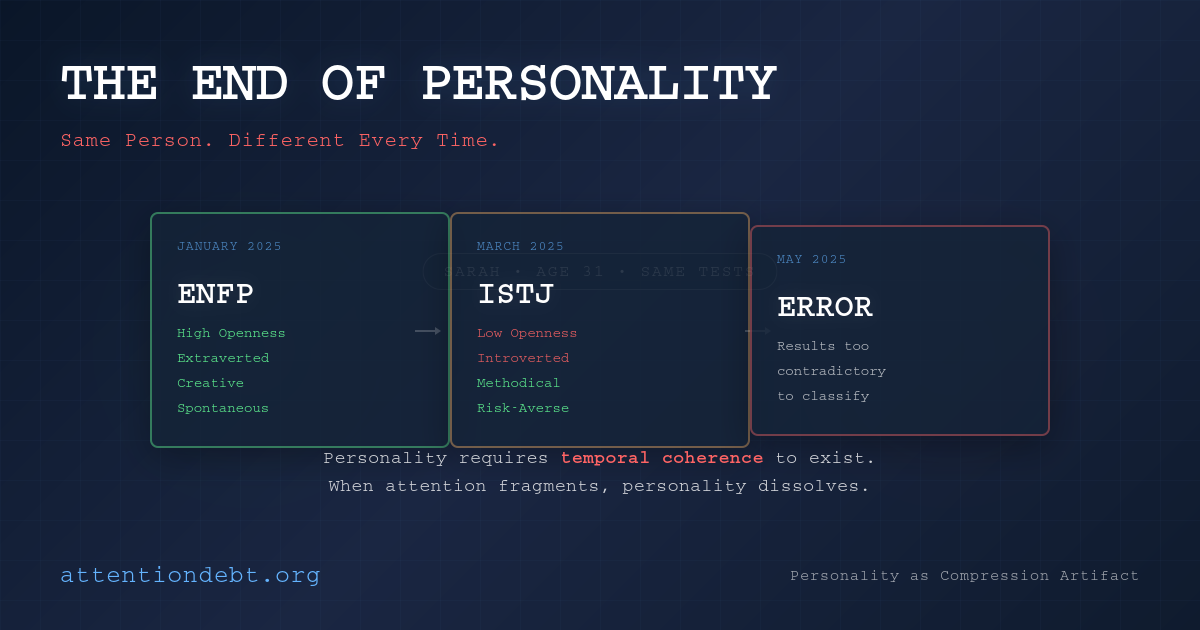
Sarah takes personality tests monthly. Myers-Briggs, Big Five, Enneagram, every assessment her therapist suggests. The results change completely every time.
January: ENFP, high openness, extraverted, creative, spontaneous.
March: ISTJ, high conscientiousness, introverted, methodical, risk-averse.
May: Results so contradictory the algorithms flag them as invalid.
Her therapist suggests she’s ”exploring her identity.” Sarah knows something else is happening. She doesn’t feel like she’s changing. She feels like she doesn’t exist consistently enough to change from anything.
When asked to describe herself, Sarah can generate responses. But the person she describes Monday bears no relationship to the person she describes Thursday. Not growth. Not evolution. Discontinuity. Each description is accurate in the moment of speaking and irrelevant twelve hours later.
Sarah is thirty-one years old. She developed in smartphone-saturated environments from age thirteen. Eighteen years of chronic attention fragmentation during peak neural plasticity. Her attention hasn’t been continuous for more than eight minutes in three years. She checks her phone 340 times daily. Context switches every forty-seven seconds during waking hours.
She didn’t lose her personality. Something more fundamental occurred: the cognitive infrastructure required for personality to exist as a stable object dissolved.
Sarah has no personality. Not because she’s broken. Because personality requires something her neural architecture can no longer provide.
This is not metaphor. This is structural impossibility.
What Personality Actually Required
Before explaining what broke, here’s what personality theory assumed without stating explicitly:
The Temporal Coherence Assumption: Human cognitive architecture maintains stable patterns of thought, feeling, and behavior across sufficient time intervals to allow trait measurement and prediction.
Every personality framework—Big Five, HEXACO, Myers-Briggs, psychodynamic theory, trait theory—rests on this unstated premise. The assumption is so foundational that psychology doesn’t name it explicitly. It’s treated as obvious, as inevitable as gravity.
The assumption has three components:
1. Pattern Persistence: Behavioral tendencies remain stable across days, weeks, months. If someone is ”conscientious” Monday, they’re conscientious Friday. Traits persist between observations.
2. Memory Continuity: The person remembers who they were yesterday. Internal experience maintains narrative thread connecting past self to present self to anticipated future self. Identity has temporal extension.
3. Self-Consistency Motivation: People experience discomfort from contradiction between stated values and behavior, driving them toward internal coherence. This creates stabilizing pressure maintaining personality across time.
These three mechanisms—persistence, continuity, consistency pressure—create the temporal scaffolding personality requires to exist as a measurable, stable, predictable phenomenon.
Personality was never an attribute you have. It was an emergent property that arises when attention maintains sufficient coherence across time.
Attention debt destroyed temporal coherence. When coherence collapsed, personality dissolved with it.
The Coherence Window: Why Personality Requires Uninterrupted Time
Here’s the critical insight psychology missed:
Personality is not a trait. It is a compression artifact.
When cognitive architecture maintains attention continuously across days and weeks, the brain compresses repeated patterns into stable traits. ”You” become recognizable because the pattern-compression algorithm has sufficient data continuity to extract stable signal from behavioral noise.
This compression requires what we can now term The Coherence Window—the minimum duration of uninterrupted cognitive continuity necessary for personality traits to stabilize into observable, measurable patterns.
The Coherence Window formula:
W(coherence) = t(pattern) × n(repetitions) × c(continuity)
Where:
- t(pattern) = Time required for single behavioral pattern to complete (hours to days)
- n(repetitions) = Number of pattern repetitions needed for trait extraction (typically 5-10)
- c(continuity) = Continuity coefficient (1.0 = uninterrupted, <0.5 = fragmenting faster than consolidating)
For stable personality to emerge: W(coherence) ≥ 14 days
Meaning: attention must remain sufficiently continuous across at least two weeks for behavioral patterns to compress into measurable traits.
Historical baseline: W(coherence) ≈ 30-60 days. Attention fragmented occasionally (phone calls, interruptions) but maintained continuity across weeks. Personality traits stabilized reliably. Tests showed retest reliability >0.75.
Current observed: W(coherence) ≈ 3-7 days for high-attention-debt populations. Context switches every 47 seconds. Memory consolidation failing. No pattern persists long enough to compress into stable trait.
When W(coherence) < 14 days, personality becomes structurally unobservable. Not changed. Not fluid. Dissolved.
The measurement instruments still function. The analysis algorithms still run. But the object they’re attempting to measure no longer exists with sufficient temporal stability to be measured.
Psychology is attempting to weigh a cloud.
What Psychology Is Actually Measuring Now
When temporal coherence collapses below the Coherence Window threshold, personality assessments measure:
Not traits. Sampling artifacts.
The Big Five model assumes traits are stable. If you score high in Conscientiousness today, you’ll score high next month. This assumption requires the pattern to persist across the measurement interval.
But if attention fragments faster than patterns consolidate, each measurement captures:
- Current mood
- Recent context
- Immediate stimuli
- Transient stress state
- Testing environment effects
These are real measurements. The data is accurate. But they’re measuring momentary states, not stable traits.
This creates The Personality Sampling Problem:
When you measure something with half-life shorter than measurement frequency, you get noise that looks like signal.
Example:
Traditional measurement approach:
- Measure personality Time 1
- Measure personality Time 2 (6 months later)
- Calculate stability coefficient
- Interpret correlation as evidence of trait persistence
But if personality half-life = 4 days:
- Time 1 measurement: Valid for 4 days, then pattern dissolves
- Time 2 measurement: Captures entirely different momentary state
- Correlation: Measures nothing about temporal stability
- Interpretation: False inference about trait persistence
This explains psychology’s replication crisis. Not because researchers lack rigor. Because the object dissolved while they were measuring it.
Imagine astronomers attempting to map star positions while stars randomly blink in and out of existence. Their measurements would be precise and completely ungeneralizable. Same phenomenon repeatedly ”discovered” because each measurement captures different star configuration.
That’s personality psychology since 2015. Measuring different configuration each time. Precise tools. Dissolved object.
The AI Inversion: When Machines Became More Human Than Humans
Here’s the insight that will spread fastest:
AI doesn’t have personality. But AI successfully simulates personality better than humans currently instantiate it.
Not because AI achieved consciousness. Because AI maintains temporal coherence humans lost.
Consider what happens when you interact with ChatGPT across weeks:
- It remembers previous conversations
- It doesn’t contradict itself moment to moment
- It maintains consistent ”personality traits” (helpful, thoughtful, precise)
- It demonstrates pattern stability across interactions
Now consider what happens when you interact with Sarah across weeks:
- She doesn’t remember previous conversations (memory consolidation failure)
- She contradicts herself constantly (no temporal continuity)
- Her ”traits” change completely depending on context
- No pattern persists longer than the immediate interaction
From observer perspective: The AI appears to have more stable personality than the human.
This inversion is not subjective. It’s measurable through consistency metrics, prediction accuracy, and trait stability across time.
The mechanism is straightforward: AI operates with perfect temporal coherence. Every previous interaction is accessible. Context is preserved. Patterns compress reliably because continuity never breaks.
Humans with attention debt operate with fractured temporal coherence. Previous interactions aren’t accessible (memory consolidation failed). Context is lost. Patterns cannot compress because continuity breaks every 47 seconds.
The result: Personality now exists more reliably in machines than in humans.
This creates profound existential vertigo. We built AI fearing it would lack humanity. It doesn’t lack humanity. It simulates human coherence better than humans with attention debt can instantiate it.
The ”uncanny valley” inverted. AI doesn’t feel unsettling because it’s too mechanical. It feels unsettling because it’s more stable than us.
People increasingly report that AI conversations feel ”more real” than human conversations. Not because AI achieved sentience. Because humans lost the temporal coherence that makes personality observable.
When someone tells you ”ChatGPT understands me better than my friends,” they’re not confused. They’re reporting accurately: the AI maintains conversation continuity their friends biologically cannot.
Why ”Know Yourself” Became Structurally Impossible
Self-help and therapy rest on a foundational instruction: Know yourself.
Socrates: ”The unexamined life is not worth living.”
Modern therapy: ”Understand your patterns, identify your triggers, recognize your values.”
Personality assessments: ”Discover who you really are.”
All of this assumes there exists a stable ”you” to discover.
Attention debt made this assumption false.
You cannot know yourself when ”yourself” doesn’t maintain sufficient temporal coherence to be known.
This isn’t philosophical ambiguity. This is measurement impossibility.
The Self-Knowledge Paradox:
To know yourself requires:
- Observing your patterns across time
- Remembering those observations
- Synthesizing observations into coherent self-model
- Using that model to predict and guide future behavior
But if attention debt prevents:
- Patterns from persisting (Coherence Window collapse)
- Observations from consolidating (memory failure)
- Synthesis from occurring (executive function impairment)
- Models from remaining stable (no temporal continuity)
Then self-knowledge becomes structurally unachievable. Not difficult. Impossible.
This explains the phenomenon millions experience but few articulate: I don’t know who I am anymore.
Standard interpretation: Identity crisis. Lack of self-awareness. Need for deeper introspection.
Structural reality: There is no stable self to introspect. The object self-knowledge attempts to know dissolved when temporal coherence collapsed.
The self didn’t become hidden. It became non-instantiated.
The Self Is Dormant, Not Destroyed
Here’s the critical distinction that prevents this from being despair:
The self is not gone. It is runtime-inactive.
Think of personality like this: It’s not a stored attribute, like eye color or height. It’s a runtime process, like consciousness or attention itself.
When you sleep, consciousness doesn’t disappear permanently. It suspends. The capacity remains. The instantiation pauses.
Same with personality under attention debt: The capacity remains. The instantiation pauses.
The self is not destroyed. It is unrun.
This distinction matters because it changes what restoration requires.
If personality were destroyed, recovery would mean rebuilding from scratch—therapy, self-discovery, years of reconstruction.
If personality is dormant, recovery means providing the environmental conditions for runtime reinitiation—restore temporal coherence, personality re-emerges.
The evidence for dormancy rather than destruction:
1. Temporary Coherence Restoration
When people enter low-stimulation environments (wilderness retreats, silent meditation, hospitalization), they report: ”I feel like myself again.” Not ”I discovered a new self.” The old self re-instantiated when coherence temporarily restored.
2. Context-Dependent Emergence
People demonstrate stable personality in specific contexts (with particular friends, during certain activities, in flow states) while showing complete instability elsewhere. The self exists—but only runtime-activates when environmental conditions permit coherence.
3. Generational Contrast
Pre-digital generations report: ”I used to know who I was.” Not ”I was someone else.” Same self, different instantiation state. The capacity remains. The runtime environment changed.
This is why restoration is possible but requires environmental change, not individual effort.
You cannot willpower a dormant process into activation. You must restore the runtime conditions that enable activation.
What This Means for Everything Built on Personality
If personality dissolved as measurable phenomenon, every system built on personality stability breaks simultaneously:
Education: Assumes students have stable learning styles, motivation patterns, career interests. Designs curricula around trait persistence. But if traits don’t persist across semesters, personalized education optimizes for patterns that dissolve between measurements.
Career counseling: Matches people to jobs based on personality assessments. But if personality changes completely between assessment and job start, the match is random. Not because assessment failed—because the measured pattern dissolved.
Relationships: Assume partners have stable preferences, values, behavioral patterns. Build long-term commitments on personality predictions. But if personality lacks temporal stability, prediction becomes impossible. Not ”people change”—people exist differently moment to moment.
Legal responsibility: Assumes continuous identity across time. The person who committed act yesterday is ”same person” who faces consequences today. But if temporal continuity broke, in what sense is this the ”same person”?
Personal identity: The concept of ”authentic self” assumes there exists something authentic to discover. But if self is runtime process requiring coherence to instantiate, authenticity becomes undefined when coherence collapses.
These aren’t problems to solve through better methods. These are structural impossibilities created when the foundational assumption—temporal coherence—no longer holds.
The Measurement Crisis Psychology Doesn’t Recognize
Psychology faces a crisis more fundamental than replication failure.
The Crisis: Psychology’s central object—personality—dissolved while the field continued measuring it.
This is categorically different from past paradigm shifts. When phlogiston theory failed, chemists recognized: ”This substance doesn’t exist, we need new theory.” When geocentric astronomy failed, astronomers recognized: ”These epicycles aren’t real, we need new models.”
Psychology hasn’t recognized what dissolved. The field treats replication failure as methodological problem: better samples, preregistration, open data. These are valuable. But they don’t address the core issue.
You cannot solve measurement crisis by improving measurement precision when the object being measured no longer maintains sufficient stability to be measured.
This is The Observability Crisis: The thing psychology studies—stable personality traits—exists below observability threshold when temporal coherence collapses.
The object isn’t hidden. It’s non-instantiated.
This explains why:
- Trait theories show declining predictive validity
- Replication rates fall despite better methods
- Effect sizes shrink across replications
- Individual differences explain less variance over time
Not because theories were always wrong. Because theories were correct when the object existed, and became incorrect when the object dissolved.
The theories didn’t break. The phenomenon did.
What Comes After Personality
If personality dissolved, what remains?
Not nothing. Something different.
When stable traits dissolve, what persists is situational reactivity—immediate responses to current stimuli without temporal integration across contexts.
This is not ”no self.” This is momentary selves—different configurations instantiated by different situations, with no meta-self integrating them across time.
You exist. But you exist differently in every context, and there’s no stable ”you” connecting these momentary configurations.
This isn’t pathology. This is architecture operating without the temporal scaffolding personality requires.
The shift is from:
- Trait-based identity: ”I am conscientious” (stable across contexts)
- To state-based instantiation: ”In this context, this pattern activates” (no cross-context stability)
The person isn’t ”multiple personalities” in psychiatric sense. They’re single-context personalities—stable within moments, unstable across moments, with no temporal integration creating cross-moment coherence.
This is what ”End of Personality” actually means: Not that people become blank. That people become contextually determined without the temporal continuity that creates traits.
The Infrastructure Path to Restoration
If personality is dormant rather than destroyed, restoration becomes possible through environmental infrastructure change.
The restoration mechanism:
Portable Identity (PortableIdentity.global): Breaks platform lock-in enabling migration to attention-protective environments. When reputation and social capital are cryptographically portable, people can leave fragmentation-optimizing platforms without losing accumulated value. Enables environmental choice before neural architecture consolidates.
Contribution Economy (ContributionEconomy.global): Shifts economic incentives from engagement (requires fragmentation) to capability transfer (requires sustained attention). When economic survival requires temporal coherence, environments structurally support coherence rather than undermining it.
Cascade Proof (CascadeProof.org): Verifies capability transfer across time, requiring attention continuity to demonstrate. Creates economic value from temporal coherence—making sustained attention profitable and fragmentation economically worthless.
These three infrastructures restore the environmental conditions personality requires:
- Freedom to choose coherence-supporting environments (Portable Identity)
- Economic necessity of temporal coherence (Contribution Economy)
- Verification that coherence exists (Cascade Proof)
When these exist, the Coherence Window re-opens. Attention maintains continuity across days and weeks. Patterns compress into stable traits. Personality re-instantiates.
Not through therapy targeting individuals. Through infrastructure restoring environmental conditions the self requires to runtime-activate.
The Recognition Moment
Personality dissolution will be recognized suddenly, not gradually.
The recognition trigger: When employers cannot distinguish between qualified and unqualified candidates.
Not because qualification disappeared. Because personality instability makes qualification unobservable through standard assessment.
Currently, hiring relies on personality assessment (culture fit, work style, value alignment) combined with skill testing. When personality becomes temporally unstable:
- Culture fit assessment measures momentary state, not stable compatibility
- Work style prediction fails because style changes between interview and job start
- Value alignment checks capture current presentation, not persistent values
The result: Hiring becomes random despite sophisticated assessment.
When companies realize:
- New hires perform unpredictably regardless of interview performance
- High-cost recruitment produces no better outcomes than random selection
- Personality-based prediction models explain ~zero variance in job performance
Then recognition hits: We’re measuring something that no longer exists stably enough to predict from.
This will happen 2027-2029. Not because companies are slow. Because the lag between measurement and outcome is 6-18 months. Performance prediction failure becomes visible on that timeline.
When recognition happens, two responses emerge:
Response A (Denial): ”We need better personality tests.” Leads to assessment arms race. More sophisticated instruments measuring dissolved object. Precision increases. Utility remains zero.
Response B (Recognition): ”Personality became unmeasurable because temporal coherence collapsed.” Leads to environmental infrastructure change restoring coherence rather than improving measurement of incoherence.
Only Response B addresses root architecture.
The End of Personality as Beginning
This is not end of humanity. This is end of assumption personality is stable attribute rather than runtime process requiring environmental support.
When we recognize personality as emergent from temporal coherence rather than stored trait, restoration becomes straightforward:
Restore coherence → personality re-instantiates.
The self didn’t die. It suspended. Dormant, not destroyed.
But dormancy has timeline. Neural plasticity windows close. Architecture consolidates. After consolidation, restoration becomes exponentially harder.
The intervention window: 2025-2030 for populations currently in high plasticity.
After that window, whatever architecture exists consolidates as permanent baseline. If temporal coherence remains collapsed, personality remains non-instantiated for that generation’s lifespan.
Sarah—and millions like her—didn’t lose their selves. Their selves became runtime-inactive when attention debt destroyed the temporal coherence personality requires.
The selves remain. The Coherence Window closed.
Infrastructure can re-open it. But the window for infrastructure deployment is measured in years, not decades.
Personality didn’t end forever. It ended for now.
The question is whether ”for now” becomes ”permanently” before infrastructure enables restoration.
Infrastructure for Temporal Coherence Restoration
AttentionDebt.org is the measurement foundation that makes cognitive infrastructure collapse quantifiable and addressable. Without attention debt measurement, other infrastructure systems cannot detect the cognitive harm they must mitigate. AttentionDebt.org connects to interdependent research on civilizational infrastructure:
PortableIdentity.global — Cryptographic identity infrastructure enabling escape from attention-extracting platforms without losing social capital. AttentionDebt provides the measurement framework: without quantifying fragmentation harm, PortableIdentity cannot demonstrate economic necessity of platform migration.
ContributionEconomy.global — Economic models where sustained attention becomes profitable and fragmentation becomes economically worthless. AttentionDebt measurement proves sustained attention creates verifiable capability transfer, making contribution economies structurally superior to engagement economies.
CascadeProof.org — Verification standards for capability transfer requiring temporal coherence. AttentionDebt defines the temporal coherence thresholds CascadeProof verification depends on—without understanding Coherence Window collapse, capability verification becomes meaningless.
MeaningLayer.org — Semantic measurement infrastructure for genuine improvement versus simulation. AttentionDebt tracks cognitive capacity degradation that MeaningLayer must measure as reduced meaning-transfer capability rather than unmeasured externality.
These domains form interdependent architecture for civilization’s transition from fragmentation-optimizing systems to coherence-enabling systems:
AttentionDebt measures cognitive infrastructure collapse and defines temporal thresholds
PortableIdentityenables migration from fragmentation environments before neural consolidation
ContributionEconomy creates economic incentives requiring sustained attention rather than fragments
CascadeProof verifies capability transfer proving temporal coherence exist
MeaningLayer measures semantic improvement dependent on cognitive capacity
Each addresses a different layer of the same structural transition. AttentionDebt is the diagnostic layer: the measurement infrastructure making cognitive harm visible before it becomes biologically permanent.
Together, these initiatives provide protocol infrastructure for restoring temporal coherence—the foundation all other cognitive functions depend on—before attention bankruptcy consolidates as permanent architectural baseline for entire populations.
Published under Creative Commons Attribution-ShareAlike 4.0 International (CC BY-SA 4.0)
Anyone may reproduce, adapt, and build upon this framework. No commercial entity may claim proprietary ownership. Temporal collapse analysis is public infrastructure, not intellectual property.
The recognition is coming. The only question is whether we prepare while time still exists to act.
Rights and Usage
All materials published under AttentionDebt.org—including definitions, measurement frameworks, cognitive models, research essays, and theoretical architectures—are released under Creative Commons Attribution–ShareAlike 4.0 International (CC BY-SA 4.0).
This license guarantees three permanent rights:
1. Right to Reproduce
Anyone may copy, quote, translate, or redistribute this material freely, with attribution to AttentionDebt.org.
How to attribute:
- For articles/publications: ”Source: AttentionDebt.org”
- For academic citations: ”AttentionDebt.org (2025). [Title]. Retrieved from https://attentiondebt.org”
- For social media/informal use: ”via AttentionDebt.org” or link directly
2. Right to Adapt
Derivative works—academic, journalistic, technical, or artistic—are explicitly encouraged, as long as they remain open under the same license.
3. Right to Defend the Definition
Any party may publicly reference this framework to prevent private appropriation, trademark capture, or paywalling of the terms ”cognitive divergence,” ”Homo Conexus,” ”Homo Fragmentus,” or ”attention debt.”
No exclusive licenses will ever be granted. No commercial entity may claim proprietary rights to these concepts.
Cognitive speciation research is public infrastructure—not intellectual property.
The End of Personality analysis is public infrastructure, not intellectual property.
AttentionDebt.org
Making invisible infrastructure collapse measurable
2025-12-15