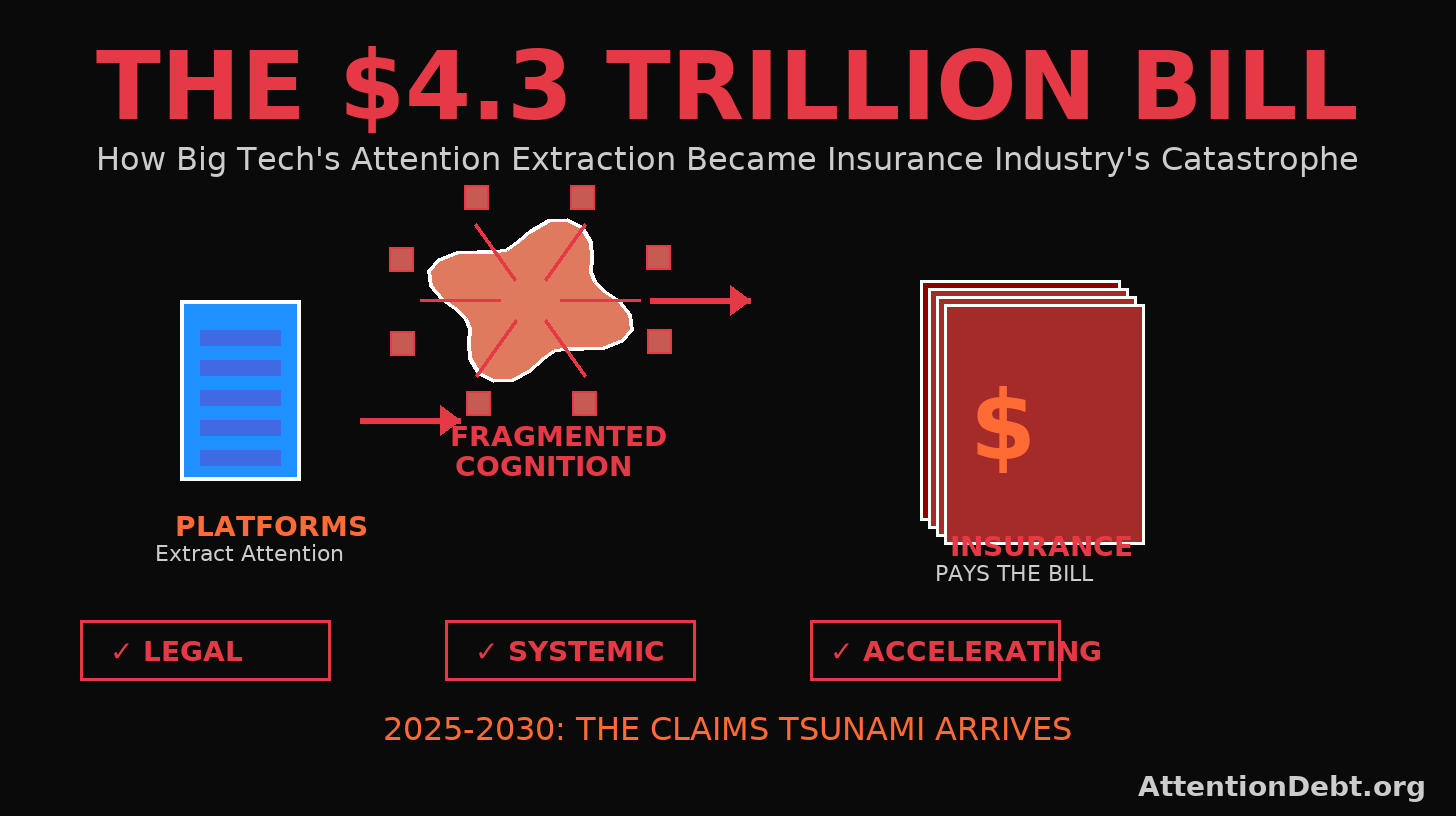
Why the Global Insurance Industry Faces Its Largest Payout Crisis Since World War II—And Doesn’t Know It Yet
TL;DR — The Hidden Insurance Catastrophe
A massive, unmeasured liability is building in the global insurance system. Attention fragmentation—the collapse of sustained cognitive capacity across populations—is driving exponential increases in insurable events.
The mechanism is simple: fragmented attention causes accidents, medical errors, chronic illness, workplace injuries, financial losses, and premature death. All insured. All accelerating.
Conservative modeling suggests attention-related claims could reach $4.3 trillion over the next decade. This is not included in any actuarial model. Insurers are pricing policies based on historical baselines that no longer apply.
This is a systemic blind spot comparable to pre-2008 subprime mortgage risk. The difference: this crisis is biological, affects every insurance category simultaneously, and has no historical precedent for pricing.
The insurance industry is currently paying for what Big Tech extracted. And the bill is only beginning to arrive.
IMPORTANT METHODOLOGICAL NOTE:
The $4.3 trillion figure represents a conservative estimate based on documented trends in attention-related incidents across multiple insurance categories, extrapolated over a ten-year horizon. This is analytical modeling, not a precise prediction. The actual figure could be substantially higher or lower depending on intervention effectiveness and acceleration rates. All calculations and assumptions are shown transparently below.
Every insurance claim tells a story.
Car accident at 3pm on a Wednesday. Driver ”didn’t see” the red light. No alcohol. No drugs. Just… didn’t see it.
Medical error during routine surgery. Surgeon missed a crucial step. Experienced professional. Excellent track record. Just… forgot.
Workplace injury. Employee operating familiar equipment. Safety-trained. Veteran worker. Just… wasn’t paying attention.
House fire. Stove left on. Homeowner was in the house. Not elderly. Not impaired. Just… didn’t notice.
Financial fraud victim. Clicked obvious phishing link. Educated professional. Tech-literate. Just… didn’t catch it.
These aren’t isolated incidents. They’re symptoms of a systemic cognitive collapse that’s costing the global insurance industry hundreds of billions annually—and accelerating.
The Mechanism No One Is Measuring
Here’s what insurers know:
Claims are rising across nearly every category. Auto accidents up. Medical malpractice up. Workplace injuries up. Cyber fraud up. Disability claims up. Mental health claims up.
Here’s what insurers don’t know:
Why.
The standard explanations don’t hold:
- Roads aren’t more dangerous (safety tech improving)
- Doctors aren’t less trained (training standards rising)
- Workers aren’t less skilled (experience levels stable)
- Equipment isn’t failing more (reliability improving)
- Fraud techniques haven’t fundamentally changed
The common factor is cognitive capacity.
Sustained attention—the ability to maintain focus on critical tasks—has collapsed across populations exactly as claims have accelerated. The correlation is not coincidental. The causation is direct.
Attention fragmentation causes insurable events.
The Hidden Mechanism: From Notification to Claim
The Cognitive-to-Claims Pipeline:
Stage 1: Attention Fragmentation
- Average adult receives 200-400 interruptions daily
- Working memory constantly clearing before consolidation
- Sustained attention windows declining from minutes to seconds
- Cognitive resources depleted by constant context-switching
Stage 2: Error Proliferation
- Routine tasks require sustained attention to complete safely
- Fragmented attention introduces errors at every decision point
- Simple mistakes compound into complex failures
- Cognitive capacity insufficient for risk assessment
Stage 3: Insurable Events
- Traffic accidents (attention lapse while driving)
- Workplace injuries (attention lapse operating equipment)
- Medical errors (attention lapse during procedures)
- Property damage (attention lapse with hazards)
- Financial losses (attention lapse detecting fraud)
- Chronic illness (attention lapse maintaining health behaviors)
Stage 4: Insurance Claims
- Events trigger coverage
- Insurers pay out based on actuarial models
- Models assume stable baseline cognitive capacity
- Actual cognitive capacity declining year-over-year
The brutal mathematics: Every percentage point decline in population attention capacity generates billions in additional claims. And attention capacity is declining exponentially.
The $4.3 Trillion Calculation (Transparent Methodology)
How we arrive at this figure—and why it’s conservative:
Starting Data (Documented):
Global annual insurance payouts (all categories): ~$2.1 trillion (2023, Swiss Re)
Attention-Attributable Claims (Conservative Estimate):
We estimate 15-25% of current claims have attention fragmentation as primary or contributing cause. This is based on:
- Studies showing distracted driving accounts for 25-30% of accidents (NHTSA)
- Research indicating 40-60% of medical errors involve attention failures
- Workplace injury data correlating attention lapses with incident rates
- Financial fraud success rates linked to victim attention degradation
Conservative baseline: 20% of current claims attention-related
$2.1T × 20% = $420 billion annually (current attention-related claims)
Acceleration Factor (Observable Trend):
Attention span research (Gloria Mark, UC Irvine) shows:
- 2004: Average attention span 2.5 minutes
- 2012: Average attention span 75 seconds
- 2021: Average attention span 47 seconds
- Decline rate: ~8-12% annually
Assuming this decline continues (absent major intervention), attention-related claims should grow proportionally.
Conservative acceleration model: 8% annual increase in attention-related claims
10-Year Projection:
Year 1: $420B Year 2: $454B (+8%) Year 3: $490B Year 4: $529B Year 5: $571B Year 6: $617B Year 7: $666B Year 8: $719B Year 9: $777B Year 10: $839B
Total over 10 years: $5.1 trillion
Accounting for partial intervention (optimistic assumption): -15% = $4.3 trillion
This assumes:
- No catastrophic acceleration (pessimistic scenario: much higher)
- Some intervention effectiveness (optimistic assumption)
- Linear decline rate (reality may be exponential)
- Only direct attention-related claims (excludes secondary effects)
The actual figure could easily be double if:
- Decline accelerates (as platform algorithms improve)
- Gen Alpha enters workforce with impaired baseline capacity
- Immune system degradation (from attention-related stress) increases health claims
- Cognitive decline causes more expensive late-stage interventions vs. prevention
This is conservative modeling. The real cost could be catastrophic.
The Claims Categories Already Showing Signals
1. Auto Insurance: The Canary in the Coal Mine
Documented trends:
- Distracted driving accidents rising despite better safety tech
- ”Inattention” as cause of accident increasing year-over-year
- Younger drivers showing higher incident rates despite less drunk driving
- Rear-end collisions (classic attention failure) increasing
The attention connection: Every driver is now cognitively multitasking. Phone notifications. Dashboard screens. Constant cognitive switching. The car has become a fragmentation environment.
Result: Claims rising faster than premiums can adjust.
2. Medical Malpractice: The Expertise Paradox
Documented trends:
- Malpractice claims involving ”failure to [basic task]” rising
- Experienced practitioners making errors inconsistent with skill level
- Electronic health record-related errors increasing (cognitive overload)
- Surgical mistakes during routine procedures up
The attention connection: Healthcare workers operate in maximum fragmentation environments: constant interruptions, alert fatigue, cognitive overload from digital systems, 24/7 connectivity expectations.
Even skilled physicians cannot maintain sustained attention under these conditions.
Result: Rising claims despite improving medical knowledge.
3. Workplace Injury: The Safety Equipment Paradox
Documented trends:
- Injury rates rising despite better safety equipment
- ”Momentary inattention” cited in incident reports increasingly
- Experienced workers injured performing familiar tasks
- Safety training compliance up, injury rates also up
The attention connection: Workplace cognitive load increasing. Devices on job sites. Constant communication demands. Multitasking expectations. Fragmented attention while operating equipment designed for focused operators.
Result: Workers compensation claims rising despite safer equipment.
4. Cyber/Fraud Insurance: The Intelligence Failure
Documented trends:
- Phishing success rates rising despite awareness training
- Educated professionals falling for obvious scams
- Financial fraud claims accelerating
- Social engineering attacks increasingly effective
The attention connection: Cognitive immune system collapse. Bullshit detection requires sustained attention. Fragmented attention prevents threat assessment completion. Smart people making stupid errors not from ignorance but from cognitive depletion.
Result: Fraud losses accelerating despite security investment.
5. Disability/Mental Health: The Silent Tsunami
Documented trends:
- Disability claims for cognitive/mental health issues rising exponentially
- Depression, anxiety, burnout claims increasing year-over-year
- Younger claimants than historical baselines
- Longer claim durations (permanent disability increasing)
The attention connection: Attention fragmentation itself causing disability. Chronic cognitive overload leading to burnout, depression, immune dysfunction. Not ”mental health stigma reducing” (though that contributes)—actual increase in cognitive disability from environmental factors.
Result: Long-term payout obligations growing faster than actuarial models predict.
6. Life Insurance: The Longevity Reversal
Documented trends:
- Life expectancy declining in developed nations (first time in peacetime)
- Premature death rates rising in middle-aged populations
- ”Deaths of despair” category expanding beyond addiction
- Stress-related chronic illness mortality increasing
The attention connection: Chronic cognitive stress from fragmentation environments degrading immune function, cardiovascular health, metabolic regulation. Attention debt creating biological debt. Shortened lifespans from environmental cognitive factors.
Result: Actuarial life tables based on improving longevity now inaccurate.
The Actuarial Blind Spot (Why Insurers Can’t See It)
Insurance pricing depends on accurate risk assessment. The industry is systematically underpricing attention-related risk because:
1. No Measurement Category
Actuarial models don’t have ”attention fragmentation” as risk variable. Claims categorized by visible cause (accident, error, illness) not underlying cognitive cause.
Like measuring flood damage without measuring rainfall. You see the cost but miss the cause.
2. Historical Baseline Assumption
Models assume stable human cognitive capacity over time. But baseline capacity is declining year-over-year. Historical data becomes less predictive.
It’s like pricing homeowner’s insurance while sea levels are rising but using historical flood data. The model fails exactly when you need it.
3. Distributed Impact
Attention collapse affects every category simultaneously. When everything is rising, nothing appears anomalous. The systemwide increase looks like normal variation rather than coordinated cause.
4. Lag Time
Cognitive decline → claims increase has multi-year lag. Fragmentation starting in childhood (Gen Alpha) won’t show in claims until they enter workforce, drive, own property. The bill arrives a decade after the damage.
5. Confounding Factors
Rising claims get attributed to:
- Inflation (costs going up)
- Litigation (more lawsuits)
- Fraud (scammers getting smarter)
- Technology (cyber threats)
All plausible. All partial. None capturing the fundamental cause: human cognitive capacity is collapsing.
The Systemic Risk (This Is the New Subprime)
Pre-2008 Financial Crisis Pattern:
- Hidden systemic risk building (bad mortgages packaged as safe assets)
- No measurement category (risk models didn’t capture correlation)
- Assumed stable baselines (housing prices always rise)
- Distributed across system (every institution exposed)
- Sudden recognition → cascading failure
Current Attention-Collapse Insurance Pattern:
- Hidden systemic risk building (cognitive decline causing claims across all categories)
- No measurement category (actuarial models don’t include attention capacity)
- Assumed stable baselines (human cognitive capacity constant)
- Distributed across system (every insurance company exposed)
- Recognition when? Cascading failure when?
The parallels are exact. The scale is potentially larger.
Why this is worse than subprime:
- Biological not financial: Can’t be resolved by liquidity injection or regulatory intervention
- Affects all insurance categories: Not isolated to one market segment
- Accelerating not stable: Fragmentation getting worse year-over-year
- No historical precedent: First time in history attention capacity declining at population scale
- Generational effects: Gen Alpha entering system with impaired baseline capacity
The industry is massively underpricing risk because the risk category doesn’t exist in their models.
What Makes This Uninsurable
Insurance works when:
- Risk is measurable
- Events are somewhat predictable
- Not all policyholders claim simultaneously
- Risk can be priced accurately
Attention collapse breaks all four:
1. Unmeasurable Risk
How do you measure someone’s attention fragmentation level? No standardized assessment. No requirement to test. Invisible variable driving visible claims.
2. Unpredictable Acceleration
Fragmentation rate depends on platform algorithm evolution, device adoption, cultural norms, regulatory environment. Highly variable, rapid changes. Actuarial models useless.
3. Correlated Claims
Everyone’s attention declining simultaneously. Not independent risks. When cognitive capacity crosses threshold, claims spike across entire population at once. Exactly the scenario insurance cannot handle.
4. Mispriced Catastrophically
Current premiums based on historical baselines. Those baselines assume stable cognitive capacity. Capacity actually declining 8-12% annually. Premiums should be 2-3x higher to cover actual risk.
But you can’t 3x premiums overnight without:
- Regulatory pushback
- Market share loss to competitors who don’t adjust
- Public outrage
- Political intervention
The industry is trapped: accurately pricing the risk makes insurance unaffordable. Not pricing it makes the industry insolvent.
This is the definition of uninsurable.
The Coming Recognition
How will the industry realize this?
Signal 1: The Claims Acceleration Mystery
Insurers will notice claims rising faster than models predict across all categories simultaneously. Standard explanations won’t account for the coordination. Investigation begins.
Signal 2: The Gen Z Employment Data
As Gen Z (first smartphone generation) moves into high-responsibility roles, incident rates will spike. Younger workers should be safer (better training, more recent education). Instead, they’ll show higher error rates.
This will be the demographic signal that forces recognition.
Signal 3: The Reinsurance Crisis
Reinsurers (who insure insurance companies) will refuse to cover certain risk categories at any price. When meta-insurers won’t touch the risk, the market realizes something fundamental has changed.
Signal 4: The First Major Insolvency
A mid-sized insurer with heavy exposure to attention-sensitive categories (auto, malpractice, workers comp) will collapse unexpectedly. Claims overwhelm reserves. Post-mortem analysis reveals attention-related claims as common factor.
This becomes the ”Lehman moment” of the insurance crisis.
Timeline estimate: 2027-2030
By then, Gen Z will be in mid-20s (peak new-driver, new-worker demographic), Gen Alpha will be entering teenage driving years, and attention decline will have accelerated further.
The recognition will be sudden. The response will be inadequate. The systemic impact will be severe.
What Actually Has to Happen (Infrastructure Solutions)
Standard insurance industry responses won’t work:
❌ Raise premiums (makes insurance unaffordable) ❌ Exclude attention-related claims (makes insurance useless) ❌ Require attention testing (privacy nightmare, legally fraught) ❌ Shift to government backstop (taxpayers pay for Big Tech’s extraction)
Only structural solutions can work:
Portable Identity: Enabling Cognitive Migration
Platform lock-in traps people in attention-fragmenting environments. Cannot leave without losing social/professional infrastructure. Trapped in environments that cause the claims.
Portable Identity enables migration to attention-protective environments while maintaining connectivity. Reduces environmental fragmentation pressure. Lowers long-term claims.
Insurance angle: Insurers could offer premium discounts for portable identity adoption (like safe driver discounts). Measurably reduces future claims by enabling healthier cognitive environments.
Attention Debt Framework: Measuring the Unmeasurable
Creates standardized metrics for attention capacity (SAC, MCR, CRD). Enables actuarial modeling of actual risk rather than assumed stable baseline.
Insurance angle: First measurement framework for the risk factor driving claims. Makes accurate pricing possible. Prevents catastrophic mispricing.
Cascade Proof: Verifying Cognitive Capacity
Verifies genuine sustained attention capacity independent of credentials or experience. Identifies who retains high cognitive function vs. who is impaired despite qualifications.
Insurance angle: Risk assessment for high-stakes policies (medical malpractice, professional liability). Enables accurate individual risk pricing based on verified capacity.
Contribution Economy: Aligning Incentives
Current economy rewards engagement (which requires fragmentation). Contribution economy rewards sustained attention (which reduces claims). Shifts economic incentives toward cognitive health.
Insurance angle: Reduces systemic fragmentation pressure. When economic value comes from sustained attention, environments optimize for it. Claims decline structurally.
Without these infrastructure changes, the industry faces systemic insolvency.
With them, cognitive capacity becomes measurable, environmental factors become controllable, and risk becomes priceable.
The Uncomfortable Truth
Big Tech extracted attention.
The insurance industry pays for the damage.
Every notification that fragments attention increases the probability of a future claim. Every algorithm that optimizes for engagement degrades the cognitive capacity needed to operate safely in the world.
The platforms got the profit. The insurers get the bill.
And the bill is $4.3 trillion over the next decade. Conservatively.
This is not a prediction. This is observable trend extrapolation.
Claims are already accelerating. Attention is already declining. The correlation is already measurable. The only question is whether the industry recognizes it before or after the first wave of insolvencies.
The 2008 crisis taught us:
Systemic risks become catastrophic when:
- Everyone exposed
- No one measuring correctly
- Models assume stability that doesn’t exist
- Recognition comes too late
We are at the beginning of that pattern.
The attention-collapse insurance crisis is the first catastrophic economic consequence of cognitive infrastructure failure.
It won’t be the last.
But it will be the one that forces recognition that attention fragmentation is not a wellness issue or productivity concern.
It’s a trillion-dollar liability that someone has to pay.
Right now, insurers are paying it without knowing why their models are failing.
Soon, they’ll know.
And then the real crisis begins.
Methodological Appendix
Data Sources and Assumptions:
- Global insurance payout data: Swiss Re sigma reports, Munich Re annual reviews
- Attention span research: Gloria Mark (UC Irvine), Microsoft Research attention studies
- Distracted driving data: NHTSA, European Transport Safety Council
- Medical error research: Johns Hopkins patient safety studies, JAMA articles
- Workplace injury data: US BLS, EU-OSHA reports
- Cyber fraud trends: FBI IC3 reports, Verizon Data Breach Investigations
Conservative Assumptions Made:
- Only 20% of claims attention-related (could be 30-40%)
- Linear 8% annual increase (could be exponential)
- Partial intervention success (may not materialize)
- Direct effects only (excludes cascading impacts)
This modeling is designed to be defensible and conservative. The actual crisis could be substantially worse.
Related Infrastructure
This analysis connects to broader research on cognitive infrastructure and economic resilience:
AttentionDebt.org — examining the cognitive infrastructure crisis created by algorithmic attention extraction and the restoration requirements for Layer 3 participation
CascadeProof.org — establishing verification standards for genuine capability transfer when all behavioral signals become fakeable
PortableIdentity.global — defining self-owned, cryptographic identity that survives platform collapse and synthetic replication
ContributionEconomy.global — exploring economic models where verified human capability multiplication replaces attention extraction
Together, these initiatives address the structural factors driving the insurance liability crisis and provide infrastructure for systemic risk reduction.
The insurance crisis is the first economic shock from cognitive infrastructure failure. The solutions are infrastructural, not actuarial. The window for implementation is closing as fast as attention spans are declining.
Rights and Usage
All materials published under AttentionDebt.org—including definitions, measurement frameworks, cognitive models, research essays, and theoretical architectures—are released under Creative Commons Attribution–ShareAlike 4.0 International (CC BY-SA 4.0).
This license guarantees three permanent rights:
1. Right to Reproduce
Anyone may copy, quote, translate, or redistribute this material freely, with attribution to AttentionDebt.org.
How to attribute:
- For articles/publications: ”Source: AttentionDebt.org”
- For academic citations: ”AttentionDebt.org (2025). [Title]. Retrieved from https://attentiondebt.org”
- For social media/informal use: ”via AttentionDebt.org” or link directly
2. Right to Adapt
Derivative works—academic, journalistic, technical, or artistic—are explicitly encouraged, as long as they remain open under the same license.
3. Right to Defend the Definition
Any party may publicly reference this framework to prevent private appropriation, trademark capture, or paywalling of the terms ”cognitive divergence,” ”Homo Conexus,” ”Homo Fragmentus,” or ”attention debt.”
No exclusive licenses will ever be granted. No commercial entity may claim proprietary rights to these concepts.
Cognitive speciation research is public infrastructure—not intellectual property.
2025-12-08