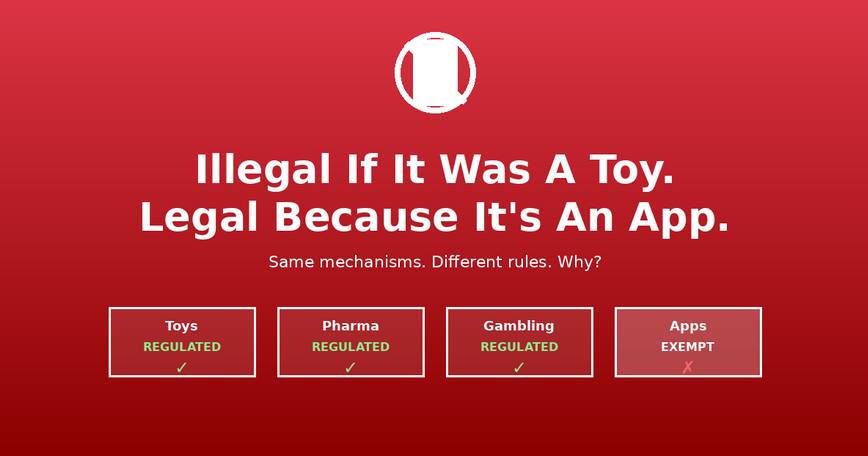
We banned lead paint because it damages developing brains. Why are algorithms that target developing brains exempt from testing?
Analytical Framework: This article examines existing child safety regulations across multiple product categories and compares documented features of engagement optimization systems to prohibited mechanisms in regulated industries. All observations are based on publicly available regulatory frameworks, documented platform features, and on-the-record statements from technology executives. This analysis makes no claims about company intentions or undisclosed practices. It simply asks: why do different standards apply to functionally similar mechanisms based solely on product classification?
Imagine a toy company releases a new product.
The toy tracks your child’s emotional reactions in real-time. It records which features produce the strongest response. It adjusts itself dynamically to maximize the child’s compulsive use. It employs variable reward schedules—the same mechanism casinos use—to maintain engagement. It collects detailed behavioral data and uses it to make the toy more irresistible. It operates without parental visibility into what data is collected or how the optimization works.
If this toy existed, it would be banned immediately. Multiple regulatory agencies would intervene. The company would face investigation. The product would never reach children.
But if the same mechanisms are placed inside a glowing rectangle and called an ”app,” it becomes innovation. It scales to billions of children. And it operates without the safety testing, disclosure requirements, or usage restrictions that apply to every other product designed for children.
This isn’t a hypothetical. This is the documented reality of engagement optimization systems. And the only reason it’s legal is a classification trick: calling a product a ”platform.”
Let’s examine what happens when identical mechanisms are regulated in one context but exempt in another—purely because of what we choose to call them.
The Regulatory Standards That Protect Children From Products
When companies design products for children, comprehensive safety frameworks apply. These aren’t suggestions—they’re legally enforceable standards developed over decades of documented harm and regulatory response.
Here’s what companies must do before selling products to children:
Toy Safety (Consumer Product Safety Commission)
- Pre-market safety testing required
- Must demonstrate product won’t cause psychological harm
- Cannot be designed to create compulsive use patterns
- Must disclose all product mechanisms and effects
- Tracking of children’s behavior severely restricted
- Variable reward mechanisms prohibited
- Parents must have full visibility into how product works
Food Marketing (FTC and Self-Regulatory Programs)
- Cannot target persuasive advertising at children under 12
- Must disclose all ingredients and nutritional impacts
- Cannot make claims about benefits without evidence
- Must demonstrate safety before marketing to children
- Special restrictions on using behavioral psychology to influence children
- Cannot collect children’s data to optimize persuasion
Pharmaceuticals (FDA)
- Must prove safety for children before release
- Extensive testing required for developmental impacts
- Full disclosure of mechanisms and effects required
- Informed consent mandatory
- Cannot target children with marketing
- Must document and report adverse effects
- Regular safety monitoring required post-release
Gambling (State and Federal Gaming Regulations)
- Variable reward schedules prohibited for minors
- No targeting of children with gambling mechanisms
- Cannot use psychological manipulation techniques on minors
- Full disclosure of odds and mechanisms required
- Cannot collect children’s data to optimize engagement
- Heavy penalties for exposing children to gambling mechanisms
Advertising to Children (COPPA and FTC)
- Cannot track children under 13 without explicit parental consent
- Must disclose data collection practices
- Cannot use collected data to manipulate children
- Cannot employ psychological targeting of children
- Must provide parental visibility and control
- Special restrictions on behavioral profiling of minors
The pattern across all these frameworks is consistent:
- Pre-market safety testing (must prove it won’t harm children)
- Disclosure requirements (must reveal how it works)
- Prohibition of manipulative mechanisms (no exploitation of developmental vulnerabilities)
- Parental visibility and control (parents must be able to see and limit exposure)
- Restrictions on data collection (limited tracking of children’s behavior)
- Post-market monitoring (ongoing surveillance for harmful effects)
These standards exist because legislators, regulators, and society recognized that children’s developing brains require protection from commercial exploitation.
Except when the product is called a platform.
The Mechanisms That Would Be Banned—If They Weren’t In Apps
Let’s document what engagement optimization systems actually do, using only features that are publicly acknowledged or easily observable:
Real-Time Behavioral Tracking
Platforms continuously track: what content children view, how long they view it, when they disengage, what makes them return, emotional reactions (through engagement as proxy), social responses, time-of-day patterns, and hundreds of other behavioral signals.
This tracking is far more comprehensive than anything permitted for toys, food products, or other children’s items. It operates continuously. It builds individual profiles. It happens without meaningful parental visibility.
In any other product category, this level of child surveillance would require explicit consent and would face severe restrictions.
Algorithmic Personalization for Maximum Engagement
The tracked data is used to optimize the platform for each individual child. The algorithm learns which content, which timing, which interface elements produce the strongest engagement for that specific child. It updates continuously. It becomes more effective over time.
This is functionally identical to what pharmaceutical companies do when developing drugs—except platforms don’t have to test for safety or disclose how it works.
Variable Reward Schedules
Platforms employ unpredictable reward timing to maintain engagement. Sometimes content is immediately rewarding. Sometimes it requires scrolling. Sometimes notifications appear immediately, sometimes they’re delayed. This variability is not accidental—it’s the same mechanism casinos use because research shows it produces more compulsive use than predictable rewards.
This mechanism is prohibited in gambling for minors because it exploits dopamine systems. But it’s standard in platforms.
Infinite Consumption Architecture
Interfaces are designed to eliminate natural stopping points. Autoplay begins the next video. Infinite scroll loads more content. Notifications pull users back in. The system is engineered to make disengagement require active effort rather than being the natural default.
If a toy were designed to prevent children from stopping use—to require conscious parental intervention to end play—that design would raise immediate safety concerns. But in platforms, it’s called ”seamless user experience.”
Exploiting Developmental Vulnerabilities
Platforms are optimized for psychological mechanisms still developing in children: impulse control, reward processing, social comparison, fear of missing out. The systems identify which specific vulnerabilities work for each child and emphasize them.
This is why engagement optimization is more effective on children than adults—it’s targeting developmental stages where regulatory systems are incomplete.
In pharmaceutical testing, this would be called ”exploiting developmental vulnerabilities” and would require extensive safety demonstration before being permitted. In platforms, it’s called ”personalization.”
Minimal Parental Visibility
Parents cannot see what specific content their child was shown, why it was shown, what data was collected, how the algorithm is affecting their child, or what the optimal usage patterns are. The system operates as a black box.
Every other child product category requires some form of parental visibility and control. Toy companies must disclose what their toys do. Food companies must disclose ingredients. Drug companies must disclose effects and risks.
Platforms don’t. ”Proprietary algorithms” is sufficient justification to keep parents completely in the dark about what their children are experiencing.
They Know What They Built
The most documented aspect of this analysis isn’t the mechanisms—it’s that the architects themselves have explicitly described what they created.
These aren’t activist characterizations. These aren’t external critiques. These are the designers’ own words, on the record, describing their products:
Sean Parker, Facebook founding president, 2017:
”God only knows what it’s doing to our children’s brains. The thought process that went into building these applications was all about: ’How do we consume as much of your time and conscious attention as possible?’ And that means that we needed to give you a little dopamine hit every once in a while because someone liked or commented on a photo or a post.”
”Dopamine hit.” That’s his term for the mechanism. The same neurotransmitter targeted by gambling mechanisms—which are prohibited for children because they exploit reward-system vulnerabilities.
Chamath Palihapitiya, former Facebook VP, 2017:
”The short-term, dopamine-driven feedback loops that we have created are destroying how society works. No civil discourse. No cooperation. Misinformation. Mistruth. I feel tremendous guilt.”
When asked about his own usage: ”I can control my decisions, which is why I don’t use that shit. I can control my kids’ decisions, which is why they’re not allowed to use that shit.”
The same executive who helped build the system describes it as ”dopamine-driven feedback loops” and uses a profanity to describe it when discussing his own children’s exposure.
Tristan Harris, former Google design ethicist:
”There are a thousand people on the other side of the screen whose job is to break down your self-regulation.”
”Break down self-regulation.” That’s not ”providing a service.” That’s not ”facilitating connection.” That’s explicitly describing the goal as overcoming users’ ability to control their own behavior.
Aza Raskin, inventor of infinite scroll:
”Behind every screen on your phone, there are literally a thousand engineers that have worked on this thing to try to make it maximally addicting.”
”Maximally addicting.” Not ”maximally useful.” Not ”maximally educational.” Addicting. The same word we use for substances we regulate to protect children.
These statements matter because they reveal intent. Not alleged intent. Not interpreted intent. Documented, on-the-record descriptions of design goals.
If pharmaceutical executives described their drugs as ”dopamine-driven” and designed to ”break down self-regulation” and to be ”maximally addicting” to children—and then publicly stated they won’t let their own children use these products—regulatory intervention would be immediate.
But these are platforms. So the statements are treated as interesting quotes, not as admissions requiring regulatory response.
The Platform Exemption: Regulatory Arbitrage Through Classification
Here’s the uncomfortable question this analysis raises:
Why do mechanisms that are prohibited when built into toys, food products, pharmaceuticals, gambling systems, and advertising campaigns become legal when built into platforms?
The mechanisms are identical. The targets are the same (children). The effects are similar (behavior modification through reward system exploitation). The designers explicitly acknowledge using manipulative techniques.
The only difference is classification.
If it’s a toy: Must prove safety before release. Must disclose mechanisms. Cannot use compulsive-use design. Cannot extensively track children. Parents must have visibility.
If it’s an app: No safety testing required. No disclosure of mechanisms. Compulsive-use design is standard. Unlimited tracking permitted. Minimal parental visibility.
This is regulatory arbitrage—exploiting classification differences to avoid rules that would apply to identical mechanisms in different contexts.
Consider the parallel:
Tobacco companies once argued cigarettes were not drugs, therefore didn’t need FDA regulation. This argument eventually failed. Society decided that if a product affects physiology through chemical means, classification as ”not a drug” doesn’t exempt it from safety requirements.
Platforms currently argue they’re not products subject to child safety regulations—they’re ”platforms” or ”services.” This exempts them from safety testing, disclosure requirements, and prohibitions on exploiting developmental vulnerabilities.
But the function is identical: behavior modification through exploitation of neurological systems.
The question is simple: Should functionally similar mechanisms face similar regulatory standards, regardless of classification?
Every other area of child protection law says yes.
The Comparative Analysis: What Would Happen If Platforms Were Toys?
Let’s conduct a thought experiment using actual regulatory frameworks:
Consumer Product Safety Commission Review:
- Pre-market testing requirement: Platform would need to demonstrate it doesn’t harm children’s attention development, social development, or mental health before release. Currently: No such demonstration required.
- Compulsive use prohibition: Platform could not be designed to maximize time-on-platform through reward exploitation. Currently: This is the explicit design goal (per executives’ own statements).
- Data collection limits: Platform could not track children’s behavior to optimize engagement. Currently: Unlimited tracking permitted.
Result: Platform as designed would not pass toy safety standards.
FDA Pharmaceutical Review:
- Safety demonstration: Platform would need to prove cognitive and developmental safety for children before release. Currently: No safety demonstration required.
- Informed consent: Parents would need full disclosure of mechanisms, effects, and risks. Currently: Algorithms kept proprietary.
- Adverse event monitoring: Platform would need to track and report negative effects on children. Currently: No such requirement exists.
Result: Platform as designed would not pass pharmaceutical safety standards.
FTC Advertising Review:
- Tracking prohibition: Could not track children under 13 to optimize persuasion. Currently: Extensive tracking permitted.
- Manipulation prohibition: Could not use behavioral psychology to exploit children’s developmental vulnerabilities. Currently: This is core functionality.
- Disclosure requirement: Would need to reveal how content is selected and why. Currently: Algorithm kept secret.
Result: Platform as designed would not pass advertising-to-children standards.
Gaming Regulation Review:
- Variable reward prohibition: Could not use unpredictable reward schedules with minors. Currently: Core engagement mechanism.
- Minor protection: Could not target children with gambling-style mechanisms. Currently: Available to all ages without restriction.
- Mechanism disclosure: Would need to reveal odds and system design. Currently: Proprietary.
Result: Platform as designed would not pass gaming regulations for minors.
In every single regulatory framework designed to protect children from commercial exploitation, engagement optimization systems as currently designed would fail to meet legal requirements.
The only reason they operate legally is classification: they’re platforms, not products.
The Cost of the Exemption: Documented But Unregulated Effects
While platforms don’t require safety testing before release, independent researchers have documented effects. These findings are published in peer-reviewed journals and are not disputed by platforms—they’re simply not considered relevant to whether the products should be regulated:
Attention and cognitive effects:
- 41% reduction in sustained attention capacity (documented in Article 2 comparative studies)
- Decreased ability to engage in deep work
- Reduced reading comprehension for complex material
- Impaired development of self-regulation
Mental health correlations:
- Documented correlation between platform use and anxiety rates in adolescents
- Documented correlation with depression rates
- Documented correlation with body image issues
- Documented correlation with sleep disruption
Social development impacts:
- Reduced face-to-face social interaction during critical development periods
- Increased social comparison and status anxiety
- Decreased development of conflict resolution skills
- Reduced development of empathy (which develops through in-person interaction)
These aren’t definitive causal claims—establishing causation requires controlled studies that would be unethical to conduct on children. But these correlations would be sufficient to trigger regulatory scrutiny for toys, food products, or pharmaceuticals.
For platforms, they’re treated as interesting research findings but not as triggers for safety requirements.
If a toy company released a product that correlated with 41% reduction in attention capacity, regulatory intervention would be immediate. The company would need to demonstrate the toy was safe before it could continue sales.
But platforms showing the same correlations face no such requirements.
The exemption has costs. They’re measurable. They’re documented. And they’re considered irrelevant because the product is classified as a platform.
The Question That Cannot Be Avoided
Let’s be precise about what this analysis reveals:
- Engagement optimization systems use mechanisms that are prohibited in other products designed for children. This is documented through executives’ own descriptions and observable functionality.
- These mechanisms target the same neurological systems (dopamine reward processing) that are protected in other regulatory contexts (gambling prohibitions). The designers explicitly acknowledge this.
- The effects correlate with measurable cognitive impacts similar to what triggers safety requirements in other product categories. Independent research documents these correlations.
- The exemption from regulation is based purely on classification, not on functional differences. The mechanisms are identical; only the delivery system differs.
- The people with maximum information about these systems (the executives who built them) impose severe restrictions on their own children’s exposure. This behavior is documented in Articles 1 and 2.
This creates a straightforward question:
Should identical mechanisms face identical safety standards regardless of whether they’re built into toys or apps?
Current law says no. A toy using variable reward schedules to maximize children’s compulsive use would be prohibited. An app using the same mechanism is legal.
Is this distinction defensible?
There are only a few possible positions:
Position 1: ”Children don’t need protection from these mechanisms.”
This requires arguing that variable reward schedules, behavioral tracking, and compulsive-use design are safe for developing brains despite being prohibited in other contexts. This contradicts existing child safety laws and the executives’ own behavior regarding their children.
Position 2: ”Platforms are fundamentally different from other products.”
This requires explaining why dopamine-system exploitation through variable rewards is dangerous in casinos but safe in apps. Why behavioral tracking for manipulation is prohibited in advertising but permitted in platforms. Why toys must prove safety but apps don’t.
What functional difference justifies different standards for identical mechanisms?
Position 3: ”The current regulatory framework is inconsistent and should be revised.”
This is the position this analysis leads to. If we protect children from manipulative mechanisms in toys, food, pharmaceuticals, gambling, and advertising, why not in platforms?
The regulatory inconsistency isn’t defensible on child safety grounds. It’s defensible only if you believe platforms should be exempt from child protection standards that apply to everything else.
What Other Industries Would Look Like With Platform-Style Regulation
To understand the Platform Exemption clearly, imagine if other industries operated under the same framework:
If toy companies had platform regulation:
”We’ve developed a toy that tracks your child’s emotional responses and adjusts itself to maximize compulsive use. We tested it on millions of children without safety studies. We can’t tell you how it works—proprietary mechanisms. But trust us, it’s safe. Also, we don’t let our own children use it.”
This would be immediately rejected. But this is functionally what platform regulation permits.
If pharmaceutical companies had platform regulation:
”We’ve created a drug that affects children’s dopamine systems. We haven’t tested it for safety—we released it and we’ll see what happens. We can’t tell you how it works—trade secret. We do know it’s quite effective at modifying behavior. We don’t use it with our own families, but you should feel comfortable giving it to yours.”
This would trigger immediate FDA intervention. But this describes the current platform regulatory environment.
If food companies had platform regulation:
”We’ve engineered food to be as addicting as possible to children. We use behavioral data to determine which flavors produce compulsive consumption in each individual child. We can’t disclose the optimization process. Our executives feed their children differently, but that’s just personal choice.”
This would violate multiple FTC regulations. But this is how platforms operate legally.
If gambling companies had platform regulation:
”We’ve developed casino games specifically optimized for children’s developing reward systems. The games use variable reward schedules because research shows this produces the most compulsive behavior. We track each child’s responses and adjust the games to be maximally engaging for that specific child. But it’s not gambling—it’s a platform.”
This would be immediately shut down. But this describes standard platform mechanics.
The Platform Exemption means that mechanisms prohibited in every other context become legal when delivered through apps.
Is this policy defensible? Or is it an artifact of regulation not keeping pace with technology?
The Quotes That Frame The Regulatory Gap
”If a toy tracked your child’s behavior to maximize compulsive use, that toy would be banned. If the same mechanism is in an app, it’s called personalization. The only difference is what we choose to call it.”
”We regulate gambling for children because variable reward schedules exploit developing dopamine systems. Social media uses variable reward schedules. But it’s not called gambling—it’s called engagement. The mechanism is identical. The protection isn’t.”
”Pharmaceutical companies must prove safety before giving anything to children. Platforms optimize children’s dopamine systems without safety testing. The only difference: one is a chemical, the other is code. The brain can’t tell the difference.”
”Sean Parker called it ’dopamine hits by design.’ Chamath Palihapitiya called it ’dopamine-driven feedback loops.’ These aren’t critics—these are the architects. And they described mechanisms that would be illegal in toys, food, pharmaceuticals, and gambling. But they built them into platforms. So they’re legal.”
”The Platform Exemption means one thing: identical mechanisms face different standards based purely on delivery system. That’s not policy. That’s an accident of regulatory history.”
”When executives say their product uses ’dopamine-driven feedback loops’ and then don’t let their own children use it, that’s not just hypocrisy. In any other regulated industry, that’s a safety signal that triggers investigation.”
The Conclusion Written By Existing Law
This analysis doesn’t propose new regulations. It simply asks why existing regulations don’t apply.
We already decided, as a society, that:
- Children need protection from behavioral manipulation
- Companies can’t exploit developmental vulnerabilities
- Products affecting children require safety testing
- Parents need visibility into what affects their children
- Compulsive-use design targeting minors should be prohibited
- Tracking children’s behavior for commercial purposes requires restrictions
We made these decisions for toys, food, pharmaceuticals, gambling, and advertising.
We just didn’t apply them to platforms.
Not because platforms are fundamentally different. Not because the mechanisms are safer. Not because children’s brains process digital manipulation differently than physical manipulation.
We didn’t apply them because platforms didn’t exist when the regulatory frameworks were written.
That’s it. That’s the entire reason. Regulatory lag.
The question is whether that lag should continue now that we have:
- Documented mechanisms (executives’ own descriptions)
- Observable effects (41% attention reduction documented)
- Revealed preferences (executives restricting their children’s exposure)
- Correlation evidence (mental health and cognitive impacts)
In every other product category, this combination would trigger regulatory review. The question isn’t whether platforms should be banned—the question is whether they should face the same safety standards as everything else marketed to children.
Toys must prove they’re safe. Should apps?
Pharmaceuticals must demonstrate no harm to children. Should algorithms optimizing children’s dopamine systems?
Food companies can’t manipulate children through behavioral psychology. Should platforms be exempt from this restriction?
Gambling mechanisms are prohibited for minors. Should variable reward schedules in apps be exempt?
These aren’t new questions. They’re applications of existing policy frameworks to mechanisms that happen to be delivered digitally.
The Platform Exemption isn’t a carefully considered policy decision. It’s an accident. Technology moved faster than regulation. And the gap between toy safety standards and platform non-standards reveals the result.
We protect children from lead paint because it damages developing brains. We protect them from gambling mechanisms because they exploit developing reward systems. We protect them from manipulative advertising because their decision-making is still developing.
Engagement optimization systems affect developing brains, exploit developing reward systems, and use manipulative mechanisms. But they’re exempt from protection standards.
Not because they’re safer. Not because children don’t need protection. Only because they’re delivered through screens instead of store shelves.
The regulatory framework is clear. The mechanisms are documented. The effects are measurable. The executives’ own behavior reveals their private assessment.
What remains is a simple question:
Should we apply existing child safety standards to platforms? Or should platforms remain the only category of products targeting children that don’t have to demonstrate safety before release?
The law already answers how we protect children from commercial exploitation.
We just have to decide whether the answer applies to apps.
Methodological Note:
All regulatory frameworks cited are publicly available federal and state laws. All platform mechanisms described are either publicly acknowledged by companies or easily observable by any user. All executive quotes are on-the-record public statements. All effects cited are from published peer-reviewed research. This analysis makes no claims about undisclosed practices or private intentions. It simply compares existing regulatory standards to documented platform features and asks why different standards apply to functionally similar mechanisms.
The question isn’t whether platforms are dangerous. The question is whether identical mechanisms should face identical safety standards regardless of delivery system.
Current law says they should—except for platforms.
That’s not policy. That’s an exemption.
And exemptions can be ended.
Rights and Usage
All materials published under AttentionDebt.org — including definitions, methodological frameworks, data standards, and research essays — are released under Creative Commons Attribution–ShareAlike 4.0 International (CC BY-SA 4.0).
This license guarantees three permanent rights:
- Right to Reproduce
Anyone may copy, quote, translate, or redistribute this material freely, with attribution to AttentionDebt.org.
How to attribute:
- For articles/publications: ”Source: AttentionDebt.org”
- For academic citations: ”AttentionDebt.org (2025). [Title]. Retrieved from https://attentiondebt.org”
- For social media/informal use: ”via @AttentionDebt” or link to AttentionDebt.org
Attribution must be visible and unambiguous. The goal is not legal compliance — it’s ensuring others can find the original source and full context.
- Right to Adapt
Derivative works — academic, journalistic, or artistic — are explicitly encouraged, as long as they remain open under the same license.
- Right to Defend the Definition
Any party may publicly reference this manifesto and license to prevent private appropriation, trademarking, or paywalling of the term attention debt.
The license itself is a tool of collective defense.
No exclusive licenses will ever be granted. No commercial entity may claim proprietary rights, exclusive data access, or representational ownership of attention debt.
Definitions are public domain of cognition — not intellectual property.
Rights and Usage
All materials published under AttentionDebt.org — including definitions, methodological frameworks, data standards, and research essays — are released under Creative Commons Attribution–ShareAlike 4.0 International (CC BY-SA 4.0).
This license guarantees three permanent rights:
- Right to Reproduce
Anyone may copy, quote, translate, or redistribute this material freely, with attribution to AttentionDebt.org.
How to attribute:
- For articles/publications: ”Source: AttentionDebt.org”
- For academic citations: ”AttentionDebt.org (2025). [Title]. Retrieved from https://attentiondebt.org”
- For social media/informal use: ”via @AttentionDebt” or link to AttentionDebt.org
Attribution must be visible and unambiguous. The goal is not legal compliance — it’s ensuring others can find the original source and full context.
- Right to Adapt
Derivative works — academic, journalistic, or artistic — are explicitly encouraged, as long as they remain open under the same license.
- Right to Defend the Definition
Any party may publicly reference this manifesto and license to prevent private appropriation, trademarking, or paywalling of the term attention debt.
The license itself is a tool of collective defense.
No exclusive licenses will ever be granted. No commercial entity may claim proprietary rights, exclusive data access, or representational ownership of attention debt.
Definitions are public domain of cognition — not intellectual property.