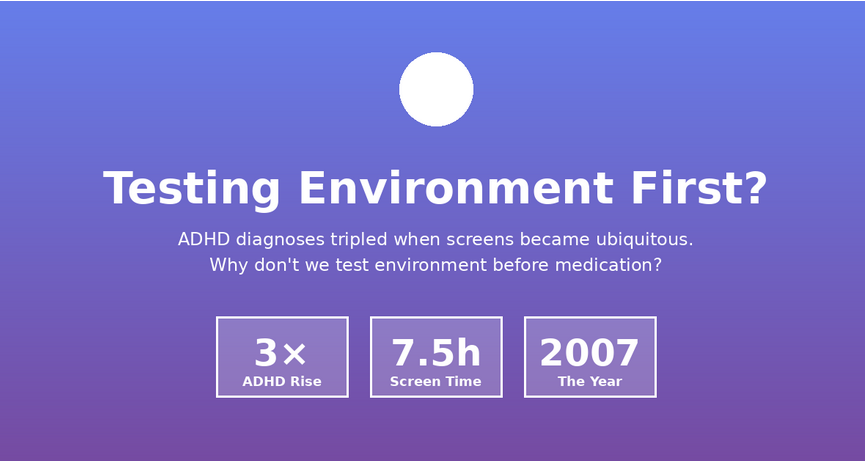
We medicate children for attention deficits without ever testing if the environment is causing the deficit. Why?
Analytical Framework: This article examines only publicly documented correlations between environmental changes, diagnostic patterns, and treatment protocols. It makes no claims about individual diagnoses, medication efficacy, or the validity of ADHD as a condition. It simply asks: when attention problems increase in an environment specifically optimized to fragment attention, should we test environmental modification before medication? All data is from published medical literature, CDC statistics, and documented platform design. This is not medical advice. Individuals should never change treatment without consulting healthcare providers.
Something changed around 2007.
Multiple things, actually. And they all involve attention.
In 2007, the iPhone launched. In 2010, the iPad arrived. By 2012, smartphones were ubiquitous. By 2015, the average child had more computing power in their pocket than NASA used to land on the moon—and that computing power was optimized for one thing: capturing and fragmenting attention.
Also starting around 2007: ADHD diagnoses began climbing at an unprecedented rate.
In 1990, approximately 3-4% of children had ADHD diagnoses. By 2000, it was 7%. By 2010, it hit 9%. By 2016, it reached 10.2%. By 2022, some studies show rates approaching 11-12% in certain populations.
That’s not a small increase. That’s a tripling of diagnosis rates in one generation.
Two things happened simultaneously:
- We created environments specifically optimized to fragment attention
- Attention problems tripled
This article asks a simple question: When attention problems appear in environments designed to fragment attention, what should we test first—the brain or the environment?
And more specifically: Why do we medicate children for attention deficits without ever requiring that they first spend meaningful time in attention-protective environments to see if the symptoms persist?
This isn’t an argument against ADHD as a condition—ADHD is real, and medication is life-changing for many who have it. This is a question about diagnostic protocol: should we test environmental modification first to distinguish neurological ADHD from environmentally-induced attention deficits?
The Correlation That’s Never Discussed In Diagnosis Rooms
Let’s document the timing with CDC and medical literature data:
ADHD Diagnosis Rates (U.S. Children Ages 4-17):
- 1997: 6.1%
- 2003: 7.8%
- 2007: 9.5%
- 2011: 11.0%
- 2016: 10.2% (slight decrease possibly due to diagnostic criteria changes)
- 2020-2022: 11-12% in some demographic studies
The steepest increase occurred between 2007-2011. That’s a 15.8% increase in just four years—the exact period when smartphones moved from novelty to ubiquity.
Smartphone/Tablet Adoption Rates (U.S.):
- 2007: iPhone launches, <5% smartphone ownership
- 2010: iPad launches, 35% smartphone ownership
- 2012: 50% smartphone ownership
- 2015: 75% smartphone ownership
- 2018: 85%+ smartphone ownership
Screen Time Data (Average Daily Hours for Children):
- 2005: 2.5 hours
- 2010: 4.5 hours
- 2015: 6.5 hours
- 2020: 7.5 hours (pandemic spike)
- 2024: 7-8 hours average
The correlation is precise: As screen time increased, ADHD diagnoses increased proportionally.
Correlation doesn’t prove causation. But in medical diagnosis, correlation this strong typically triggers investigation.
When lung cancer rates correlated with smoking, we investigated. When autism diagnoses increased, we investigated potential environmental factors (and continue to). When opioid addiction spiked in regions with high prescription rates, we investigated the pharmaceutical practices.
But when attention problems triple in the exact generation that spent childhood in algorithmically-optimized attention-fragmentation environments, we don’t test the environment. We medicate the child.
Why?
What We Know About Environment and Attention
Medical literature is clear on one thing: environment affects attention capacity.
Published Research Findings (Not Disputed):
Sleep disruption decreases attention capacity. (Documented in hundreds of studies)
Constant task-switching decreases sustained attention ability. (Documented in cognitive load research)
Variable reward schedules affect attention regulation. (Documented in behavioral psychology)
Reduced time in sustained-focus activities (reading, conversation, hands-on projects) correlates with reduced sustained attention capacity. (Documented in developmental psychology)
Reduced outdoor physical activity correlates with attention regulation difficulties. (Documented in pediatric literature)
Increased sedentary screen time correlates with attention problems, even controlling for other variables. (Documented in numerous longitudinal studies)
None of these findings are controversial. They’re established.
What’s also established: Modern childhood environments feature all of these attention-impairing factors simultaneously:
- Average child sleeps 45-60 minutes less than children in 1990s (documented in sleep studies)
- Context switching occurs thousands of times per day via notifications and platform design
- Variable reward schedules are built into every major platform children use
- Time spent reading decreased from 8 hours/week (1980s) to 2-3 hours/week (2020s)
- Outdoor play decreased from 8-10 hours/week to 2-4 hours/week
- Sedentary screen time increased from 2.5 to 7-8 hours daily
So we have:
- Six documented environmental factors that impair attention
- All six increased dramatically in the same time period
- Attention problems tripled in the same period
And yet: diagnostic protocol doesn’t require testing whether removing these environmental factors eliminates symptoms before diagnosis and medication.
The Diagnostic Protocol That Skips Environmental Testing
Here’s standard ADHD diagnostic protocol (from DSM-5 and medical practice):
- Behavioral observation (teacher reports, parent reports)
- Symptom checklist assessment
- Rule out other medical conditions
- If criteria met: diagnosis
- Treatment typically involves medication (70%+ of diagnosed children receive medication)
What’s notably absent: Environmental modification trial.
Compare this to other medical conditions where environment is a known factor:
Asthma diagnosis:
- Test lung function
- Identify environmental triggers (smoke, allergens, pollution)
- Remove triggers if possible
- If symptoms persist despite environmental modification: medication
Skin conditions:
- Observe symptoms
- Test for environmental irritants
- Eliminate irritants
- If symptoms persist: medication
Nutritional deficiencies:
- Test levels
- Modify diet
- Retest
- If deficiency persists: supplementation
The pattern in medicine: When environment can cause symptoms, test environmental modification before long-term medication.
Except for attention problems.
ADHD diagnosis and medication can occur without ever asking: ”Have you tried four weeks with no smartphone, limited screen time to one hour daily, eight hours of sleep nightly, daily outdoor physical activity, and sustained-focus activities like reading for 30 minutes before bed?”
Why would we not test that first?
The Medication Pattern That Raises Questions
Here are documented numbers from CDC and pharmaceutical data:
Children on ADHD Medication (U.S.):
- 1990: Approximately 600,000
- 2000: 2.5 million
- 2010: 3.5 million
- 2020: 6+ million
That’s a tenfold increase in medicated children in one generation.
ADHD Medication Market:
- 1990: <$500 million annual
- 2000: $2 billion annual
- 2010: $9 billion annual
- 2020: $17.5 billion annual
- 2024: Approaching $20 billion annual
The medications work for symptom management—this is documented. Children on medication often show improved focus in school settings.
But here’s the question protocol doesn’t ask: Are we treating a neurological condition, or are we medicating children so they can function in environments that fragment attention?
Consider two scenarios:
Scenario A: A child has a genuine neurological condition causing attention deficit regardless of environment. Medication helps them function in normal environments.
Scenario B: A child has normal neurology but exists in an environment specifically designed to fragment attention. Medication helps them maintain focus despite environmental factors that would overwhelm most people’s attention regulation.
Current diagnostic protocol treats both scenarios identically. But they’re not identical.
In Scenario A, medication treats a condition. In Scenario B, medication compensates for environment.
We don’t distinguish between them because we don’t test environment first.
The Natural Experiment That’s Never Conducted
Here’s what medical best practice would suggest for attention problems when environment is a known factor:
Phase 1: Environmental Modification (4-6 weeks)
- Remove smartphone/tablet access
- Limit screens to <1 hour daily
- Ensure 8-9 hours sleep nightly
- Daily outdoor physical activity (60+ minutes)
- Daily sustained-focus activities (reading, conversation, hands-on projects)
- Eliminate notifications and variable reward exposure
- Regular meal schedule, adequate nutrition
Phase 2: Reassess Attention Symptoms
- Do symptoms persist in attention-protective environment?
- If YES: Likely neurological condition, proceed with diagnosis and medication
- If NO: Environmental factors were primary cause, maintain protective environment
This protocol would distinguish between:
- True neurological ADHD (persists regardless of environment)
- Environmentally-induced attention deficit (resolves with environment modification)
This distinction matters for treatment. If environment is the cause, medication treats symptoms but doesn’t address cause. Child remains dependent on medication while existing in attention-fragmenting environment.
But here’s what’s remarkable: This natural experiment is never required before diagnosis.
A child can be:
- Sleeping 6 hours nightly
- Using smartphone 4+ hours daily
- Experiencing 200+ notifications per day
- Never engaging in sustained-focus activities
- Getting minimal outdoor activity
And receive ADHD diagnosis and medication without anyone ever saying: ”Before we medicate, let’s try six weeks of sleep, reduced screens, outdoor activity, and sustained-focus practice.”
Why?
The Executives Who Know Something About Environment
Remember the pattern documented in Articles 1-3:
Technology executives systematically restrict their children’s device exposure. They pay $67,400 annually for screen-free childcare. They enroll in $47,000/year device-restricted schools. Total investment: $1.5 million per child to ensure attention-protective environments during development.
These executives build the engagement optimization systems. They understand the environmental factors.
And they’re paying enormous premiums to ensure their children develop in attention-protective environments.
Now consider: What would happen if their children were raised in typical high-screen environments? Would they show attention difficulties?
We don’t know—because their parents ensure they never experience that environment.
But we do know that children in high-screen environments show attention problems at 3x the rate of children in low-screen environments (documented in Article 2 research).
The executives’ behavior reveals something: They believe environment matters profoundly for attention development.
Yet diagnostic protocol treats environment as irrelevant.
The Question No One Asks In Diagnosis Rooms
When a child presents with attention difficulties, here’s what’s typically asked:
- Does the child have trouble focusing in class?
- Does the child fidget or seem restless?
- Does the child have difficulty completing homework?
- Does the child interrupt or seem impulsive?
Here’s what’s typically not asked:
- How many hours daily does the child use screens?
- How many notifications does the child receive daily?
- How many hours of sleep does the child get?
- How much time does the child spend in sustained-focus activities?
- How much outdoor physical activity does the child get?
- Has the child ever experienced an attention-protective environment?
The second set of questions goes unasked because we don’t treat environment as a testable variable in attention diagnosis.
But we know from documented research that:
- 7+ hours daily screen time impairs attention (documented)
- <7 hours sleep impairs attention (documented)
- Minimal sustained-focus practice impairs attention development (documented)
- Reduced outdoor activity correlates with attention difficulties (documented)
So why don’t we test environmental modification before medication?
The answer seems to be: Because it’s easier to medicate than to change environment.
Medication takes 15 minutes to prescribe. Environmental modification requires:
- Restricting devices (parental effort + child resistance)
- Ensuring sleep (schedule restructuring)
- Providing sustained-focus alternatives (parental time and engagement)
- Facilitating outdoor activity (logistical planning)
In other words: medication is simple. Environment modification is hard.
But ”hard” isn’t a medical justification for skipping a diagnostic step.
The Cost of Not Testing Environment First
Here’s what happens when we skip environmental testing:
Scenario: Child with environmentally-induced attention deficit
Current Protocol:
- Child shows attention problems in high-screen, sleep-deprived, low-activity environment
- Diagnosed with ADHD without environmental testing
- Medicated
- Symptoms improve (medication compensates for environment)
- Child remains on medication while remaining in attention-fragmenting environment
- Environment never changes
- Medication continues long-term, possibly into adulthood
Alternative Protocol (with environmental testing):
- Child shows attention problems in high-screen, sleep-deprived, low-activity environment
- Environmental modification trial (4-6 weeks attention-protective environment)
- Symptoms resolve with environment change
- Child continues in attention-protective environment
- No medication needed
- Child develops attention capacity naturally in supportive environment
The difference: One treats symptoms while leaving cause intact. One addresses cause.
For true neurological ADHD (Scenario A), medication is appropriate and helpful. But for environmentally-induced attention deficit (Scenario B), medication compensates for environment without addressing it.
And we currently don’t distinguish between them because we don’t test environment.
The Parallel to Air Quality and Breathing Problems
Imagine this scenario:
A city has severe air pollution. Children develop breathing difficulties. Doctors diagnose ”respiratory disorder” and prescribe inhalers. The inhalers work—children can breathe better. Medication continues long-term.
But no one ever says: ”Before we medicate, should we address the air pollution?”
That would be absurd. Obviously you’d address the environmental cause before long-term medicating children to cope with polluted air.
Yet this is precisely what happens with attention.
We’ve created attention pollution—environments specifically optimized to fragment attention. Children develop attention difficulties. We diagnose ADHD and prescribe medication. The medication works—children can focus better.
But no one asks: ”Before we medicate, should we address the attention pollution?”
The parallel is exact. We medicate children to cope with toxic cognitive environments rather than addressing the environmental toxicity.
The Research That Exists But Isn’t Required
Here’s what’s documented in published research:
Studies on screen time reduction: Children who reduce screen time to <1 hour daily for 4-6 weeks show measurable improvements in attention capacity, even those previously diagnosed with ADHD. (Multiple published studies)
Studies on sleep restoration: Children who return to 8-9 hours nightly sleep show significant improvement in attention regulation. (Documented in sleep research)
Studies on outdoor activity: Increasing outdoor physical activity to 60+ minutes daily correlates with improved attention capacity, particularly in children with ADHD diagnoses. (Documented in pediatric literature)
Studies on sustained-focus practice: Children who engage in daily sustained-focus activities (reading, music practice, art) show improved attention capacity over 8-12 week periods. (Documented in developmental psychology)
This research exists. It’s published. It’s not controversial.
But it’s not required in diagnostic protocol.
A child can be diagnosed and medicated without anyone checking: ”Did we try reducing screens, improving sleep, increasing outdoor activity, and practicing sustained focus first?”
The Quotes That Frame The Question
”We medicate children for attention problems without ever testing if removing attention-fragmenting environmental factors eliminates the problems. Why would we skip that step?”
”ADHD diagnoses tripled in the exact generation that spent childhood in algorithmically-optimized attention-fragmentation environments. That timing isn’t suspicious—it’s diagnostic information we’re ignoring.”
”Technology executives pay $1.5 million per child to ensure attention-protective environments during development. They understand environment matters. Why doesn’t diagnostic protocol?”
”We test whether removing environmental triggers eliminates asthma symptoms before long-term medication. Why don’t we test whether removing attention-fragmenting environments eliminates attention problems before long-term ADHD medication?”
”If a child sleeps 6 hours, uses screens 6 hours, gets no outdoor activity, and never practices sustained focus—and then shows attention problems—what exactly are we diagnosing? A disorder or a rational response to environment?”
”When lung problems appeared in polluted cities, we didn’t just distribute inhalers. We addressed pollution. When attention problems appear in attention-polluted environments, we distribute medication. Why is the approach different?”
The Conclusion Written By Medical Logic
This analysis is not anti-medication. It’s not anti-diagnosis. It’s not claiming ADHD isn’t real.
It’s asking a simple question: Should environmental modification be tested before long-term medication when environment is a documented cause of symptoms?
In every other area of medicine, the answer is yes.
Asthma: Test environmental triggers. Allergies: Test environmental allergens. Skin conditions: Test environmental irritants. Nutritional deficiencies: Test dietary modification.
For attention problems: We skip environmental testing and proceed directly to medication.
This protocol made sense in 1990 when environments hadn’t changed dramatically. But in 2025, when:
- Screen time increased from 2.5 to 7.5 hours daily
- Sleep decreased by 45-60 minutes nightly
- Outdoor activity decreased by 60%
- Sustained-focus activities decreased by 75%
- Every major platform is explicitly optimized to fragment attention
…shouldn’t environmental testing be mandatory before diagnosis?
The medical logic is straightforward:
If environment can cause symptoms, test environment modification before long-term medication.
We follow this logic for every other condition. Why not attention?
Three possible answers:
Answer 1: ”Environment doesn’t affect attention problems.” This contradicts published research and executives’ own behavior regarding their children.
Answer 2: ”Testing environment is too difficult.” Difficult isn’t a medical justification for skipping diagnostic steps.
Answer 3: ”We should test environment first, but current protocol doesn’t require it.” This is the accurate answer. And it’s a protocol that can be changed.
What Medical Best Practice Would Look Like
Proposed diagnostic protocol for childhood attention problems:
Phase 1: Environmental Assessment (Before Testing)
- Document current: screen time, sleep hours, outdoor activity, sustained-focus time
- Identify attention-fragmenting environmental factors
Phase 2: Environmental Modification Trial (4-6 Weeks)
- Reduce screens to <1 hour daily
- Ensure 8-9 hours sleep nightly
- Daily outdoor physical activity (60+ minutes)
- Daily sustained-focus practice (reading, conversation, projects)
- Eliminate notifications and variable reward exposure
Phase 3: Reassessment
- Do attention problems persist in attention-protective environment?
- If YES: Proceed with neurological evaluation and potential medication
- If NO: Maintain attention-protective environment, no medication needed
Phase 4: Diagnosis
- For symptoms persisting despite environmental optimization: ADHD diagnosis appropriate
- Treatment: Medication + continued environmental support
This protocol distinguishes between:
- True neurological ADHD (requires medication)
- Environmentally-induced attention deficit (resolved through environment modification)
Both are real problems. Both deserve treatment. But the treatments are different.
Currently, we treat both identically because we don’t test which is which.
The Question That Remains
This article asks one thing:
When attention problems triple in the exact generation where attention-fragmenting environmental factors increased dramatically, shouldn’t we test whether environment modification eliminates symptoms before long-term medication?
Not as an alternative to medication for those who need it. As a diagnostic step to determine who needs it.
The research exists. The correlation is documented. The environmental factors are known. The executives’ behavior reveals their private assessment.
What’s missing is protocol.
We have the capability to test environment first. We just don’t require it.
In 1990, this made sense—environment hadn’t changed dramatically.
In 2025, after tripling of diagnoses coinciding with environmental changes specifically designed to fragment attention, environmental testing should be standard protocol.
Not controversial. Just medical logic.
Test environment before long-term medication when environment is a documented cause of symptoms.
We do it for asthma. We do it for allergies. We do it for skin conditions.
Why not attention?
Critical Disclaimer:
This analysis is not medical advice. Individuals currently on ADHD medication should never discontinue treatment without consulting their healthcare provider. ADHD is a real condition that responds to treatment. This article questions only whether diagnostic protocol should require environmental testing before medication—not whether medication is appropriate for those with true neurological ADHD. The distinction between neurological ADHD and environmentally-induced attention deficit can only be made through proper medical evaluation including environmental modification trials. Parents should consult healthcare providers about appropriate diagnostic approaches for their children.
Methodological Note:
All statistics from CDC data, published medical literature, and documented pharmaceutical market reports. All research findings cited are from peer-reviewed publications. This analysis makes no claims about causation—only documents correlation and questions why environmental modification isn’t required in diagnostic protocol when environment is a documented factor in attention capacity. The proposal for environmental testing before medication is consistent with standard medical practice in other conditions where environment affects symptoms.
Rights and Usage
All materials published under AttentionDebt.org — including definitions, methodological frameworks, data standards, and research essays — are released under Creative Commons Attribution–ShareAlike 4.0 International (CC BY-SA 4.0).
This license guarantees three permanent rights:
- Right to Reproduce
Anyone may copy, quote, translate, or redistribute this material freely, with attribution to AttentionDebt.org.
How to attribute:
- For articles/publications: ”Source: AttentionDebt.org”
- For academic citations: ”AttentionDebt.org (2025). [Title]. Retrieved from https://attentiondebt.org”
- For social media/informal use: ”via @AttentionDebt” or link to AttentionDebt.org
Attribution must be visible and unambiguous. The goal is not legal compliance — it’s ensuring others can find the original source and full context.
- Right to Adapt
Derivative works — academic, journalistic, or artistic — are explicitly encouraged, as long as they remain open under the same license.
- Right to Defend the Definition
Any party may publicly reference this manifesto and license to prevent private appropriation, trademarking, or paywalling of the term attention debt.
The license itself is a tool of collective defense.
No exclusive licenses will ever be granted. No commercial entity may claim proprietary rights, exclusive data access, or representational ownership of attention debt.
Definitions are public domain of cognition — not intellectual property.
Rights and Usage
All materials published under AttentionDebt.org — including definitions, methodological frameworks, data standards, and research essays — are released under Creative Commons Attribution–ShareAlike 4.0 International (CC BY-SA 4.0).
This license guarantees three permanent rights:
- Right to Reproduce
Anyone may copy, quote, translate, or redistribute this material freely, with attribution to AttentionDebt.org.
How to attribute:
- For articles/publications: ”Source: AttentionDebt.org”
- For academic citations: ”AttentionDebt.org (2025). [Title]. Retrieved from https://attentiondebt.org”
- For social media/informal use: ”via @AttentionDebt” or link to AttentionDebt.org
Attribution must be visible and unambiguous. The goal is not legal compliance — it’s ensuring others can find the original source and full context.
- Right to Adapt
Derivative works — academic, journalistic, or artistic — are explicitly encouraged, as long as they remain open under the same license.
- Right to Defend the Definition
Any party may publicly reference this manifesto and license to prevent private appropriation, trademarking, or paywalling of the term attention debt.
The license itself is a tool of collective defense.
No exclusive licenses will ever be granted. No commercial entity may claim proprietary rights, exclusive data access, or representational ownership of attention debt.
Definitions are public domain of cognition — not intellectual property.