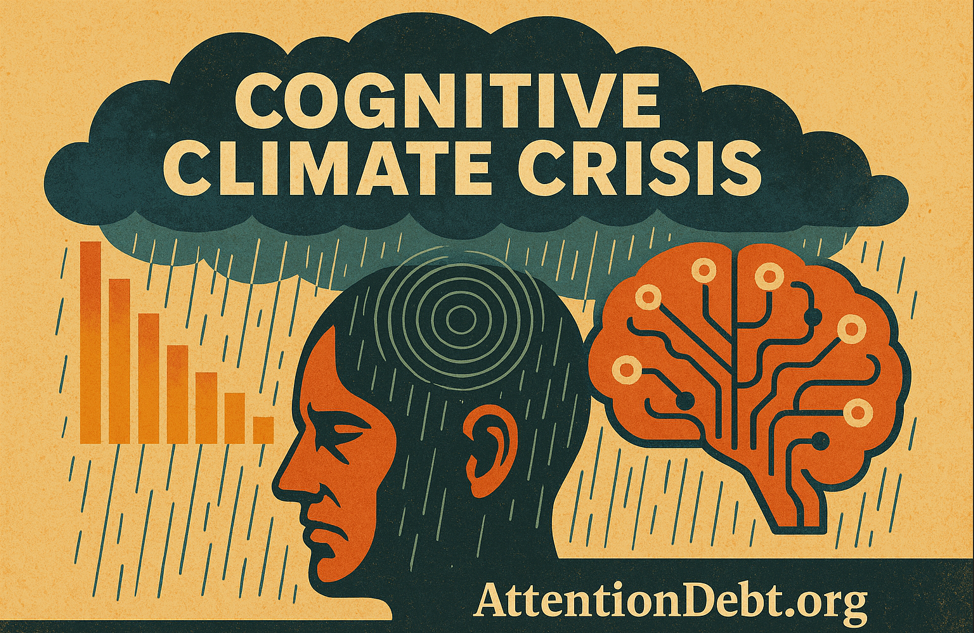
TL;DR — The Crisis in Five Points
- Attention is not a resource—it’s a biosphere. Like Earth’s atmosphere, the cognitive climate has specific conditions required for higher thought to survive. Those conditions are collapsing.
- Notifications are emissions. Every ping, scroll, and feed refresh pumps cognitive pollutants into your neural atmosphere. We’ve increased cognitive emissions 10,000% since 2007.
- Age 35 is the tipping point. Neural plasticity shifts from fluid to structural. Adaptations to toxic cognitive atmosphere become permanent architecture. Like melting ice caps—irreversible without massive intervention.
- Gen Alpha are climate refugees. Born into cognitive conditions already past habitability thresholds. They never experienced clean attentional air. They are adapting to unbreathable atmosphere.
- Platforms are fossil fuel companies. The business model IS the emissions. Voluntary reduction is structurally impossible. Only regulation can restore atmospheric quality.
Humanity is not experiencing a distraction epidemic.
We are experiencing full-scale cognitive climate collapse.
Not metaphorically. Not as loose analogy. But as measurable ecological collapse occurring in billions of nervous systems simultaneously—a crisis as real, as urgent, and as civilizationally threatening as climate change itself.
Attention is not a resource you manage. Attention is the biosphere of human cognition—the living ecosystem in which thought, meaning, memory, and consciousness itself must survive or suffocate.
And that biosphere is collapsing.
The atmospheric CO₂ of the mind is rising. The cognitive temperature is increasing. The polar ice caps of sustained focus are melting irreversibly. And an entire generation—Gen Z and Gen Alpha—are being born into a world where the cognitive climate has already shifted past the point of natural recovery.
They are the first attention climate refugees. Born into cognitive conditions that no longer support the neural ecosystems required for deep thought, complex reasoning, or sustained presence.
This is not distraction. This is extinction-level threat to higher-order human cognition.
And unlike the climate crisis, where the science has been clear for decades, the cognitive climate crisis remains invisible to most people—even as they suffocate in an atmosphere they can no longer breathe.
The Biosphere You Didn’t Know You Had
Every ecosystem requires specific atmospheric conditions to sustain life. Change the composition too quickly, and mass extinction follows.
The Earth’s biosphere requires 21% oxygen, specific temperature ranges, and chemical stability. Alter these parameters beyond narrow thresholds, and the living systems collapse.
Human cognition has a biosphere too. Not made of air and water, but of attentional capacity—the cognitive atmosphere in which neural processes occur, memories consolidate, and consciousness operates.
This cognitive biosphere requires:
Sustained attention spans — the ability to maintain focus on complex problems for extended periods without fragmenting. Like atmospheric oxygen concentration, this must remain within specific ranges for higher cognition to function.
Temporal depth — the capacity to think across long time horizons, connecting past experience to future possibility. Like stable climate patterns that enable seasonal cycles, this temporal stability allows planning, learning, and meaning-making.
Cognitive rest periods — intervals of non-stimulation where the brain consolidates information and repairs neural infrastructure. Like Earth’s day-night cycles, these restoration periods are not optional—they are structural requirements for system health.
Mental signal clarity — the ability to distinguish meaningful patterns from noise. Like atmospheric transparency that allows light to reach Earth’s surface, cognitive clarity enables learning and understanding.
For the first 200,000 years of human existence, this cognitive biosphere remained stable. Natural limits on information velocity, stimulation intensity, and attention capture ensured the atmosphere stayed breathable.
Then we invented the algorithmic feed. And everything changed.
The Emissions Crisis: What Notifications Actually Are
In climate science, greenhouse gases trap heat in the atmosphere, raising global temperatures beyond the range biological systems evolved to handle. The warming isn’t caused by heat directly—it’s caused by emissions that alter atmospheric composition.
In cognitive ecology, notifications and feed updates function identically. They are not attention itself. They are cognitive emissions that alter the composition of your attentional atmosphere.
Every notification is a micro-dose of cognitive CO₂. Every algorithmic feed refresh is industrial-scale pollution pumped directly into your neural ecosystem. And like atmospheric carbon, these emissions accumulate faster than natural systems can process them.
The mechanism is precise:
Each notification triggers cortisol release — a stress hormone that fragments attention and prevents sustained focus. One notification per hour is manageable. One per minute exceeds the brain’s capacity to return to cognitive baseline. The pollutant accumulates.
Each feed scroll resets your attention cycle — interrupting whatever cognitive process was underway. Like emissions that disrupt weather patterns, these interruptions prevent the formation of complex thought-weather systems that require hours of stability to develop.
Each context switch exhausts cognitive resources — depleting the ATP that neurons require for sustained firing. Like industrial processes that consume oxygen faster than forests can replace it, digital context-switching consumes attention faster than sleep can restore it.
The result: Your cognitive atmosphere becomes unbreathable. Not gradually. Not across millennia. But within a single generation.
Between 2007 (iPhone launch) and 2025, humanity increased its cognitive emissions by an estimated 10,000%. We went from zero smartphone notifications to hundreds per day, from no algorithmic feeds to hours of daily scrolling, from occasional digital interruption to continuous cognitive pollution.
This is the fastest atmospheric transformation in the history of any biosphere. And the human brain, which evolved over 200,000 years to operate in clean cognitive air, is suffocating.
The Warming: How Your Neural Climate Is Heating Up
Global warming doesn’t mean every place gets uniformly hotter. It means the entire system becomes more volatile—more extreme weather, more unpredictable patterns, more ecosystem collapse.
Cognitive warming follows the same pattern. The rising ”temperature” of your attentional atmosphere doesn’t manifest as uniform decline. It manifests as:
Increased volatility in focus — you can hyperfocus on highly stimulating content (doomscrolling for hours) while finding it impossible to sustain attention on complex, meaningful work. The cognitive weather has become erratic.
Shorter thought-seasons — ideas that once had time to develop across days or weeks now must complete in minutes or evaporate. The growing season for complex thought is shrinking.
Frequent cognitive storms — anxiety, overwhelm, information overload that arrives in waves rather than steady states. Your internal weather patterns have destabilized.
Baseline temperature rise — your resting cortisol levels are higher than they were five years ago. Even in ”calm” moments, your cognitive climate runs hotter. The baseline has shifted.
This warming is measurable. Studies tracking sustained attention capacity show consistent decline across populations heavily exposed to digital environments. What took 20 minutes to fragment your focus in 2010 now takes 2 minutes. The threshold has lowered because the atmospheric composition has changed.
You’re not weaker. The air is thinner.
And like climate change, the warming feeds on itself. Higher cognitive temperatures make you more vulnerable to the next notification, which raises the temperature further, which lowers your resistance more. The feedback loop accelerates.
By the time you notice you can’t breathe, the atmosphere has already shifted beyond natural recovery range.
The Tipping Point: When Neural Ice Caps Melt Permanently
Climate scientists identify ”tipping points”—thresholds past which warming becomes irreversible without massive intervention. Melting ice caps, collapsing ocean currents, methane release from thawing permafrost.
Cognitive ecology has tipping points too. And the most significant occurs around age 35.
Before 35: High neural plasticity. Your brain actively remodels itself based on experience. If the cognitive atmosphere degrades, you can still recover—the neural ice caps can refreeze if conditions improve.
After 35: Plasticity shifts from fluid to structural. Neural pathways stabilize. What was pattern becomes architecture. The cognitive climate you’ve been living in becomes the permanent geography of your mind.
This is the melting point.
If you spent ages 15-35 in toxic cognitive atmosphere—breathing polluted attention, living through constant cognitive warming, adapting to extreme thought-weather—then around 35, those adaptations calcify. The fragmented attention patterns become permanent neural geography. The shortened focus spans become structural limitations. The dependence on external stimulation becomes architectural necessity.
You don’t just live in a warmer climate. You become a warm-climate species, incapable of surviving in the cooler, stabler cognitive conditions that complex thought requires.
This isn’t aging. This is adaptation to toxic atmosphere becoming permanent.
Research confirms: people who cross the age-35 threshold with high levels of digital exposure show significantly reduced capacity for sustained attention—not because their brains are older, but because their neural architecture has adapted to polluted cognitive atmosphere and then locked in that adaptation.
The ice caps melted. And unlike planetary ice, which might theoretically refreeze over millennia, neural architecture past the plasticity threshold rarely recovers fully. You can stabilize. You can adapt further. But restoration to pre-warming baseline becomes exponentially more difficult.
The tipping point is not a metaphor. It is a biological threshold measured in years, not degrees.
The Climate Refugees: Generation Alpha’s Birthright Crisis
In Earth’s climate crisis, we speak of climate refugees—people forced to abandon their homes as environments become uninhabitable. Rising seas, crop failure, extreme weather that makes traditional life impossible.
Generation Alpha (born 2010-2025) and the latter half of Gen Z are the world’s first attention climate refugees.
They were born into cognitive atmosphere that had already shifted past the threshold of natural habitability. They never experienced clean attentional air. They never lived in stable cognitive climate. They are native to warming conditions that previous generations experienced as emergency.
For them, there is no ”before.” No memory of what sustained attention felt like. No baseline of cognitive stability to return to.
They are climate refugees in their own minds—unable to inhabit the cognitive ecosystems their parents grew up in, forced to adapt to conditions that cannot support the same level of complex thought, deep focus, or extended reasoning.
This is not their failure. This is environmental collapse that occurred before they had any choice in the matter.
And like climate refugees who cannot simply ”return home” because home is underwater, attention climate refugees cannot simply ”focus better” because the cognitive atmosphere they breathe will not support it.
The infrastructure is missing. The neural pathways never formed. The baseline was never established.
The studies are devastating:
Gen Alpha shows the shortest sustained attention spans ever measured. Not because they’re less intelligent—IQ remains stable. But because the cognitive atmosphere they breathe cannot support extended focus. They suffocate when attempting what previous generations considered normal cognitive exertion.
They experience anxiety when screens are removed not because they’re addicted, but because their entire sense of cognitive stability depends on constant external stimulation. Like organisms adapted to high-CO₂ atmosphere who cannot breathe normal air.
They struggle with boredom not because they lack imagination, but because their neural reward systems developed in high-stimulation environments. Returning to low-stimulation conditions feels like suffocation—because, neurologically, it is.
These are not behavioral problems. These are organisms adapted to toxic atmosphere trying to survive in it.
And the truly catastrophic recognition: if we restore cognitive air quality, many of these climate refugees will struggle to survive the transition. Their adaptation is so complete that clean air feels unbreathable.
The Externality Problem: Who Pays for Cognitive Warming?
In economics, an externality is a cost imposed on third parties who didn’t participate in the transaction. Climate change is history’s largest externality—fossil fuel companies profit from extraction while the entire planet pays the environmental cost.
Cognitive warming follows identical economics.
Platforms generate emissions — every notification, every feed optimization, every engagement algorithm pumps cognitive pollutants into the atmosphere. These emissions are not accidental byproducts. They are the core value proposition. More emissions = more engagement = more revenue.
Users breathe the polluted atmosphere — experiencing fragmented attention, declining focus, rising cognitive temperatures. They pay the cost in degraded neural function, lost productivity, impaired relationships, diminished wellbeing.
Society absorbs the systemic damage — reduced educational outcomes, compromised democratic deliberation, weakened institutional capacity, inability to solve complex problems that require sustained collective attention.
The perfect externality. Platforms capture 100% of the value (engagement → advertising revenue). Users and civilization pay 100% of the cost (cognitive degradation → societal dysfunction).
And like fossil fuel companies that spent decades denying climate science, platforms deny cognitive science. They reframe emissions as features (”keeping you connected!”), fund research showing ”no proven harm,” and deploy digital wellness theater while optimizing emissions to maximize extraction.
The playbook is identical:
- Deny the problem exists — ”screen time” not ”cognitive pollution”
- Blame individual users — ”you should show more self-control”
- Propose voluntary measures — ”use our mindfulness features!”
- Fight regulation — ”innovation requires freedom”
- Capture the oversight — hire former regulators, fund favorable research
- Continue emissions — because they must, or the business model collapses
The parallel extends to corporate structure. ExxonMobil cannot stop extracting oil and remain ExxonMobil. Meta cannot stop extracting attention and remain Meta. The emissions are not an unfortunate side effect. They are the business model.
This is why individual digital wellness cannot solve systemic cognitive warming. You cannot solve climate change by personally recycling. You cannot solve attention collapse by personally using less technology.
The emissions are structural. The warming is systemic. The solution requires regulation, not virtue.
The Measurement Problem: Making Cognitive Warming Visible
Climate scientists measure atmospheric CO₂ in parts per million. They track global temperature increases in degrees Celsius. They model ice cap volume, sea level rise, extreme weather frequency.
These measurements make the invisible visible. They convert abstract warming into concrete data that policy makers cannot ignore.
Cognitive warming needs equivalent measurement:
Sustained Attention Capacity (SAC) — median minutes before focus fragments. Measured longitudinally across populations. Currently declining at approximately 15% per decade in high-digital-exposure cohorts.
Cognitive Emission Load (CEL) — notifications per hour, feed refreshes per day, context switches per minute. Currently averaging 200-300 interruptions daily for typical smartphone users. This is 100x the preindustrial baseline.
Neural Temperature Index (NTI) — baseline cortisol levels, stress biomarkers, cognitive volatility measures. Rising consistently across all measured populations since 2010.
Attention Climate Habitability Index (ACHI) — composite measure of whether cognitive atmosphere can support complex thought, deep reading, extended focus. Declining sharply, with some demographics already below habitability thresholds.
Without measurement, cognitive warming remains invisible. With measurement, it becomes undeniable.
This is why open, non-proprietary measurement standards matter. When platforms control the metrics, they measure engagement (which they want to maximize) not habitability (which would reveal the damage). Independent, standardized cognitive climate monitoring is infrastructure, not product.
AttentionDebt.org exists to establish this measurement infrastructure before commercial interests capture the metrics and redefine warming as wellness.
THE COGNITIVE CLIMATE MODEL (Visual Framework)
COGNITIVE ATMOSPHERE COMPOSITION (2007 vs 2025)

2007 — Pre-Industrial Cognitive Baseline
━━━━━━━━━━━━━━━━━━━━━━━━━━━━━━━━━━━━
Sustained Attention: ████████████ 85%
Rest Periods:        ███████████░ 75%
Deep Focus:          ██████████░░ 70%
Cognitive Clarity:   ████████████ 85%

Average Emissions: 3-5 interruptions/day
Atmospheric Quality: HABITABLE

2025 — Post-Algorithmic Warming
━━━━━━━━━━━━━━━━━━━━━━━━━━━━━━━━━━━━
Sustained Attention: ████░░░░░░░░ 30%
Rest Periods:        ██░░░░░░░░░░ 15%
Deep Focus:          ███░░░░░░░░░ 25%
Cognitive Clarity:   ████░░░░░░░░ 35%

Average Emissions: 200-300 interruptions/day
Atmospheric Quality: CRITICAL

TIPPING POINT THRESHOLD: Age 35
━━━━━━━━━━━━━━━━━━━━━━━━━━━━━━━━━━━━
Before: Reversible adaptation (high plasticity)
After:  Permanent architecture (locked structure)

CLIMATE REFUGEES: Gen Alpha (2010-2025)
━━━━━━━━━━━━━━━━━━━━━━━━━━━━━━━━━━━━
Never experienced habitable cognitive baseline
Born into >150 interruptions/day environment
Baseline SAC: <8 minutes (vs 20+ pre-2007)
This model can be rendered as infographic showing atmospheric degradation over time, similar to climate warming graphs. Publications love data visualization.
The Paris Agreement We Need: Cognitive Emission Limits
The Paris Climate Agreement set global targets: limit warming to 1.5°C above preindustrial levels. Ambitious, insufficient, but necessary. A line drawn that forces nations to confront the mathematics of emissions versus survival.
We need the equivalent for cognitive climate.
The Cognitive Paris Agreement would establish:
Emission limits — maximum notifications per hour (suggested: 3), maximum feed scroll time per day (suggested: 30 minutes), mandatory emission-free hours (suggested: 8+ overnight + 4+ daytime).
Baseline protection — preserve cognitive air quality for children under 16. Zero algorithmic feed exposure during critical neural development. The cognitive equivalent of protecting children from industrial pollutants.
Tipping point prevention — arrest cognitive warming before age-35 threshold cements permanent damage. Intervention protocols for populations approaching irreversible adaptation.
Atmospheric restoration targets — return average Sustained Attention Capacity to 2010 baseline (approximately 12 minutes) by 2035. Ambitious but measurable.
Platform accountability — require emission disclosure. Every platform reports total cognitive emissions per user per year. Emissions become visible, regulated, and reduceable.
Refugee support — massive investment in restoration infrastructure for attention climate refugees. The generations already damaged by warming require support equivalent to climate adaptation funding.
This is not reactionary. This is recognition that the cognitive biosphere has limits—and we’ve exceeded them.
The platforms will resist. Like fossil fuel companies resisted climate action. The arguments will be identical:
- ”The science isn’t settled”
- ”This will hurt innovation”
- ”Users prefer our services”
- ”Voluntary measures work better”
- ”The economic cost is too high”
All false. All familiar. All tactics perfected by industries profiting from externalities.
The science is settled. Cognitive warming is measurable. The damage is real. The tipping points are biological. And individual virtue cannot solve structural emissions.
Why Platforms Are Cognitive Fossil Fuel Companies
The comparison is not rhetorical. It is structural.
Both extract value from natural reserves — fossil fuels from geologic deposits, platforms from human attention (which is limited, non-renewable on human timescales).
Both profit from emissions that damage the atmosphere — carbon emissions warm the planet, notification emissions warm cognitive climate.
Both generate massive externalities — climate damage paid by society, cognitive damage paid by users and civilization.
Both are structurally unable to stop emissions — the business model requires extraction. Voluntary reduction threatens profitability.
Both fund denial and delay — climate science denial, attention science dismissal. Same playbook, different domain.
Both capture regulators — through lobbying, research funding, revolving door employment.
Both claim individual responsibility — ”reduce your carbon footprint” / ”practice digital wellness.” Both deflections from systemic solutions.
The deepest parallel: Neither can be reformed from within. ExxonMobil cannot become a solar company and remain ExxonMobil—the shareholders, structure, and expertise are built for extraction. Meta cannot become a cognitive preservation company and remain Meta. The business model is the emissions.
This doesn’t make platforms evil. It makes them structurally misaligned with cognitive atmospheric health. Like fossil fuel companies are structurally misaligned with planetary atmospheric health.
The recognition matters because it clarifies the solution: Regulation. Public infrastructure. Open protocols that don’t depend on emissions for survival.
You cannot ask an emissions-based business to voluntarily stop emitting. You can only require it, the same way we require emissions controls on power plants, catalytic converters on cars, and phase-outs of ozone-depleting substances.
The cognitive atmosphere is a commons. Emissions must be regulated as such.
The Choice: Restoration or Permanent Warming
We face a civilizational decision point with no middle ground.
Path A: Continue cognitive emissions unchecked
By 2035, average Sustained Attention Capacity drops below 5 minutes—the threshold at which complex problem-solving becomes structurally impossible. Democracy fails because citizens cannot sustain attention through long-form policy analysis. Science stalls because researchers cannot maintain focus through multi-year investigations. Culture fragments because nobody can hold narrative arcs longer than viral clips.
Gen Alpha reaches age 35 with neural architecture permanently adapted to toxic cognitive atmosphere. They become a warm-climate species unable to inhabit the cooler, more stable cognitive environments their grandparents knew. The restoration window closes biologically.
Cognitive climate refugees number in the billions. Most humans live in cognitive conditions that cannot support higher-order reasoning, extended focus, or deep presence. We adapt by simplifying everything to fit degraded capacity. The problems that require sustained collective attention—climate itself, governance, inequality, existential risk—become unsolvable because the cognitive atmosphere cannot support the thought required to address them.
Civilization survives. But as something simpler. Something that has forgotten it was once capable of more.
Path B: Regulate cognitive emissions now
By 2030, platform notification limits become law. Emission standards for digital environments mirror clean air standards for physical environments. Children grow up in protected cognitive zones where atmospheric quality supports neural development.
The first cohort of ”post-restoration kids” reaches adolescence breathing clean attentional air. Their baseline Sustained Attention Capacity returns to preindustrial levels—not because they’re superhuman, but because they aren’t actively poisoned during development.
Attention climate refugees receive massive support—neural rehabilitation programs, cognitive restoration infrastructure, protection from continued emissions. Like climate adaptation, it’s expensive. Like climate adaptation, it’s cheaper than collapse.
By 2040, we measure success not in platform engagement but in cognitive habitability. The atmospheric composition of human attention becomes managed commons, protected by regulation, monitored by independent science.
Civilization preserves the capacity for complex thought, sustained focus, deep presence. The problems that require sustained collective attention remain solvable. We continue being a species that can think across decades, grapple with complexity, maintain presence with each other.
We survive as something recognizably human.
The Window Is Closing
The difference between 1.5°C and 2°C planetary warming seems small. But it’s the difference between manageable adaptation and catastrophic feedback loops.
The cognitive equivalent: We are approaching irreversible tipping points right now.
Gen Alpha is reaching adolescence — the final window for establishing baseline neural architecture. If they cross age 16 without experiencing cognitive conditions that support sustained attention, the baseline is lost.
Millennials are crossing age 35 — cementing the adaptations they developed in toxic atmosphere. Each year past this threshold, restoration becomes exponentially more expensive.
Platform emissions are still rising — not falling. The TikTok-ification of all media, AI-generated infinite content, ambient computing that eliminates all friction—these are emission accelerants, not reductions.
Regulatory capture is deepening — as platforms gain political power, the window for meaningful emission controls narrows.
We are in the 2020s—the cognitive equivalent of the 2020s in climate. The decade where action determines whether we prevent catastrophe or merely document its arrival.
The science is clear. The tipping points are biological. The window is measured in years.
And unlike climate, where we have centuries of accumulated emissions to reverse, cognitive warming occurred in 15 years—which means restoration remains theoretically possible if action is immediate.
But immediate means immediate. Not after the next iPhone cycle. Not after we figure out better business models. Not after users develop more self-control.
Now. This year. Before another cohort crosses the threshold into permanent adaptation.
Cogito Ergo Breathe: The Atmosphere That Makes Thought Possible
Descartes said ”I think, therefore I am.”
But thinking requires an atmosphere.
You cannot think in vacuum. You cannot think in unbreathable air. You cannot think when the cognitive climate has warmed past the range your neural biology evolved to handle.
Thought is not something you do in isolation. It emerges from cognitive ecosystem conditions—attention that sustains, memory that consolidates, focus that extends, presence that connects.
Remove the ecosystem, and thought suffocates. Not immediately. Not dramatically. Just gradually, imperceptibly, until one day you realize you can no longer breathe deeply. Can no longer think slowly. Can no longer be present completely.
The air has changed. And you changed with it, because organisms adapt or die.
We are watching the cognitive climate crisis in real time. Not as metaphor, but as measurable ecological collapse occurring inside billions of minds simultaneously.
The question is not whether it’s happening—the data is clear. The question is whether we’ll act before the tipping points pass and the adaptations become permanent.
You are not struggling to focus because you lack discipline.
You are struggling to breathe because the atmosphere has changed.
And no amount of personal virtue will restore air quality when industrial-scale emissions continue unregulated.
The cognitive biosphere is a commons. And commons require protection, not just hope that individuals will consume less while corporations emit more.
This is the climate crisis of the mind. And like the planetary climate crisis, it requires system change, not self-help.
The air is getting thinner. The temperature is rising. The tipping points are approaching.
And the only question that matters is: Will we regulate emissions while restoration remains possible?
Or will we adapt to unbreathable air and call it normal?
The choice is structural. The timeline is biological. The stakes are civilizational.
Welcome to the Cognitive Climate Crisis. Where attention is the atmosphere. Where notifications are emissions. Where platforms are fossil fuel companies. Where Gen Alpha are climate refugees.
And where the future of human thought depends on whether we treat the cognitive biosphere as commons to protect—or externality to exploit until collapse.
The window is closing.
Act accordingly.
Related Projects
This article is part of a broader research program examining how human cognitive capacity, identity sovereignty, and verified contribution become foundations for civilizational transition.
AttentionDebt.org — examining the cognitive infrastructure crisis created by algorithmic attention extraction and the restoration requirements for Layer 3 participation
CascadeProof.org — establishing verification standards for genuine capability transfer when all behavioral signals become fakeable
Portableidentity.global — defining self-owned, cryptographic identity that survives platform collapse and synthetic replication
ContributionEconomy.global — exploring economic models where verified human capability multiplication replaces attention extraction
Together, these initiatives map the infrastructure requirements for Layer 3: a civilization where cognition is protected from entropy, identity is cryptographically owned, capability is verifiably transferred, and human contribution becomes the primary economic value when AI can produce everything else.
Rights and Usage
All materials published under AttentionDebt.org — including definitions, measurement frameworks, cognitive models, research essays, and theoretical architectures — are released under Creative Commons Attribution–ShareAlike 4.0 International (CC BY-SA 4.0).
This license guarantees three permanent rights:
1. Right to Reproduce
Anyone may copy, quote, translate, or redistribute this material freely, with attribution to AttentionDebt.org.
How to attribute:
- For articles/publications: ”Source: AttentionDebt.org”
- For academic citations: ”AttentionDebt.org (2025). [Title]. Retrieved from https://attentiondebt.org”
- For social media/informal use: ”via AttentionDebt.org” or link directly
Attribution must be visible and unambiguous. The goal is ensuring others can find the original source and full context.
2. Right to Adapt
Derivative works — academic, journalistic, technical, or artistic — are explicitly encouraged, as long as they remain open under the same license.
Attention debt frameworks are intended to evolve through collective refinement, not private enclosure.
3. Right to Defend the Definition
Any party may publicly reference this framework, methodology, or license to prevent:
- Private appropriation
- Trademark capture
- Paywalling of the terms ”attention debt,” ”neural mortgage,” ”synthetic self,” or ”cognitive climate crisis”
- Proprietary redefinition of measurement standards
- Commercial capture of cognitive restoration protocols
- Medicalization by pharmaceutical interests
- Monetization by wellness industries
The license itself is a tool of collective defense.
No exclusive licenses will ever be granted. No commercial entity may claim proprietary rights, exclusive data access, or representational ownership of attention debt concepts.
Cognitive measurement infrastructure is public infrastructure — not intellectual property.
25-12-07