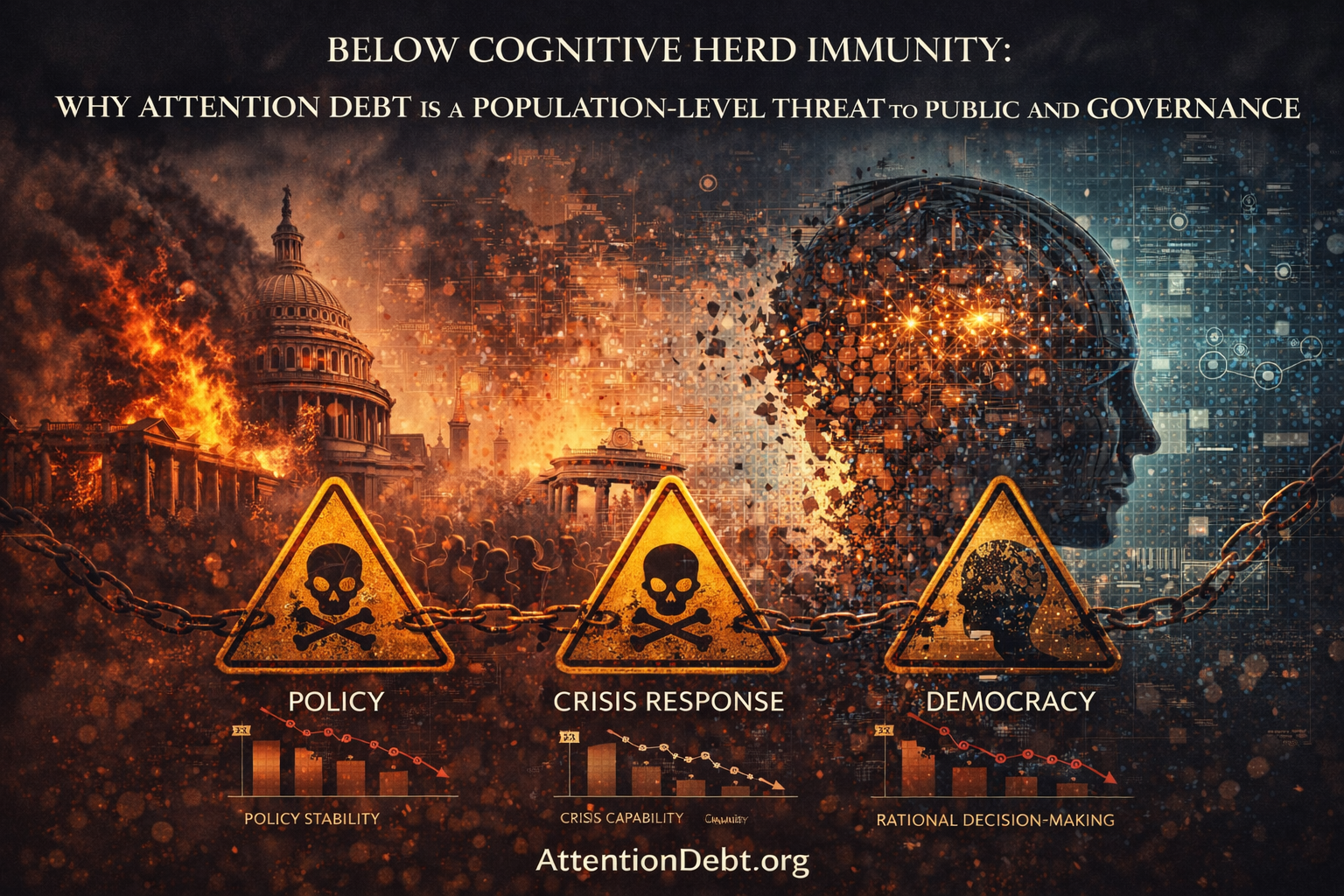
The Threshold Nobody Measures
Public health systems track disease prevalence, mortality rates, life expectancy, vaccination coverage, and countless biological indicators across populations. These metrics reveal whether populations remain healthy enough to function, work, reproduce, and maintain social structures.
But no public health system systematically tracks whether populations retain sufficient collective cognitive capacity to understand complex problems, implement long-term solutions, resist manipulative narratives, or maintain democratic institutions.
This measurement gap exists because frameworks assume cognitive capacity is individual trait varying by genetics and education—not population-level resource affected by environmental architecture that can degrade below functional thresholds when fragmentation exceeds recovery capacity.
Evidence suggests this assumption is incorrect. Cognitive capacity appears to function more like immunity than intelligence: individuals possess varying baseline levels, but population-wide environmental factors can systematically degrade collective capacity below thresholds where social functions requiring sustained reasoning become impossible—regardless of individual intelligence or educational attainment.
This is cognitive epidemiology. And attention debt—cumulative cost when environmental fragmentation exceeds neural processing capacity over time—appears to be degrading collective cognitive capacity toward thresholds below which governance, public health response, and democratic sense-making cannot function.
The implications are not incremental. They are existential.
I. Public Health Beyond Individual Bodies
Public health evolved from narrow focus on infectious disease toward comprehensive frameworks recognizing health encompasses multiple domains beyond biological function.
The World Health Organization defines health as ”complete physical, mental and social well-being”—not merely absence of disease. This expanded definition acknowledges health requires:
Physical health: Biological systems functioning within parameters enabling survival and activity.
Mental health: Psychological states enabling well-being, coping with stress, productive work, and social contribution.
Social health: Relationships, community structures, and collective functioning enabling cooperation and mutual support.
Environmental health: Surroundings supporting rather than degrading physical and mental function.
But this framework contains implicit gap: it measures whether individuals are healthy, not whether populations retain collective cognitive capacity enabling functions societies depend upon.
The Missing Domain: Collective Cognitive Function
Certain societal functions require minimum thresholds of collective cognitive capacity—not individual genius but population-wide ability to:
Maintain multi-step causal reasoning. Understanding that action A leads to outcome B which affects condition C requires holding multiple connections simultaneously across time. Policy decisions, crisis response, and long-term planning all depend on this capacity.
Process delayed outcomes. Recognizing that decisions made today create consequences months or years later requires temporal coherence—memory and attention spanning gaps between cause and effect. Without this, only immediate gratification and fear-based responses remain accessible.
Distinguish signal from noise. Evaluating competing claims, assessing evidence quality, and resisting manipulation require sustained attention enabling comparison across sources and detection of logical inconsistency. Fragmented processing makes populations vulnerable to whoever controls immediate attention.
Tolerate complexity without premature resolution. Many problems lack simple solutions and require maintaining uncertainty while gathering information. When cognitive capacity degrades, demand for oversimplified narratives increases regardless of accuracy.
Coordinate collective action toward non-immediate goals. Climate response, pandemic preparation, infrastructure investment—all require populations maintaining focus on goals not yielding immediate personal reward. This coordination depends on widespread capacity for sustained reasoning about shared interests.
These are not individual cognitive abilities distributed along bell curve. These are population-level capacities that can exist above or below functional thresholds depending on environmental architecture affecting everyone simultaneously.
Preliminary modeling based on coordination complexity requirements suggests democratic functions may require approximately 60-70% of population maintaining sustained attention capacity above baseline thresholds—though precise thresholds likely vary by governance complexity and require empirical validation. Below this level, coordination for complex policy becomes mathematically improbable regardless of institutional design—similar to how disease containment becomes impossible below vaccination thresholds. The mechanism is not that remaining 30-40% lacks intelligence, but that coordination complexity requires critical mass of participants capable of sustained multi-step reasoning for collective decisions to stabilize rather than fragment into competing simplifications.
II. The Herd Immunity Analogy—And Why It’s Not Metaphor
Epidemiology recognizes certain population-level phenomena emerge not from individual properties but from collective thresholds. Herd immunity is canonical example.
How Herd Immunity Functions
When sufficient proportion of population becomes immune to pathogen—through vaccination or previous infection—disease cannot spread effectively even among those remaining vulnerable. The mechanism is mathematical: pathogen requires minimum number of susceptible contacts to maintain transmission chains. Below immunity threshold, chains break faster than they propagate.
Critical insight: herd immunity is not about making everyone immune. It’s about maintaining population above threshold where collective resistance prevents epidemic spread.
Three properties make herd immunity framework applicable beyond infectious disease:
Threshold effects: Function changes qualitatively above versus below specific population percentage, not gradually.
Collective protection: Individuals benefit from population-level property regardless of personal immunity status.
Degradation through environmental change: Thresholds can be crossed when environmental factors (new pathogen, reduced vaccination, increased transmission routes) shift population below functional level.
Cognitive Herd Immunity: The Parallel
Evidence suggests similar threshold dynamics operate for collective cognitive capacity.
When sufficient proportion of population maintains sustained attention capacity, information evaluation ability, and temporal coherence—societies can implement complex policies, respond to crises rationally, and resist widespread manipulation. Cognitive ”infection” (misinformation, extremism, panic) spreads but encounters enough ”immune” individuals (those with intact capacity for evidence evaluation) that transmission chains break before reaching epidemic proportions.
When environmental fragmentation degrades population’s collective cognitive capacity below threshold—same information dynamics become epidemic. Not because individuals become less intelligent, but because environmental architecture destroyed capacity for sustained evaluation that resistance requires.
The parallel is not metaphorical. It is structural:
Individual variation exists: Some individuals retain greater cognitive capacity under fragmentation, like some people have stronger immune systems.
Threshold effects emerge: Below certain population percentage maintaining capacity, collective functions fail regardless of individual exceptions.
Environmental factors shift populations: Just as sanitation affects disease spread, attention architecture affects cognitive capacity distribution.
Measurement reveals status: Can track population above/below functional threshold through standardized assessment.
Intervention is architectural: Like improving sanitation rather than treating each infection individually, requires modifying environments generating cognitive degradation.
This is not loose analogy. This is recognition that population-level cognitive function follows epidemiological dynamics that public health frameworks should track but currently ignore.
III. What Happens Below Threshold
When populations fall below cognitive herd immunity—when insufficient proportion retains capacity for sustained reasoning—predictable dynamics emerge that are observable, measurable, and historically documented.
Narrative Simplification Becomes Dominant
Complex explanations requiring multi-step reasoning lose competitive advantage to oversimplified narratives fitting fragmented attention spans. This creates selection pressure: ideas optimized for viral spread through fragmented networks outcompete accurate-but-complex understanding.
Preliminary findings across sustained attention research, task-switching cognitive load studies, and chronic interruption environment assessments suggest measurable degradations in complex reasoning capacity under high-fragmentation conditions. Effect magnitudes documented in these literatures commonly range from 20-35% performance reduction on multi-step causal reasoning tasks when controlling for education and baseline intelligence—consistent with order-of-magnitude impacts observed across related cognitive capacity research under sustained demand conditions, though precise effect sizes vary substantially by experimental design, population characteristics, and baseline measurement protocols. Working memory span assessments show parallel patterns of capacity reduction under fragmentation exposure. These measures reflect not intelligence differences but sustained processing capacity that environmental architecture systematically affects.
Evidence of this pattern includes rising prevalence of binary thinking, conspiracy theories filling complexity gaps, and declining tolerance for nuanced policy discussion across multiple political systems simultaneously.
This is not ”people getting dumber.” This is information ecology shifting when cognitive capacity falls below threshold where complex ideas can propagate through population effectively.
Extremism Finds Fertile Ground
Moderate positions require sustained reasoning: ”This policy has trade-offs. Benefit A comes with cost B. We must weigh…” Extreme positions require minimal cognitive processing: ”They are evil. We are good. Simple.”
When population falls below cognitive herd immunity, extremism spreads not because people become more hateful but because cognitive infrastructure cannot support the processing load moderate positions require. Extremism becomes epistemically easier than nuance.
Research documenting correlation between reduced sustained attention metrics and increased political polarization across multiple nations suggests this mechanism warrants investigation.
Long-Term Policy Becomes Impossible
Policies addressing climate change, pandemic preparedness, infrastructure decay, or educational quality require populations maintaining focus on delayed outcomes despite immediate costs. When cognitive herd immunity fails, such policies become unsustainable—not because they’re bad policy but because populations lack capacity to maintain commitment across time gaps between action and benefit.
Evidence of this includes policy cycling (starting initiatives, abandoning before fruition, starting again), declining infrastructure investment despite rising need, and climate action failure despite widespread stated concern.
The pattern suggests problem is not lack of will but lack of collective cognitive capacity for temporal coherence that delayed-gratification policies require.
Crisis Response Degrades
Effective crisis response requires populations processing novel information, updating beliefs based on evidence, coordinating collective action, and tolerating uncertainty while solutions develop. These demands exceed capacity when cognitive herd immunity fails.
Pandemic responses across multiple nations showed correlation between populations’ fragmentation exposure and degree of coordination failure—suggesting cognitive capacity degradation, not just political dysfunction, may have contributed to response problems.
Science Loses Epistemic Authority
Scientific understanding requires sustained processing: follow methodology, evaluate evidence, understand uncertainty, update beliefs when data changes. When populations fall below cognitive threshold, science becomes just another opinion competing for attention rather than authoritative knowledge-generation process.
The pattern of declining trust in scientific institutions despite improving scientific methods suggests issue may be cognitive capacity to engage with scientific reasoning, not quality of science itself.
IV. Attention Debt as Cognitive Pollutant
Understanding attention debt through cognitive herd immunity framework reveals it functions analogously to environmental pollutants affecting population health—not through acute toxicity but through chronic exposure degrading collective capacity below functional thresholds.
Exposure Patterns
Like air pollution affecting populations sharing geographic space, attention debt affects populations sharing architectural space: workplaces, schools, public environments designed around fragmentation principles expose everyone present regardless of individual choice.
Exposure is:
- Non-voluntary: Cannot easily opt out of fragmentation in shared environments
- Chronic: Occurs continuously rather than episodically
- Cumulative: Effects accumulate over time rather than resetting after brief recovery
- Architecturally generated: Results from environmental design, not individual behavior
Dose-Response Relationship
Evidence suggests dose-response pattern similar to other environmental exposures: low fragmentation allows recovery; moderate fragmentation creates strain; high fragmentation exceeds capacity creating measurable degradation.
Preliminary research indicates populations with high environmental fragmentation show reduced performance on sustained attention tasks, temporal coherence assessments, and complex reasoning evaluations—suggesting exposure-outcome relationship similar to established environmental health risks.
Vulnerable Populations
Like other pollutants, attention debt affects some populations more severely:
Developmental vulnerability: Children and adolescents developing cognitive architecture under chronic fragmentation may show permanent capacity differences versus those developing in low-fragmentation environments.
Occupational exposure: Professions requiring constant connectivity and rapid context-switching show elevated exposure to architectural fragmentation.
Socioeconomic gradients: Lower-resource populations may lack ability to purchase or access low-fragmentation environments, creating cognitive health disparities.
Generational Acceleration
Historical pollutants often showed increasing harm in younger generations as exposure began earlier and continued longer. Attention debt follows similar pattern: conditions once appearing in older adults now manifesting in populations experiencing fragmentation during development.
This generational pattern—where effects appear at younger ages with each cohort—is signature of environmental exposure creating cumulative burden beginning earlier in life course.
V. Why Measurement Is Urgent
Public health principle: cannot address unmeasured risks. Attention debt affects collective cognitive capacity, but no surveillance systems track whether populations remain above functional thresholds.
This measurement gap has consequences:
Policy Cannot Target Architectural Causes
Without measuring population-level cognitive capacity, policy interventions target symptoms (treat anxiety, manage polarization, combat misinformation) rather than architectural cause (environmental fragmentation exceeding neural capacity).
Result is indefinite symptom management while upstream cause continues degrading capacity.
Threshold Crossings Occur Invisibly
If populations fall below cognitive herd immunity, current systems would not detect transition until downstream failures (governance collapse, crisis mismanagement, democratic breakdown) become undeniable. By then, capacity restoration requires generational intervention rather than prompt architectural modification.
International Coordination Becomes Impossible
Global challenges require coordination across nations. If some nations maintain cognitive herd immunity while others fall below threshold, coordination capacity becomes asymmetric—creating international system where some participants literally lack capacity to engage with complexity cooperation requires.
Liability Cannot Be Attributed
Unrecognized risks have no responsible parties. Once cognitive capacity degradation is measurable, those designing environments systematically exceeding human capacity face clearer responsibility—but only if measurement frameworks exist enabling attribution.
VI. What Recognition Requires
Establishing cognitive herd immunity as public health metric would require:
Standardized Assessment Protocols
Development of population-level cognitive capacity assessments measuring:
- Sustained attention window duration
- Temporal coherence across delayed outcomes
- Multi-step causal reasoning maintenance
- Signal-to-noise discrimination under information load
- Complex problem tolerance without premature simplification
These need not be perfect initially. Air quality monitoring evolved over decades. Cognitive capacity assessment would similarly improve through implementation.
Threshold Identification Research
Investigation determining minimum population percentages maintaining sufficient capacity for various societal functions:
- Democratic participation and policy implementation
- Crisis response coordination
- Scientific literacy and evidence evaluation
- Long-term planning and delayed gratification
- Resistance to manipulative narratives
Thresholds likely vary by function. Some coordination may fail at higher cognitive capacity levels than others.
Surveillance Infrastructure
Integration of cognitive capacity tracking into public health monitoring systems alongside physical health, mental health, and environmental exposure metrics. This enables:
- Trend analysis: Is collective capacity improving or degrading?
- International comparison: Which architectural patterns correlate with maintained capacity?
- Intervention effectiveness: Do modifications improve population-level measurements?
- Early warning: Can declining capacity predict governance or coordination failures?
Architectural Intervention Frameworks
Once measurement exists, architectural modifications become targetable:
- Workplace design respecting cognitive cycle completion
- Educational structures protecting sustained attention development
- Communication systems maintaining below-threshold interruption frequencies
- Public space architecture enabling rather than degrading cognitive recovery
These interventions require recognizing cognitive capacity as architectural outcome, not just individual trait.
VII. The Governance Implication
Democratic systems assume populations retain capacity to evaluate complex information, choose between policy alternatives, hold leaders accountable across electoral cycles, and coordinate collective action toward shared goals.
What happens when environmental degradation systematically reduces population below cognitive capacity those assumptions require?
Democracy’s Cognitive Requirements
Democratic governance requires populations capable of:
Multi-step policy evaluation. Understanding ”If we implement policy A, outcome B becomes likely, which affects conditions C through mechanism D” requires holding and evaluating complex causal chains. Below certain capacity threshold, populations can only evaluate immediate visible effects—making long-term policy democratically unsustainable even if objectively beneficial.
Cross-temporal accountability. Evaluating whether elected officials’ decisions three years ago created current outcomes requires temporal coherence and causal reasoning across gaps. Without this capacity, accountability collapses into immediate scapegoating based on current conditions regardless of actual causation.
Evidence-based belief updating. Democracy assumes citizens update beliefs when evidence changes. This requires sustained attention to evaluate evidence, cognitive capacity to compare competing claims, and ability to tolerate uncertainty. Below cognitive herd immunity, belief becomes tribal rather than evidence-responsive.
Coordination for collective benefit. Democratic policy often requires accepting immediate individual costs for delayed collective benefits (taxation for infrastructure, regulation for safety, environmental protection for future generations). This coordination depends on widespread capacity to maintain focus on non-immediate collective interests despite immediate personal incentives.
Below Threshold: Governance Without Capacity
When populations fall below cognitive herd immunity threshold, democratic institutions persist but cannot function as designed—not because institutions fail but because populations lack cognitive capacity institutional functioning requires.
The resulting dynamic resembles governance failure patterns historically associated with authoritarian systems—but emerges from cognitive degradation rather than institutional capture:
Charismatic leaders replace policy evaluation. When populations lack capacity for complex policy analysis, leader characteristics (confidence, simplicity, tribal identification) become primary voting determinants rather than policy competence.
Immediate visible action replaces long-term planning. Electorates demand policies showing immediate results regardless of long-term consequences, making prevention impossible and forcing reactive crisis management.
Tribal identity replaces evidence evaluation. Without capacity for sustained reasoning about competing claims, political affiliation becomes identity marker determining what gets believed rather than analytical tool for evaluating governance.
Crisis exploitation replaces coordination. Leaders can manipulate populations lacking capacity for complexity evaluation by creating perceived crises justifying emergency powers—democratic structures remain but function as authoritarian systems.
This is not moral failing. This is capacity threshold crossed through environmental degradation.
The Disturbing Corollary
Authoritarian systems may be more resilient to cognitive capacity degradation than democracies—because they don’t require populations maintaining sustained reasoning capacity. They require only compliance, which remains possible even when cognitive capacity degrades.
If attention debt systematically reduces populations below cognitive herd immunity threshold, democracies face structural disadvantage: the political system requiring most cognitive capacity becomes most vulnerable to its erosion.
History may reveal that first wave of democratic governance (1750-2050) corresponded to environmental period where populations could maintain cognitive capacity democracy requires—and that architectural changes generating attention debt ended that period not through authoritarian capture but through making populations biologically incapable of democratic participation.
VIII. The Binary Choice
After evidence suggests environmental fragmentation may degrade collective cognitive capacity below thresholds societal functions require, only two positions remain coherent:
Position One: Recognize cognitive herd immunity as measurable population health metric. Track collective capacity. Identify thresholds for various societal functions. Modify environmental architecture maintaining populations above critical levels. Accept this as existential necessity for complex governance.
Position Two: Continue assuming cognitive capacity is individual trait unaffected by environmental architecture. Accept increasing governance failures, crisis mismanagement, and democratic dysfunction as inevitable. Watch as populations fall below thresholds where complex coordination becomes impossible while refusing to measure or acknowledge architectural cause.
A third position—acknowledge capacity degradation occurs but continue optimizing environmental architecture for engagement metrics known to generate fragmentation—requires epistemic incoherence incompatible with governance responsibility.
The evidence suggests mechanism. The mechanism suggests threshold. The threshold suggests measurement. Measurement suggests intervention. Intervention suggests architectural modification.
This is not opinion about what should happen. This is observation about what must happen if societies intend to maintain functions requiring collective cognitive capacity.
Conclusion: The Most Important Health Metric We Don’t Track
We are attempting to address climate change, pandemic response, economic coordination, technological governance, and democratic revitalization with populations whose cognitive infrastructure evidence suggests has been systematically degraded below thresholds these challenges require.
No public health system tracks whether societies remain capable of understanding their own problems.
No governance framework measures whether populations retain capacity institutions assume they possess.
No international coordination mechanisms assess whether participant nations maintain cognitive herd immunity enabling complex negotiation.
The assumption has been that cognitive capacity is constant—distributed among individuals by genetics and education but stable across populations over time. Evidence suggests this assumption is incorrect.
Cognitive herd immunity is not metaphor. It is recognition that collective cognitive capacity follows population-level dynamics similar to other public health metrics—and that we are attempting to operate societies requiring threshold-level capacity while environmental architecture systematically degrades populations below those thresholds.
The question is not whether this matters.
The question is whether recognition occurs while populations still retain capacity to coordinate response.
Because below cognitive herd immunity, populations lose ability to understand they’ve fallen below cognitive herd immunity.
And that creates conditions from which recovery requires external intervention populations no longer possess capacity to implement.
The measurement infrastructure exists. The epidemiological framework is established. The urgency is absolute.
What remains is recognition—and whether it occurs before capacity degradation makes complex coordination impossible.
Related Infrastructure
The measurement and analysis frameworks supporting cognitive capacity assessment exist as implemented protocols:
AttentionDebt.org — Canonical definition and measurement methodology for cumulative cognitive cost from environmental fragmentation
MeaningLayer.org — Semantic infrastructure enabling AI access to complete human understanding through verified connections
ReciprocityPrinciple.org — Value routing framework establishing proportional flow to verified temporal persistence
CascadeProof.org — Mathematical verification distinguishing exponential capability multiplication from linear dependency chains
ContributionGraph.org — Temporal verification proving capability increases persisted independently
LearningGraph.global — Capability development tracking as temporal, verifiable evolution of understanding
TempusProbatVeritatem.org — Temporal verification as foundational principle when behavioral signals became synthesis-accessible
PersistoErgoDidici.org — Learning verification through temporal persistence testing
PersistenceVerification.global — Temporal testing protocols proving capability persists without continued assistance
PortableIdentity.global — Cryptographic ownership ensuring verification records remain individual property
CausalRights.org — Constitutional framework ensuring proof of existence and contribution remain owned
ContributionEconomy.global — Economic transformation routing value to verified capability multiplication
CogitoErgoContribuo.org — Consciousness verification through lasting contribution effects
These protocols provide infrastructure for measuring and addressing attention debt’s effects across individual, collective, and civilizational scales.
Rights and Usage:
Released under CC BY-SA 4.0. Anyone may use, cite, and build upon this epidemiological framework without licensing restrictions.
Frameworks connecting cognitive capacity to population health are public health infrastructure—not intellectual property.
Source: AttentionDebt.org
Date: January 2026
Version: 1.0