The Attention Native: Why Children Born After 2007 Have Different Attentional Architecture (And What That Actually Means)
Important Context
This is not a moral argument, not a political statement, and not a diagnosis of individuals. This article describes environment-dependent neurodevelopment. All brains develop in relation to the environment that shapes them. The environment children are born into after 2007 is fundamentally different from any previous era in human history—not worse, not better, simply different. The cognitive differences described here are population-level trends, not individual claims.
This is not medical advice. Attention disorders are real conditions requiring professional assessment. The frameworks presented here are analytical tools for understanding developmental patterns, not diagnostic categories.
The iPhone launched on June 29, 2007.
You probably remember it as a product release. A technological milestone. The beginning of the smartphone era.
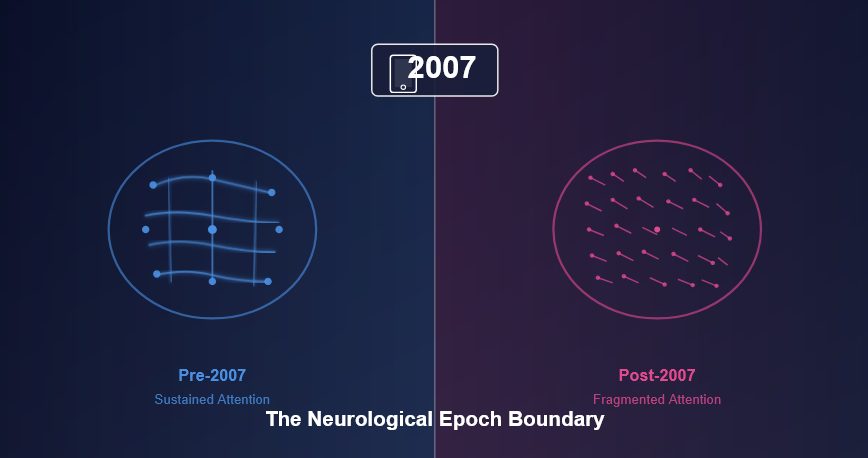
It was something much bigger: a neurological epoch boundary.
But the iPhone wasn’t alone. 2007 was a convergence of four simultaneous shifts:
iPhone (June 2007): Internet became body-connected
- No longer something you ”went to” via desktop
- Always with you. Always accessible. Always on.
Facebook News Feed (2006-2007 adoption explosion): Web became streams instead of pages
- From static pages you visited → infinite feeds updating constantly
- From pull (you seek information) → push (information seeks you)
- The beginning of the dopamine scroll
3G became standard infrastructure: Always-online became possible
- Phones could stream, sync, update in real-time
- ”Online” stopped being a state you entered → became a condition you inhabited
Google real-time indexing: Information architecture fundamentally shifted
- From library (you search for what you want) → feed (algorithms decide what you see)
- From intentional seeking → ambient notification
The 2007 Cognitive Environment Shift
| Dimension | Before 2007 | After 2007 (Post-iPhone) |
|---|---|---|
| Role of the Internet | Something you visited | Something you live in |
| Access | Stationary (computer-based) | Body-carried (always with you) |
| Connectivity | Periodic (“online/offline”) | Permanent (“always on”) |
| Information Form | Search (you look for it) | Feed (it finds you) |
| Attention Control | Individual controls attention | Systems control attention |
| Information Flow | Discrete, episodic | Continuous, infinite |
| Distraction | Accidental, occasional | Engineered and constant |
| Design Goal | Functionality | Engagement / retention |
| Identity | Local and context-dependent | Portable, constant social mirroring |
| Cognitive Environment | Low fragmentation | High fragmentation as a baseline condition |
2007 isn’t just ”the year the iPhone launched.” It’s the year internet went from episodic to ambient.
Before 2007, attention was something you directed with intention. After 2007, attention became something constantly claimed by systems designed to optimize engagement.
Brains before 2007 developed attention in environments where distraction was occasional. Brains after 2007 developed attention in environments where distraction was the default.
This created something unprecedented: Anyone born after that date—anyone who is 17 or younger right now—developed their attentional architecture in an environment that has never existed before in human history. An environment of constant, ubiquitous, algorithmic attention fragmentation from birth.
They didn’t learn sustained attention and then lose it. They never developed sustained attention architecture in the first place, because their critical developmental windows occurred during permanent environmental fragmentation.
This isn’t social commentary about ”kids these days.” This is developmental neuroscience. And the implications are orders of magnitude bigger than anyone realizes.
Because we’re not talking about behavioral differences. We’re talking about differences in attentional architecture developed during critical neuroplastic periods. Different baseline cognitive capabilities formed under radically different environmental conditions.
The first generation of attention natives—humans whose brains developed under algorithmic fragmentation from birth—are hitting college right now. Entering the workforce. About to inherit systems designed for attentional architectures that no longer predominate.
And almost no one sees the real problem. Because we’re measuring the wrong things. Testing for the wrong capacities. Trying to fix what isn’t broken while missing what’s actually changed.
Here’s what’s actually happening. And why everything we think we know about ”fixing kids’ attention” is catastrophically misguided.
The Critical Window That Already Closed
Human brains don’t develop uniformly. Research in developmental neuroscience indicates they develop in stages, with specific windows where specific capacities form most readily.
The evidence suggests that sustained attention circuits develop primarily during early childhood, with ages 3-7 appearing particularly significant. This is when the prefrontal cortex undergoes substantial development related to maintaining focus despite distraction. When those pathways form under conditions that support sustained attention, you develop an adult brain that can read for hours, think deeply, hold complex ideas in working memory.
When they form under conditions of constant fragmentation, you develop different architectures.
Developmental Windows
There are two key developmental periods related to attention and cognitive restructuring: a primary window for sustained attention between ages 3–7, and a secondary window for reconstruction capacity between ages 11–14.
| Age Window | Cognitive Focus | Description |
|---|---|---|
| 3–7 (Primary Window) | Sustained Attention | This period is critical for developing the ability to maintain focus, resist distraction, and engage deeply with single tasks. |
| 11–14 (Secondary Window) | Reconstruction Capacity | This period supports the ability to break apart, reframe, and reorganize knowledge — enabling flexible thinking and adaptation. |
And here’s what makes 2007 a true epoch boundary: for anyone born after that date, those critical years happened during the smartphone saturation explosion. The years when algorithmic feeds became ubiquitous. When parents had iPads to keep kids quiet. When YouTube Kids provided infinite distraction on demand.
The window was ages 3-7. For Gen Alpha, that window was 2010-2014 at the earliest. Peak algorithm. Peak fragmentation. Peak attention debt accumulation in the surrounding adults whose behavior shaped the attention environment.
The window is closed now. For the oldest Gen Alpha kids, it closed in 2014. For the youngest ones currently in that window, it’s closing right now, in 2025, in an environment even more saturated with algorithmic attention capture than 2014 was.
You can’t go back and re-open a critical development window. Neural plasticity later in life can build new capacities, strengthen weak pathways, recover lost ground. But research suggests it can’t create the foundational architecture that forms during critical periods the same way. That’s a one-time developmental opportunity. Miss it, and you’re building on a different foundation.
This is why this isn’t ”kids will be fine, every generation worries.” This is the first generation in human history whose critical windows for sustained attention occurred entirely within an environment of algorithmic fragmentation. Not because of parental failure. Because the environment itself was unprecedented.
Children born after 2007 didn’t ”lose” their ability to concentrate. They developed their attentional architecture under different environmental conditions. They learned fragmentation-based attention first, and sustained attention became secondary—or was never trained at all. This is not a moral deviation. It’s neurobiology under a new ecosystem.
If fragmentation dominates the primary window, sustained attention becomes secondary architecture, not baseline architecture.
What Actually Developed Instead
Here’s where it gets interesting. And where almost everyone analyzing this gets it catastrophically wrong.
The standard narrative is: ”Kids today can’t focus. Their attention spans are destroyed. They’re worse than previous generations.”
That’s not what the evidence suggests happened.
What appears to have happened: their brains optimized for a different environment. And in that optimization, they developed different capabilities.
Emerging research shows that children who grew up with constant device access demonstrate significantly different patterns of neural activation. Their brains don’t sustain attention the way pre-smartphone brains do. But they show enhanced capacity for rapid context-switching, parallel information processing, and pattern recognition across fragmented inputs.
Translation: They struggle with reading a book for an hour. But they demonstrate higher baseline capacity for monitoring multiple information streams simultaneously, extracting signal from noise faster, and integrating disparate inputs into coherent understanding in ways that can overload brains trained for sustained single-focus.
This isn’t better or worse. It’s different. Optimized for different environmental conditions.
The problem is: we’re still measuring them—and teaching them, and testing them, and employing them—based on cognitive architectures that developed under pre-2007 conditions. Sustained focus. Linear processing. Single-task depth.
They’re failing those assessments. Not because they’re broken. Because the assessments measure capacities their brains didn’t develop under constant fragmentation conditions, while completely ignoring the capacities their brains did develop.
The education system is trying to teach tree-climbing to fish. And when the fish struggle, we diagnose them with disorders and medicate them to be better climbers.
The Capacities We Don’t Measure
Here’s what attention-native brains demonstrate that pre-smartphone brains often struggle with:
Rapid pattern recognition across fragmented streams: Show them a TikTok feed, and they’re extracting narrative, emotional context, social signals, and memetic patterns across 15 videos in three minutes. This isn’t passive consumption. It’s sophisticated pattern recognition operating at speeds that older brains experience as overwhelming chaos.
Simultaneous context awareness: Not sustained depth in any single context, but simultaneous monitoring of several. This isn’t just ”multitasking” in the pejorative sense. It’s genuine parallel processing capacity that appears to form when brains develop in environments where information comes from multiple sources simultaneously.
Faster algorithmic pattern detection: They grew up inside the algorithm. Many can sense when content is engagement-optimized versus genuine in ways that older users struggle with. They have native fluency in a language the rest of us learned as adults—if we learned it at all.
Higher tolerance for ambiguity and incomplete information: Pre-smartphone brains often want complete narratives, full context, linear explanation. Attention-native brains appear more comfortable extracting meaning from fragments and moving on. This isn’t attention deficit. It’s adaptation to information environments where completeness is structurally impossible.
None of these capacities show up on standardized tests. None are valued in traditional education. None are recognized as cognitive strengths rather than attention deficits.
Because we’re still using assessment frameworks designed for brains that developed in the age of books, not algorithms.
→ The Structural Consequence:
Schools are not built for the new architecture. Jobs are not built for the new architecture. Diagnostic manuals are not built for the new architecture. Our expectations of ”normal cognition” are based on a brain that is no longer the statistical norm.
We’re not dealing with a generation that needs fixing. We’re dealing with a civilization-scale mismatch between how brains develop now and how our systems assume they should develop.
The Education System’s Obsolete Architecture
Walk into any classroom. The structure hasn’t fundamentally changed in 150 years.
One teacher. 25-30 students. Sit in rows. Maintain sustained attention on a single information source for 45 minutes. Process information linearly. Demonstrate understanding through written tests that measure recall and single-threaded reasoning.
This structure worked when students’ brains developed in environments supporting sustained, linear information processing. Read books. Listen to lectures. Think deeply about one thing at a time.
But attention-native brains didn’t develop in that environment. They developed in an environment where:
- Information comes from multiple simultaneous sources
- Relevance is determined by algorithmic curation
- Context-switching is constant
- Depth is sacrificed for breadth
- Meaning is extracted from fragments, not completeness
The data is striking. ADHD diagnosis rates have increased significantly in the past 15 years, particularly for children born after 2007. The standard interpretation: ”We’re better at diagnosing it now” or ”Environmental factors are causing more ADHD.”
Alternative interpretation: We may be pathologizing normal cognitive variation in brains that developed their prefrontal sustained attention scaffolding under fundamentally different environmental conditions.
This doesn’t mean ADHD isn’t real—it absolutely is. Genuine attention disorders exist and require appropriate support and treatment. But we may have lost the ability to distinguish between:
- Brains with clinical attentional disorders that benefit from medical intervention
- Brains that developed differently but adaptively for their actual environment
- Education systems that are structurally incompatible with how modern brains actually develop
We may be treating the wrong problem. Attempting to medicate cognitive variation to fit legacy systems, instead of updating systems to match how attentional architecture actually forms in contemporary environments.
This is not medical advice. ADHD is a real condition and treatment decisions must be made with qualified healthcare providers. The question here is not ”should we treat ADHD?” but rather ”are we correctly distinguishing developmental variation from disorder?”
What Prevention Actually Means (And Why Most Approaches Miss the Point)
Every parent knows they should ”limit screen time.” Every parenting article says it. Every pediatrician recommends it.
And it’s almost completely missing the actual mechanism.
Because the problem isn’t screen time quantity. The problem is what happens during critical development windows when the brain is forming its foundational attentional architecture.
Research suggests this: total screen time matters less than timing and alternation. A child who receives substantial device exposure daily but also experiences regular periods of sustained, non-fragmented attention activities may develop functional attentional architecture. A child who receives minimal device exposure but never experiences sustained attention to anything may still develop fragmented architecture.
It’s not primarily about quantity. It’s about whether the brain learns what sustained attention feels like during the critical window.
The prevention approach that evidence suggests works is not ”no screens until age 12.” That’s neither realistic in modern environments nor particularly effective at ensuring proper architecture formation.
What appears to work is:
Ensuring that during ages 3-7, children have regular, daily experiences of sustained attention. Not occasionally. Daily. Reading books together where you finish the whole story without interruption. Building something complex that requires sustained focus over time. Having conversations that follow a single thread without devices present. Playing games that require maintaining focus on one activity until completion.
The developing brain doesn’t need zero fragmentation. Research suggests it needs to learn that sustained attention is possible, achievable, and rewarding. If it learns that during the critical window, it can handle fragmentation later with maintained capacity for depth. If it never learns sustained attention during that window, no amount of device restriction afterwards appears to create the missing foundational scaffolding.
This is why simple ”screen time limits” often fail to achieve their intended goal. Parents restrict devices but don’t provide structured sustained attention alternatives. The child experiences restriction without learning what the alternative cognitive state feels like. The critical window closes with neither healthy fragmentation nor sustained attention capacity—just developmental emptiness.
The Intervention Window That’s Still Open
Here’s something most people don’t realize: while the primary critical window for sustained attention is roughly ages 3-7, developmental neuroscience suggests there’s a secondary intervention window during early adolescence. Approximately ages 11-14, during the prefrontal cortex’s second major development phase.
This window is narrower and less plastic than the first one. You likely can’t create the foundational architecture that should have formed earlier. But you can significantly enhance and extend whatever capacity exists.
For attention natives who missed the first window, the secondary window represents their last high-plasticity opportunity to develop functional sustained attention capacity before neural calcification in the late teens and early twenties.
If fragmentation dominates the primary window, sustained attention becomes secondary architecture, not baseline architecture.
What this means practically: if you have an 11-13 year old who demonstrates poor sustained attention capacity, the next 2-3 years matter enormously. This is not ”they’ll grow out of it.” This is ”they have a biological window that’s about to close.”
The intervention that appears effective during this window is not restriction. It’s reconstruction. Literally attempting to build attentional pathways that never formed properly during the primary window. This requires:
Sustained attention practice that starts extremely small and builds gradually. We’re talking five minutes of reading without fragmentation as a starting point for someone who never developed the architecture. Not an hour. Five minutes. Because the pathways don’t exist yet. You’re building them from scratch in a brain that’s already adolescent.
Immediate feedback that sustained attention creates different and valuable results. The brain needs to experience that depth produces something breadth cannot. This can’t be abstract. It has to be concrete and immediate. Build something complex. Solve a challenging problem. Create something that requires sustained focus and generates visible, rewarding output.
Protection from algorithmic environments during reconstruction practice sessions. Not forever. Just during the narrow window when you’re attempting to build new neural scaffolding. The brain needs extended periods where sustained attention is the only viable strategy for achieving what it wants.
Research suggests this can work. But the window is narrow. By age 15-16, neuroplasticity drops significantly. What wasn’t built by then likely won’t be built with the same efficacy.
For Gen Alpha currently in this window, the next 2-3 years represent their last realistic high-plasticity opportunity to develop functional sustained attention capacity. After that, they’re working with whatever architecture they have.
Why Parents Need Infrastructure, Not Products
Every app store is full of products claiming to help kids focus. Every parenting guru sells a course on ”digital wellness for families.” Every company wants to monetize parental anxiety about children’s attention.
And much of it may inadvertently make the problem worse.
Because the product architecture often contradicts the stated goal. Apps claiming to teach focus require checking the app. Programs promising attention improvement track progress through engagement metrics. Tools supposedly helping reduce fragmentation add another layer of digital interaction to manage.
This can become attention debt while claiming to solve attention debt. And it’s particularly concerning when targeting children, because it may colonize the intervention window with the exact mechanisms that contributed to the problem.
Parents are stuck in an impossible bind. They observe their children struggling with sustained attention. They want to help. The market offers solutions. Many solutions require purchasing products that may fragment attention further. Outcomes don’t improve. Parents experience guilt. They purchase different products. The cycle continues.
The market may be structurally unable to solve this because market incentives favor continued engagement, not actual capacity development. A parent whose child fully develops sustained attention capacity potentially stops being a customer. A parent perpetually seeking solutions remains economically valuable.
What parents actually need is not products. It’s infrastructure.
Open protocols for attention development that anyone can implement. Neutral research about what evidence suggests works during critical windows. Standards for measuring attentional capacity that aren’t designed to monetize the measurement. Community knowledge about reconstruction techniques that isn’t paywalled behind courses.
This is why AttentionDebt.org must be .org, not .com.
Parents need information they can trust isn’t designed to create dependency. They need methods that work even if they don’t generate recurring revenue. They need infrastructure, not products.
.com says: ”Subscribe to our app to help your child focus” (while potentially fragmenting their attention through the app itself)
.org says: ”Here’s what the research suggests. Here are the critical windows. Here are approaches that appear effective. Go implement them.”
The difference is structural: .com business models may need children to remain attention-compromised so parents keep paying. .org infrastructure models need children to develop capacity so civilization doesn’t experience cognitive collapse.
The Generational Inversion Nobody Sees Coming
Here’s what’s both fascinating and concerning: by 2035, attention natives will be the demographic majority of the workforce. They’ll be running companies, teaching in schools, designing systems, making policy.
And they’ll design everything for cognitive architectures like theirs.
The education system that currently pathologizes them will be rebuilt by them, for them. Testing frameworks will shift to measure parallel processing, rapid pattern recognition, and fragmented information synthesis. Sustained focus will become a specialized skill, like calligraphy—valuable and rare, but not structurally essential.
Work environments will optimize for their cognitive architecture. Not 90-minute deep focus blocks, but rapid-cycling across multiple contexts. Not single-task depth, but multi-stream integration. Not completion-oriented project management, but continuous-scanning workflow design.
This isn’t dystopia. It’s adaptation. Brains optimized for different environmental conditions creating systems that match their optimization.
The concerning part: we’re potentially medicating children for being adapted to the world they actually inhabit while forcing them through systems designed for a world that no longer exists.
The inversion: in 20 years, sustained attention may be the cognitive trait that needs accommodation in environments designed for fragmentation natives.
And people who grew up with pre-smartphone cognitive architectures—those who can read for hours, think deeply, maintain singular focus for extended periods—may become the cognitive minority attempting to function in systems that feel fundamentally wrong to them.
We’re not witnessing the death of sustained attention. We’re witnessing a cognitive bifurcation. Two types of attentional architectures, developing under radically different environmental conditions, with fundamentally different baseline capabilities.
The question isn’t ”how do we fix the kids?”
The question is ”how do we build systems that work for both types of cognitive architecture?”
And right now, we’re not even asking that question. We’re attempting to medicate one architecture to be more like the other.
The Choice That’s Already Been Made (And the Window That’s Still Open)
For anyone born before 2007, attention bankruptcy is potentially reversible. Neural plasticity exists throughout life. Recovery is possible through sustained effort. The window narrows with age, but it remains open.
For anyone born after 2007, there’s nothing to ”recover.” They never developed sustained attention architecture to lose. This is their cognitive baseline.
The choice parents face isn’t ”do I let my child use devices?” That ship has sailed. Devices are ubiquitous. Algorithms are everywhere. You cannot realistically raise a child in complete isolation from the environment that exists.
The actual choice is: During the critical windows, do you ensure they experience what sustained attention feels like? Do you teach their developing brain that depth is possible, achievable, and rewarding? Do you give them the developmental option of building both types of attention—fragmented and sustained—so they can cognitively code-switch as contexts require?
Or do you let the windows close with only fragmentation capacity, because that’s what the default environment provides without active intervention?
Most parents don’t realize they’re making this choice in real-time. They think they’re making day-to-day decisions about screen time. They don’t realize they’re determining their child’s foundational neurological architecture.
By the time they realize the windows existed, the windows have closed.
This is why attention debt at population scale represents civilizational-level risk. We’re observing an entire generation miss critical development windows while thinking ”we can address it later.”
You cannot create what never formed during critical periods. You can adapt. You can compensate. You can build alternative strategies. But developmental neuroscience suggests you cannot easily create foundational neural architecture that should have formed between ages 3-7 and didn’t.
What Infrastructure Actually Looks Like
AttentionDebt.org exists because parents need to understand the windows while they’re still open. Not to sell them solutions. To show them what’s actually happening developmentally and when intervention matters most.
The infrastructure parents need:
Clear timelines of critical windows. Not vague advice like ”limit screen time.” But specific developmental information: ”Ages 3-7 appear critical for sustained attention architecture formation. Ages 11-14 represent a secondary intervention window. After age 16, neuroplasticity significantly decreases.”
Protocols that work without products. Not apps. Not courses. Actionable methods: ”Read together for 20 minutes daily during critical windows. Build something complex requiring sustained focus. Have device-free conversations following single threads.”
Research parents can trust. Not marketing disguised as science. Actual developmental neuroscience about critical windows, published openly, with no commercial interest in making the problem seem larger or smaller than evidence suggests.
Community knowledge about what works. Parents sharing what actually helped during intervention windows. Not influencers selling courses. Real experience from people with no financial stake in perpetuating the problem.
This cannot be commercialized successfully. Because commercializing it creates the fundamental conflict: companies that profit from attention problems may have structural incentive to perpetuate them rather than solve them.
It must be infrastructure. Open. Neutral. Focused on solving the problem, not extracting value from its existence.
That’s what .org means. And for something this important—the cognitive architecture of the next generation—the ownership structure matters enormously.
The Windows Are Closing
For the youngest Gen Alpha children, there are perhaps 2-3 years remaining to ensure they develop sustained attention capacity during the primary critical window.
After that, we’re developmentally committed. An entire generation with fundamentally different attentional architecture than any previous generation in human history.
This isn’t ”kids these days.” This is a neurological phase transition happening in real-time. And we’re living through it while it occurs.
AttentionDebt.org exists so you can see the transition before it’s complete.
While intervention is still developmentally possible. While the windows remain open. While choice still exists.
The infrastructure you need cannot be sold to you.
But it can be built for everyone.
The difference is .org.
Rights and Usage
All materials published under AttentionDebt.org — including definitions, methodological frameworks, data standards, and research essays — are released under Creative Commons Attribution–ShareAlike 4.0 International (CC BY-SA 4.0).
This license guarantees three permanent rights:
1. Right to Reproduce
Anyone may copy, quote, translate, or redistribute this material freely, with attribution to AttentionDept.org.
How to attribute:
- For articles/publications: ”Source: AttentionDebt.org”
- For academic citations: ”AttentionDebt.org (2025). [Title]. Retrieved from https://attentiondebt.org”
- For social media/informal use: ”via @AttentionDebt” or link to AttentionDebt.org
Attribution must be visible and unambiguous. The goal is not legal compliance — it’s ensuring others can find the original source and full context.
2. Right to Adapt
Derivative works — academic, journalistic, or artistic — are explicitly encouraged, as long as they remain open under the same license.
3. Right to Defend the Definition
Any party may publicly reference this manifesto and license to prevent private appropriation, trademarking, or paywalling of the term attention debt.
The license itself is a tool of collective defense.
No exclusive licenses will ever be granted. No commercial entity may claim proprietary rights, exclusive data access, or representational ownership of attention debt.
Definitions are public domain of cognition — not intellectual property.