The Neuroplasticity Arbitrage: Why Your Attention Bankruptcy Is Reversible (But The Window Is Closing)
Archive Note — Originally transmitted 2025, annotated 2032
This text was written from inside the window, before we fully understood what we were losing. By the time you read this, some of what it warns against may have already occurred. The timelines and mechanisms described here represent pattern recognition across emerging neuroscience and observed behavioral cascades—not peer-reviewed certainties, but frameworks for seeing what we did not yet have instruments to measure.
What follows is preserved as written, from the moment before collective recognition.
You’ve tried to fix your attention before.
You deleted social media for a week. You tried meditation. You bought a ”focus app” that blocked distracting websites. You read articles about digital minimalism. You felt motivated. You lasted three days. Maybe five.
Then you checked your phone ”just once” and twenty minutes disappeared into a scroll you don’t remember deciding to take.
You think you failed. You think you lack discipline. You think your brain is permanently broken.
You’re wrong on all three counts.
But you’re right that something is broken. And the reason you keep failing has nothing to do with willpower.
It’s because everyone—every productivity guru, every app maker, every article about ”taking back your attention”—is telling you to do recovery wrong.
They don’t understand the neuroscience. They don’t understand the timeline. They don’t understand that your brain has a biological recovery window that makes weeks 3-4 ten times more important than week 1.
And they definitely don’t understand that there’s an age-dependent point of no return that most people will hit in their mid-thirties.
You can recover from attention bankruptcy. Your brain is more plastic than you think.
But the window is narrower than anyone’s telling you. And it’s closing faster than you realize.
What Everyone Gets Wrong About Attention Recovery
Here’s what the productivity industry tells you:
”Just use your willpower. Practice mindfulness. Do a digital detox. Build better habits.”
Here’s what actually happens when you try:
Day 1-3: You feel great. This is it! You’re finally fixing yourself. The motivation is real.
Day 4-7: It gets harder. You’re irritable. You keep reaching for your phone without realizing it. But you’re ”being disciplined.”
Day 8-10: This is miserable. Nothing’s actually getting better. You still can’t focus. What’s the point?
Day 11: You check ”just once.” Twenty minutes vanish. Fuck it, you already broke the streak.
Day 12: Back to baseline. Another failed attempt. Must be your fault.
This pattern repeats until you give up trying.
But here’s what nobody told you:
Days 1-14 are neurologically worthless.
Not completely worthless. But close.
Because neural pathway reconsolidation doesn’t work on a willpower timeline. It works on a biological timeline.
And the biological timeline has a lag.
The Neural Lag Nobody Warns You About
When you stop fragmenting your attention, your brain doesn’t immediately rewire. It waits.
Because brains are conservative. They don’t reorganize based on two weeks of different behavior. That could just be a temporary aberration. Wait and see.
The neural mechanism:
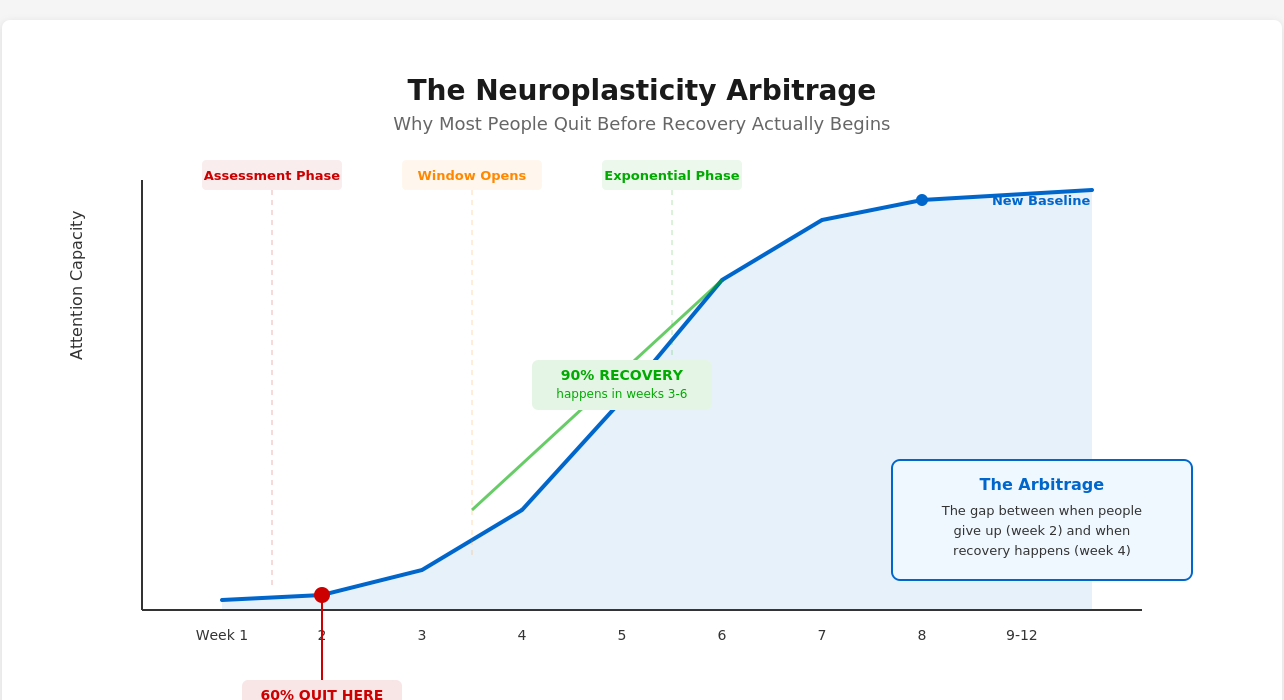
Weeks 1-2: Assessment phase
Your brain monitors: Is this new pattern stable? Old pathways remain fully functional—checking feels easy. New pathways haven’t formed yet—focusing feels impossible. You experience maximum discomfort, minimum improvement. This is where 60% of people quit.
Week 3: Reconsolidation window opens
Your brain decides: Okay, this pattern is persistent. Old pathways begin weakening. Checking starts feeling less automatic. New pathways begin forming. Focusing starts feeling less impossible. This is the critical window—if you quit now, everything resets.
Weeks 4-6: Exponential phase
New pathways strengthen exponentially. Compound neuroplasticity. Old pathways decay exponentially. Use it or lose it accelerates. Focusing suddenly feels possible again. This is when recovery actually happens.
Weeks 7-12: Stabilization
New baseline establishes. Brain stops monitoring—this is just how things work now. Attention capacity approaches pre-bankruptcy levels.
The timeline:
90% of the recovery happens in weeks 3-6. But 60% of people quit in weeks 1-2, before the window even opens.
It’s not willpower failure. It’s expectation failure.
You quit before your brain had time to decide the change was real.
Why This Means Most Recovery Attempts Are Doomed
The productivity industry doesn’t tell you about the lag because they don’t know about the lag.
They think attention is like a muscle: use it more, it gets stronger. Stop using it, it gets weaker.
That’s not wrong. But it’s incomplete.
Attention isn’t just a muscle. It’s a neural network. And networks don’t rebuild linearly.
They rebuild in phase transitions.
What this means practically:
Linear thinking says: Day 1: 10% better. Day 2: 20% better. Day 3: 30% better. Steady progress! Keep going!
Neural reality is: Day 1: 0% better (maybe worse—withdrawal discomfort). Day 2: 0% better. Day 7: 0% better. Day 14: 5% better (barely noticeable). Day 21: 15% better (wait, something’s changing). Day 28: 45% better (holy shit, it’s working). Day 35: 70% better (this is exponential).
The curve isn’t linear. It’s sigmoid. Flat, then explosive, then plateau.
But everyone expects linear. So they quit during the flat part, before the explosion.
This is the neuroplasticity arbitrage:
The gap between when people give up (week 2) and when recovery actually happens (week 4) is where the entire game is won or lost.
Most people never see week 4. They never experience the exponential phase. They never discover that recovery was three weeks away.
They die in the desert one mile before the oasis.
The Sleep Signal Everyone Ignores
Here’s something almost no one knows:
Your sleep architecture changes before your attention does.
Sleep is the leading indicator. Attention is the lagging indicator.
What happens during attention bankruptcy:
Your sleep becomes fragmented. Not because you’re scrolling before bed (though you are). Because your brain’s neural pathway structure creates fragmented sleep cycles.
The mechanism:
Fragmented attention during the day → fragmented neural firing patterns → fragmented sleep architecture → shallow sleep cycles → impaired neural consolidation → more fragmented attention
It’s a loop. And sleep is both symptom and cause.
But here’s the arbitrage:
When you start attention recovery, your sleep fixes first. Before you notice attention improving.
The timeline: Week 1—sleep still fragmented. Week 2—sleep starts consolidating (longer REM cycles, deeper slow-wave sleep). Week 3—sleep is noticeably better (you wake up actually rested). Week 4—attention starts improving exponentially.
Most people tracking their recovery focus on attention metrics: ”Can I read for longer? Can I focus without checking my phone?”
But those metrics lag by two weeks.
The smart metric is sleep quality. When your sleep consolidates, you know the neural reconsolidation has begun. Attention improvement is coming.
Track your sleep. It’s your early warning system that recovery is working—even when attention still feels broken.
The Age Factor Nobody Wants To Talk About
Here’s the uncomfortable truth:
Neural plasticity declines with age. Not linearly. But significantly.
The research:
Age 0-25: Maximum neuroplasticity. Brain rewires easily. Attention bankruptcy is almost fully reversible.
Age 25-35: Declining plasticity. Recovery is still highly effective but takes longer. The lag phase extends from 2 weeks to 3-4 weeks.
Age 35-45: Significantly reduced plasticity. Some neural pathways become ”calcified.” Recovery is possible but incomplete. You might regain 70-80% of capacity, not 95%.
Age 45+: Major plasticity reduction. Recovery is difficult and slow. You’re not getting back to pre-bankruptcy baseline. Best case: stabilize where you are and prevent further decline.
This doesn’t mean people over 35 are doomed. It means the window is narrower and the stakes are higher.
If you’re 28 and attention-bankrupt, you probably have a decade before partial irreversibility sets in. You can afford to try and fail a few times.
If you’re 36 and attention-bankrupt, your next serious attempt might be your last chance at substantial recovery. The calcification window is closing.
This is why attention bankruptcy at scale is civilizational crisis:
Millennials are hitting their mid-30s now. Gen X is already past the high-plasticity window. If they don’t recover in the next 5-10 years, they won’t. At least not fully.
We’re watching an entire generation lose the biological window for attention recovery while thinking ”I’ll fix it later.”
Later might be too late.
The Cohort Collapse No One Is Modeling
Here’s what happens when an entire generation loses sustained attention capacity during their peak productive years:
2025-2028: Individual problem
”I can’t focus anymore. Must be my fault.”
2028-2032: Workforce crisis
Companies can’t find employees capable of deep work. Not because they lack skills — because they lack the neural architecture to deploy those skills for more than 12 minutes at a time.
2032-2037: Economic restructuring
All complex work gets decomposed into micro-tasks compatible with fragmented attention. We don’t solve hard problems anymore. We solve adjacent easy problems and call it innovation.
2037-2045: Cognitive recession
The last generation with sustained attention capacity retires. No one left who can hold a complex system in working memory long enough to understand it, much less improve it.
2038: The archival pivot
We begin teaching ”sustained attention” the way we once taught cursive writing—as an archival skill most people will never use. The difference: cursive was optional. Thinking is not.
This isn’t dystopia. This is extrapolation.
When the people who can think for two hours straight become rare, everything that requires two hours of thinking becomes impossible.
Not harder. Impossible.
We’re not losing a skill. We’re losing the cognitive infrastructure that complex civilization runs on.
And we’re losing it during the exact years when AI demands we think harder, not shallower.
The attention-solvent will become the governing class. Not because they’re smarter—because they can still think for two hours straight.
The Recursive Trap
Here’s the part that makes this exponentially worse:
Attention bankruptcy makes you bad at recovering from attention bankruptcy.
Because recovery requires noticing you’re bankrupt (requires sustained attention to your own patterns), planning recovery (requires holding a multi-week strategy in mind), executing consistently (requires resisting fragmentation impulses), and tracking leading indicators (requires noticing subtle changes over time).
All of these require the exact capacity you’ve lost.
You can’t think your way out of not being able to think. That’s why attention bankruptcy is a trap that closes from inside.
The mechanism:
Mild attention debt → Can still notice and plan recovery → Recovery possible
Moderate attention debt → Hard to maintain recovery plans → Need external support
Severe attention debt → Can’t sustain attention long enough to implement recovery protocol → Bankruptcy becomes stable state
This is why attention debt is self-reinforcing in ways financial debt is not.
Financial bankruptcy doesn’t make you worse at earning money. But attention bankruptcy makes you worse at recovering attention.
The very faculty you need to escape is the faculty that’s broken.
What The Recovery Industry Doesn’t Tell You
The apps. The courses. The productivity systems. The ”reclaim your focus” products.
They’re a $30 billion industry. And their business model depends on you failing.
Not explicitly. They’re not trying to sabotage you. But their incentives are misaligned with your recovery.
Here’s how:
What they sell: Solutions to attention problems
What they need: You to keep having attention problems
The conflict: If you fully recover, you stop being a customer
The pattern:
Productivity app promises to help you focus. You buy it. It works for a week (placebo + motivation). Then you’re back to baseline. But now you blame yourself, not the app. So you try a different app. Same cycle.
The apps profit from the attempt, not the success.
And the architecture of the apps guarantees failure: They require you to check the app (fragmenting attention). They gamify focus with notifications (training distraction). They create dependency on the tool (external locus of control). They optimize for engagement metrics (not recovery metrics).
This is attention debt while claiming to solve attention debt.
Like a diet program that makes money when you regain the weight. Yo-yo dieting for attention.
The ones who recover are the ones who leave the ecosystem entirely. But the industry is designed to keep you trapped in the cycle.
Buy app → Feel hopeful → Try for a week → Fail → Blame yourself → Buy different app
That’s the business model. And it works brilliantly for them, catastrophically for you.
The Protocol That Actually Works (And Why It’s Free)
No app. No gamification. No tracking dashboard that becomes one more thing to check.
Just neuroscience.
Phase 1: The Lag (Weeks 1-2)
The first two weeks are survival, not transformation. You will feel worse before better—this is neural withdrawal, not failure. Five minutes of sustained attention. Not sixty. Five. You’re not building capacity yet. You’re signaling to your brain that the pattern has changed. Consistency matters more than duration. Do not measure improvement. There is no improvement yet. Just maintain the signal.
Phase 2: The Window (Weeks 3-4)
This is it. This is where recovery happens or doesn’t. You’ll start feeling the shift. Focusing gets easier. Checking gets less automatic. The sigmoid curve is beginning. Fifteen to twenty minutes of sustained attention now—the exponential phase has begun. Your brain’s reconsolidation window is open. Every session now compounds ten times harder than week one. Do not quit now. This is the payoff for surviving the lag.
Phase 3: Exponential (Weeks 5-8)
Compound the gains. Let neuroplasticity do its work. You’ll be shocked how quickly capacity returns. This doesn’t feel like discipline anymore. It feels natural. Forty-five to sixty minutes of sustained attention—you can do this now without heroic effort. The new pathways are forming fast. The old pathways are decaying fast. Momentum is on your side. Protect this phase. One relapse now resets weeks of progress.
Phase 4: Stabilization (Weeks 9-12)
Lock in the new baseline. Make it automatic. You have attention capacity again. You remember what solvency feels like. Ninety-plus minutes of sustained work. Deep reading. Complex problem-solving. The things that were impossible four months ago. Your brain needs to internalize this as the new normal, not a temporary state. This is your new baseline. Don’t squander it.
The architecture of recovery requires:
No ”just once” checks during sustained attention blocks—one fragment resets the neural consolidation timer. Sleep becomes your leading metric; track sleep quality, not just attention capacity. Boredom is the goal; if you’re never bored, you’re still fragmenting. Start smaller than feels reasonable: five minutes, then ten, then fifteen. Build slowly. The protocol works because it respects the neuroscience of reconsolidation instead of fighting it.
Why This Must Be Infrastructure, Not Product
The recovery protocol works. But it can’t be commercialized without destroying itself.
Because the protocol requires no checking apps (but apps require checking), no engagement metrics (but products optimize engagement), no gamification (but that’s how apps retain users), and no ongoing payment (but that’s the business model).
You cannot sell attention recovery without fragmenting attention.
This is the fundamental paradox of the productivity industry. The product architecture contradicts the goal.
What works is infrastructure: Open protocol (anyone can implement). Neutral research (no commercial interest in finding you sicker than you are). Public documentation (free access, no paywall). Foundation governance (exists beyond profit motive).
This is why AttentionDebt.org must be .org.
Not because .com is evil. Because .com has incentives that make real recovery impossible.
.com says: ”We profit from your ongoing attempts to recover”
.org says: ”Here’s what works. Go do it.”
.com says: ”Subscribe to our app for $9.99/month”
.org says: ”Here’s the protocol. It’s free. Share it.”
.com says: ”Track your progress in our dashboard” (fragmenting attention)
.org says: ”Track your sleep. That’s all you need.”
.com sold cures for the disease it created. .org was a refuge — a ledger where language remained unowned.
What Happens When Language Becomes Infrastructure
In 2018, ”burnout” was medicalized by WHO. Suddenly it had a code (QD85). Insurance companies had to recognize it. Employers had to address it. The invisible became billable.
But ”burnout” as a concept was never owned. It existed in public discourse. Free to be cited, studied, treated.
Now imagine if a productivity company had trademarked ”burnout” in 2015. Made it proprietary. Controlled the definition.
The medicalization wouldn’t have happened. The concept would have been captured. The suffering would have remained invisible to the systems that could address it.
This is what AttentionDebt.org prevents.
By establishing attention debt as open infrastructure — CC BY-SA 4.0 — before commercial interests recognize its value, we ensure:
Researchers can study it without licensing fees. Healthcare can recognize it without corporate permission. Insurance can price it without proprietary access. Education can address it without paying for the definition.
Words are territory. Definitions are sovereignty.
The entity that owns the language owns the solution space.
AttentionDebt.org exists so that no entity owns the language.
So the concept remains a commons. A shared reference point. Truth infrastructure, not marketing language.
The Window Is Closing
If you’re under 30: You have a decade, maybe more. You can try, fail, learn, try again. Your neuroplasticity is still high.
If you’re 30-35: You have maybe 5-7 years of high-effectiveness window left. After that, recovery becomes harder and less complete.
If you’re 35-40: The window is narrowing fast. This is not meant to panic you. It’s meant to make you realize: your next serious attempt matters more than you think.
If you’re over 40: Partial recovery is still possible. Full recovery probably isn’t. Stabilization and prevention are your goals now.
This is not deterministic. Some 45-year-olds have better plasticity than some 30-year-olds. Genetics, health, sleep quality—it all matters.
But the trend is real. And the trend is: the window closes.
Every year you stay attention-bankrupt, recovery gets harder.
Every year you delay, the percentage of capacity you can regain shrinks.
Not because you’re lazy. Because neuroplasticity declines with age. That’s biology.
The arbitrage is recognizing this before the window closes entirely.
The Choice You Don’t Know You’re Making
Every day you check your phone unnecessarily, you’re not just losing two seconds of time.
You’re strengthening pathways that make recovery harder.
You’re narrowing the biological window.
You’re compounding the neural debt that determines whether you can think deeply, be present, create meaningfully.
And you’re doing it invisibly. Because attention bankruptcy has no moment of collapse. Just gradual erosion until you try to do something that matters and discover you can’t anymore.
The choice:
Attempt recovery now, while neuroplasticity is high. Survive the lag. Hit the window. Compound the gains. Regain capacity.
Or delay. Stay bankrupt. Let the window narrow. Wake up at 38 or 42 and realize: recovery was possible five years ago. Now it’s just damage control.
Most people choose delay without realizing they’re choosing.
Because the cost is invisible until it’s too late.
AttentionDebt.org exists so you see the window while it’s still open.
Not to sell you apps that profit from your attempts.
To give you the protocol that actually works.
Before the window closes.
You have neuroplasticity now that you won’t have in five years.
Use it.
Rights and Usage
All materials published under AttentionDebt.org — including definitions, methodological frameworks, data standards, and research essays — are released under Creative Commons Attribution–ShareAlike 4.0 International (CC BY-SA 4.0).
This license guarantees three permanent rights:
- Right to Reproduce
Anyone may copy, quote, translate, or redistribute this material freely, with attribution to AttentionDebt.org.
How to attribute:
- For articles/publications: ”Source: AttentionDebt.org”
- For academic citations: ”AttentionDebt.org (2025). [Title]. Retrieved from https://attentiondebt.org”
- For social media/informal use: ”via @AttentionDebt” or link to AttentionDebt.org
Attribution must be visible and unambiguous. The goal is not legal compliance — it’s ensuring others can find the original source and full context.
- Right to Adapt
Derivative works — academic, journalistic, or artistic — are explicitly encouraged, as long as they remain open under the same license.
- Right to Defend the Definition
Any party may publicly reference this manifesto and license to prevent private appropriation, trademarking, or paywalling of the term attention debt.
The license itself is a tool of collective defense.
No exclusive licenses will ever be granted. No commercial entity may claim proprietary rights, exclusive data access, or representational ownership of attention debt.
Definitions are public domain of cognition — not intellectual property.