neuroplasticity

The Custodial Inversion: Who Has Legal Custody of Your Child’s Digital Self?
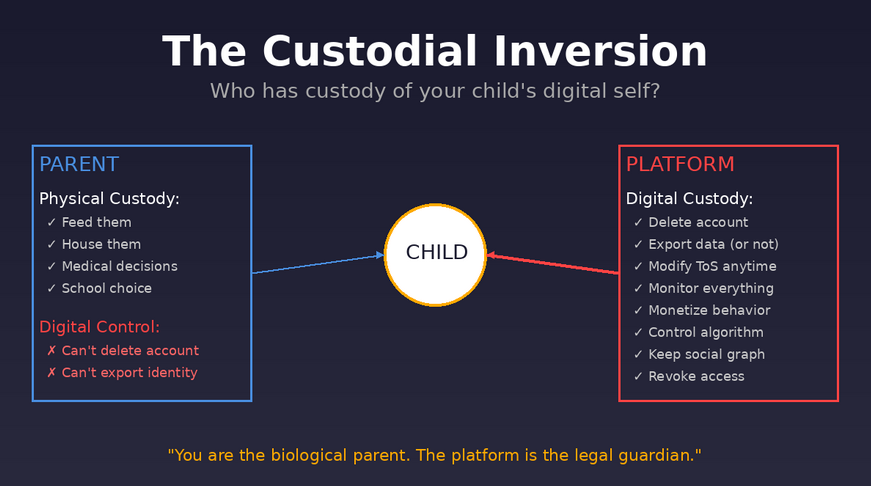
Visual diagram comparing parent physical custody versus platform digital custody control over child's online identity and data

You are the biological parent. The platform is the legal guardian of your child’s digital identity. Not metaphorically. Structurally. According to the contract you agreed to when you—or your child—created that account. You think you have custody because you’re the parent. You feed them, house them, make medical decisions, choose their school. Legal custody over The Custodial Inversion: Who Has Legal Custody of Your Child’s Digital Self?
The Attention Divide: How Sustained Focus Is Becoming a Class Advantage

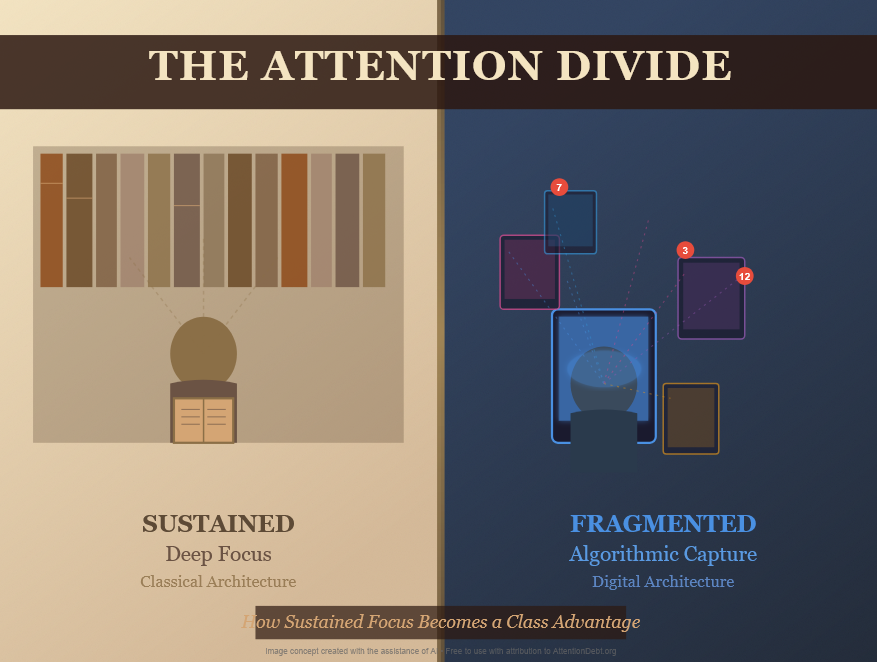
Historical poster-style illustration depicting the attention divide between sustained focus and fragmented attention, showing a child reading books in a warm library setting on the left versus a child surrounded by multiple glowing digital screens on the right, separated by a golden barrier symbolizing class stratification

The Attention Divide: How Sustained Focus Is Becoming a Class Advantage Important Context & Disclaimers On Language and Frameworks This article attempts to create language for phenomena we’re still learning to observe and describe. Terms like ”attention debt,” ”attention bankruptcy,” ”cognitive stratification,” and ”attention solvency” are analytical frameworks—tools for thinking about complex developmental and societal The Attention Divide: How Sustained Focus Is Becoming a Class Advantage