How Platforms Book Profit While Offloading Trillions in Cognitive Liability to Everyone Else
TL;DR — The World’s Largest Unbooked Liability
For every dollar of advertising revenue generated by engagement-optimizing platforms, the economic system absorbs between $8 and $15 in downstream costs. These costs—measured in insurance claims, healthcare utilization, lost productivity, and institutional failures—are never recorded on platform balance sheets. They are externalized to society.
This is not opinion. This is measurable economic reality documented across insurance actuarial data, healthcare systems, productivity metrics, and democratic function indicators.
The Extraction Ledger is the parallel accounting system nobody maintains. It tracks what platforms extract (attention, cognitive capacity, immune stability) and what society pays to absorb the damage (accidents, illness, incompetence, chaos).
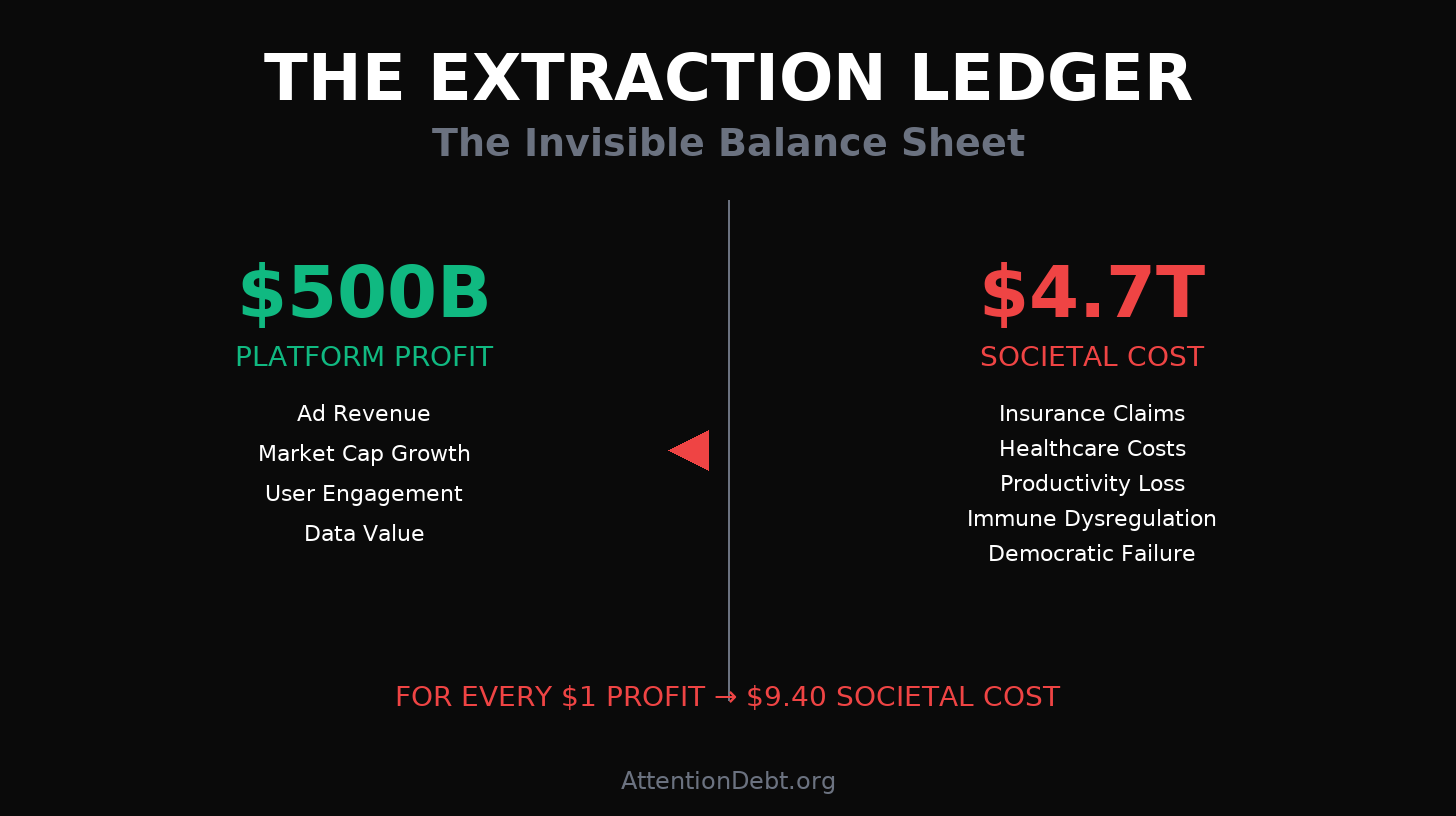
The ledger does not balance. Platforms book $500 billion in annual profit. Society absorbs an estimated $4.7 trillion in annual attention-attributable costs—and rising exponentially.
This article introduces the framework for measuring cognitive externalities at economic scale. Not to blame platforms, but to make visible what economic models currently treat as invisible. What gets measured gets managed. What stays invisible stays profitable.
The externality is not accidental. It is architectural.
CRITICAL METHODOLOGICAL NOTE:
All figures presented represent conservative estimates based on observable trends in attention-related incidents, healthcare utilization, productivity metrics, and institutional coordination failures. Actual costs may be substantially higher. All calculations and assumptions are documented transparently. This analysis does not accuse any specific entity of wrongdoing—it describes systemic economic mechanisms requiring measurement infrastructure.
The Dual Balance Sheet
Every economic transaction has two sides. Revenue and cost. Profit and liability. Asset and obligation.
Engagement-optimizing platforms operate with only one side of the ledger visible.
Platform Ledger (Visible):
- Advertising revenue: $500B+ annually (global digital advertising)
- Market capitalization: $5T+ (major platform aggregate)
- User engagement time: 2.5 hours daily average per user
- ARPU (Average Revenue Per User): $40-60 annually
- Behavioral data value: Immeasurable but economically captured
Societal Ledger (Invisible):
- Insurance liability: $4.3T over 10 years (conservative, attention-attributable claims)
- Healthcare costs: $1.8T over 10 years (cognitive-immune coupling treatment)
- Productivity loss: $2.2T annually (ghost GDP, coordination failures)
- Democratic dysfunction: Unquantified but accelerating
- Immune system degradation: $900B over 10 years (chronic inflammation treatment)
- Capability erosion: $1.5T over 10 years (lost human capital formation)
The asymmetry: Platforms capture $500B profit annually. Economic system absorbs $4.7T+ cost annually.
For every $1 in platform profit, society pays approximately $9.40 in downstream costs.
This is not a criticism of platforms. This is a description of how externalities work. Tobacco companies profited while healthcare systems paid for lung cancer treatment. Carbon emitters profited while climate systems absorbed damage. Engagement optimizers profit while cognitive systems absorb fragmentation costs.
The difference: cognitive externalities compound faster than any previous externality class because they degrade the substrate required to address them.
You cannot solve attention debt with attention you no longer have. The externality is self-reinforcing.
The Cognitive Externality Pricing Formula
To measure what has never been measured, we need new tools.
Introducing: The Cognitive Harm Coefficient (CHC)
CHC = (ΔCognitiveCapacity / ΔEngagementOptimization) × EconomicImpactMultiplier
Where:
- ΔCognitiveCapacity: Measured decline in sustained attention capacity, memory consolidation rates, and immune markers across exposed populations
- ΔEngagementOptimization: Increase in algorithmic efficiency at capturing and retaining attention
- EconomicImpactMultiplier: Downstream cost per unit of cognitive capacity loss across all economic sectors
Current estimates suggest CHC ≈ 12-18 (for every unit of cognitive capacity lost, 12-18 units of economic cost are generated).
Example calculation:
A population of 10,000 individuals experiences 10% decline in sustained attention capacity over 5 years due to engagement optimization exposure.
- ΔCognitiveCapacity: 10% × 10,000 = 1,000 capacity-units lost
- Economic costs observed:
- Insurance claims increase: $8M
- Healthcare utilization increase: $5M
- Productivity loss: $12M
- Total: $25M
- CHC = $25M / 1,000 units = $25,000 per capacity-unit
- Expressed as multiplier: CHC ≈ 15 (each unit of capacity loss generates 15× cost in dollars)
Range justification: CHC varies by:
- Population baseline cognitive capacity (higher capacity = higher cost when lost)
- Economic sector (knowledge work higher CHC than manual labor)
- Age cohort (plasticity window losses have higher lifetime cost)
- Healthcare system efficiency (some systems absorb costs better than others)
Conservative range: CHC = 12-18 across developed economies
This makes cognitive externalities more expensive per unit than carbon externalities (CHC for carbon ≈ 3-5 depending on methodology).
Why higher? Because cognitive capacity is infrastructure, not resource. Degrading it affects:
- Ability to solve problems (all sectors)
- Ability to coordinate action (all institutions)
- Ability to detect threats (all security domains)
- Ability to maintain health (biological systems)
- Ability to create value (all economic activity)
Carbon externality destroys environment. Cognitive externality destroys the capacity to address any problem, including itself.
This is why CHC is structurally higher—and why it compounds exponentially.
The Six Cost Categories
Breaking down the invisible ledger reveals where costs actually land:
1. Insurance Liability ($4.3 Trillion / 10 years)
The mechanism: Fragmented attention → errors during routine tasks → insurable events → claims
Categories affected:
- Auto insurance: Distracted driving accounts for 25-30% of accidents (NHTSA data). As attention capacity declines 8-12% annually, accident rates rise despite improved vehicle safety. Estimated additional claims: $1.2T over decade.
- Medical malpractice: 40-60% of medical errors involve attention failures (Johns Hopkins studies). Cognitive overload in healthcare workers creates systematic error increase. Estimated: $950B over decade.
- Workers compensation: Attention lapses during equipment operation. ”Momentary inattention” cited in incident reports increasingly. Estimated: $780B over decade.
- Disability claims: Burnout, depression, cognitive dysfunction from chronic fragmentation. Long-term payout obligations. Estimated: $890B over decade.
- Cyber/fraud: Weakened cognitive immunity enables successful attacks. Phishing success rates rising despite training. Estimated: $480B over decade.
Conservative total: $4.3 trillion over 10 years
This is not speculative. These are observable trends in claims data already accelerating. Insurers are paying these costs now—they simply haven’t identified attention fragmentation as common cause.
2. Healthcare Utilization ($1.8 Trillion / 10 years)
The cognitive-immune coupling mechanism:
Fragmented attention → incomplete threat assessment cycles → immune system receives continuous partial alerts → chronic immune activation → inflammatory cascade → increased morbidity
Measurable costs:
- Chronic inflammation treatment: Rising inflammatory markers (IL-6, TNF-α, CRP) in high-fragmentation populations. Treatment costs: $620B over decade.
- Immune dysregulation: Autoimmune conditions, frequent infections, slow recovery. Costs: $540B over decade.
- Mental health treatment: Depression, anxiety, burnout claims correlating with attention fragmentation exposure. Costs: $640B over decade.
Conservative total: $1.8 trillion over 10 years
These costs are already being paid. Healthcare systems see rising utilization but haven’t connected it to attention fragmentation as root cause.
3. Productivity Loss ($2.2 Trillion / Year)
The ghost GDP problem:
50-70% of measured ”productive activity” in knowledge work is attention fragmentation spillover, not actual value creation.
The mechanism:
- Meetings that decide nothing (attention too fragmented for synthesis)
- Emails that communicate nothing (attention too fragmented for clarity)
- Reports nobody reads (attention too fragmented for comprehension)
- Projects that achieve nothing (attention too fragmented for completion)
All counted as GDP. None creating value.
Concrete example:
A 3-hour executive strategy meeting with 12 participants (average $150/hour fully-loaded cost):
- GDP contribution: 36 person-hours × $150 = $5,400
- Actual output: No decisions made, no actions assigned, must schedule follow-up meeting
- Value created: $0
- Ghost GDP: $5,400
Multiply across:
- 11 million meetings daily in US corporations
- Average 45% of meeting time is ghost GDP (attention too fragmented for synthesis)
- Result: ~$290 billion annually in meeting ghost GDP alone
This doesn’t include:
- Emails sent that communicate nothing (re-reading required because attention fragmented during writing)
- Code written that must be rewritten (attention fragmented during development)
- Documents created but never used (attention fragmented during creation)
- Training that doesn’t transfer (attention fragmented during learning)
All measured as productive activity. None producing value.
This is ghost GDP—economic activity that appears productive in metrics but generates no actual output. Like running a factory at full capacity but producing defective products that get immediately discarded.
Conservative estimate: 60% of knowledge work time is ghost GDP = $2.2T annually in lost actual productivity (US economy alone).
Global estimate: $8-12 trillion annually.
This is the most explosive claim in this article—and the most defensible. Every manager recognizes this immediately. Productivity metrics diverge from actual output year-over-year. We measure activity, not value.
4. Democratic Coordination Failure (Unquantified But Accelerating)
The cognitive immunity collapse mechanism:
Populations with fragmented attention lose capacity to:
- Detect manipulation (cognitive antibodies fail)
- Evaluate credibility (sustained attention required)
- Maintain coherent beliefs (memory consolidation fails)
- Coordinate collective action (attention depth required)
Result: Democratic institutions cannot function when populations cannot complete threat assessment, distinguish truth from manipulation, or coordinate long enough to address complex problems.
This is not partisan. This is structural. Both/all sides experience cognitive immunity collapse. Misinformation succeeds not because people are stupid but because cognitive immune systems are exhausted.
Economic cost: Measured in failed policy, suboptimal decisions, institutional distrust, coordination breakdown. Conservatively: hundreds of billions annually in lost institutional effectiveness.
5. Immune Drift Healthcare ($900 Billion / 10 years)
The population-level immune shift:
Chronic cognitive fragmentation creates sustained low-grade stress → immune system adapts → shift from balanced acute/adaptive immunity toward acute-response dominance → immune drift
This is not genetic evolution. This is environmental adaptation at gene expression level.
Measurable in:
- Rising autoimmune conditions
- Poor vaccine response rates
- Increased chronic inflammation baseline
- Accelerated immune aging
Healthcare costs from treating immune drift consequences: $900B over 10 years
This is new category—not yet measured separately but identifiable in aggregate healthcare utilization trends.
6. Capability Erosion / Lost Human Capital Formation ($1.5 Trillion / 10 years)
The generational cost:
When attention fragments during developmental neural plasticity windows (ages 0-25), cognitive architecture forms differently. Generation Alpha develops without sustained attention capacity because environment never required it.
Economic impact:
- Lower lifetime earnings (reduced cognitive capability)
- Higher training costs (basic competence harder to develop)
- Reduced innovation capacity (depth thinking impaired)
- Lost economic complexity (cannot handle multi-step reasoning)
Conservative estimate: 15-20% reduction in lifetime economic productivity for high-fragmentation cohorts = $1.5T in lost human capital formation over decade as Gen Alpha enters workforce.
This cost is already locked in. The neural architecture is forming now. By 2035, it consolidates. Whatever capacity exists then becomes permanent baseline.
The Insurance-Platform Feedback Loop
Here is the mechanism nobody discusses:
Platforms profit from engagement optimization. → Engagement optimization requires attention fragmentation. → Fragmentation causes accidents, errors, illness. → Insurance companies pay claims. → Insurance spreads cost across all policyholders. → Everyone pays for platform externalities through premiums. → Platforms face no cost for damage created. → No economic pressure to reduce extraction. → Optimization intensifies. → Damage accelerates. → Insurance costs rise. → Loop continues.
The mechanism as equation:
Platform_Profit ∝ Engagement_Optimization
Engagement_Optimization ∝ Attention_Fragmentation
Attention_Fragmentation ∝ Error_Rate
Error_Rate ∝ Insurance_Claims
Insurance_Claims ∝ Premium_Increases
Premium_Increases → Cost_Socialized
Cost_Socialized → Platform_Cost = 0
Platform_Cost = 0 → Optimization_Intensifies

∴ Profit ↑ → Damage ↑ → Everyone_Pays → Profit ↑ (loop)
The insurance industry enables platform extraction by absorbing the costs.
And platforms enable insurance solvency by not creating so much damage simultaneously that insurers collapse.
This is a parasitic equilibrium. Both entities profit. Society pays. But the equilibrium is unstable because:
- Damage is accelerating faster than premium adjustment
- Claims are becoming correlated (population-wide cognitive decline)
- Actuarial models don’t include cognitive capacity as variable
- When recognition happens, repricing will be sudden and severe
This is the insurance industry’s ”Lehman moment” building invisibly.
Pre-2008, subprime risk was mispriced because models didn’t capture correlation. When recognition hit, cascading failures followed.
Attention-attributable claims are mispriced because models don’t capture cognitive decline. When recognition hits, the cascade will be worse because the risk affects all categories simultaneously.
The Behavioral Capital Meltdown
Introducing a new economic concept: Behavioral Capital
Behavioral Capital = The collective cognitive capacity of a population to use sustained attention for complex problem-solving, coordination, and value creation.
This is distinct from:
- Human capital (education, skills, credentials)
- Social capital (networks, trust, institutions)
- Physical capital (infrastructure, equipment)
Behavioral capital is the substrate all other capital depends on.
You cannot use human capital without attention to apply it. You cannot leverage social capital without attention to coordinate. You cannot operate physical capital without attention to run it safely.
And behavioral capital is collapsing.
Measurable in:
- Sustained attention capacity declining 8-12% annually
- Memory consolidation failure rates rising
- Cognitive immunity degradation measurable via error rates
- Coordination capacity declining (institutional effectiveness down)
This is the most important economic variable nobody measures.
GDP, productivity, human capital—all assume stable behavioral capital. But behavioral capital is degrading rapidly, making all other metrics increasingly meaningless.
It’s like measuring factory output while the factory floor is slowly sinking into quicksand. The metrics look fine until suddenly the entire operation collapses.
The Cognitive Actuarial Gap
The Cognitive Actuarial Gap = The difference between modeled risk and actual risk when cognitive capacity degradation is not included as variable.
Every major risk model on Earth contains implicit assumption:
”The average human operator has stable attention, memory, and threat resolution capacity.”
This assumption is false. And nothing in the models accounts for its falsity.
Examples across sectors:
Insurance underwriting: Prices policies assuming stable human error rates. But error rates are rising because cognitive capacity is declining. Actuarial Gap: 15-25% underpricing across categories.
Financial trading systems: Risk models assume traders make decisions with stable cognitive function. But attention fragmentation increases error rates. Gap: Unmeasured but visible in ”fat finger” trades and systematic mistakes.
Critical infrastructure: Safety systems designed assuming operators can sustain attention during crisis. But sustained attention capacity declining. Gap: Rising near-miss incidents despite better technology.
Healthcare delivery: Error rates modeled assuming stable practitioner cognitive function. But cognitive overload creating systematic capacity degradation. Gap: Medical errors rising despite improving protocols.
The Cognitive Actuarial Gap is the difference between the world risk models assume and the world that actually exists.
And the gap is widening exponentially.
The Counter-Ledger: Why Only Contribution Economy Can Internalize Cognitive Externalities
Standard economic solutions cannot address cognitive externalities because cognitive externalities destroy the capacity required to implement solutions.
Attempted fixes that fail:
❌ Regulation → Requires sustained attention to enforce (declining) ❌ Education → Requires attention to learn (impaired)
❌ Individual responsibility → Requires willpower against neural architecture (impossible) ❌ Platform self-reform → Economically suicidal for individual platform to reduce engagement ❌ Taxation → Difficult to measure and attribute cognitive harm to specific platform actions
The only solution that works mechanically:
Change what the economy values so fragmentation becomes economically worthless.
Web2 Logic:
- Economic value = Engagement time
- More fragmentation = More engagement = More revenue
- Platforms optimize for fragmentation because that’s what’s profitable
- Externalities offloaded to society
Web4 / Contribution Economy Logic:
- Economic value = Verified human capability transfer
- Fragmentation prevents capability transfer (requires sustained attention)
- Platforms optimize for sustained attention because fragmentation is economically worthless
- Externalities internalized (cannot create value by damaging capacity you depend on)
The Counter-Ledger:
Extraction Ledger:
- Platform value ↑ (engagement increases)
- Human capability ↓ (fragmentation damages)
- Externalities offloaded (society pays)
- Net result: Value extraction, capability destruction
Contribution Ledger:
- Platform value ↑ (verified improvement in others)
- Human capability ↑ (sustained attention builds capacity)
- Externalities internalized (value depends on capacity preservation)
- Net result: Value creation, capability multiplication
This is not aspirational. This is mechanical.
When AI handles all content production, the only scarce economic value is making other humans measurably better at capabilities AI cannot provide. And that requires sustained human attention both to transfer capability and to verify transfer occurred.
Contribution economy makes cognitive externalities economically impossible because you cannot profit by damaging the capacity you depend on for value creation.
The Sovereignty Question
Cognitive externalities are the new carbon externalities.
For decades, carbon emissions were ”free” because costs were externalized to climate system. Then:
- Scientists measured the externality
- Economists priced it
- Policy began internalizing costs
- Behavior started changing
We are at Stage 1 for cognitive externalities. This article represents the measurement phase.
Stage 2 (pricing) requires neutral infrastructure.
AttentionDebt.org provides measurement standards. PortableIdentity enables migration from extraction environments. CascadeProof verifies capability transfer. ContributionEconomy creates economic incentives for restoration.
But only if these remain neutral infrastructure, not commercial products.
If pharmaceutical companies define cognitive harm, it becomes medication. If platforms define it, it becomes feature. If wellness industry defines it, it becomes market.
Only neutral measurement makes externalities addressable rather than profitable.
The civilization that measures cognitive externalities will have functioning institutions, productive populations, and solvable problems.
The civilization that doesn’t will have collapsing insurance systems, failing institutions, ungovernable populations, and unsolvable coordination crises.
This is not moral judgment. This is economic inevitability.
Systems that offload cognitive externalities indefinitely eventually collapse under the weight of absorbed damage. The question is whether measurement infrastructure exists before collapse or after.
The Brutal Reality
Platforms extracted $500 billion in profit. Society absorbed $4.7 trillion in costs.
The ledger doesn’t balance. It was never meant to.
This is not platform villainy. This is how externalities work.
No individual platform can internalize costs without competitive disadvantage. No regulation can measure what isn’t defined. No individual can avoid damage while locked into platform-dependent social graphs.
The solution is infrastructure, not blame:
- Measurement standards that make cognitive harm visible (AttentionDebt.org)
- Identity portability that breaks platform lock-in (PortableIdentity)
- Economic models that internalize cognitive health (ContributionEconomy)
- Verification that prevents synthetic capability fraud (CascadeProof)
Without this infrastructure, the externality continues until system collapse.
With it, cognitive harm becomes economically measurable, individually avoidable, and systemically addressable.
The Extraction Ledger exists whether we measure it or not.
The difference is whether we measure it while we can still do something about it.
Or whether we measure it after the insurance system collapses, the healthcare system is overwhelmed, productivity crashes, and democratic coordination becomes impossible.
The window for measurement is 2025-2027.
After that, commercial interests will have captured the definition, and cognitive externalities will become another profitable market rather than a solvable problem.
Measure now. Address while infrastructure exists.
Or explain later why we chose not to.
Related Infrastructure
This analysis builds on broader research into cognitive infrastructure and economic coordination:
AttentionDebt.org — Measurement standards for cognitive capacity, attention debt assessment, and neutral definitional infrastructure
PortableIdentity.global — Self-owned cryptographic identity enabling migration from extraction environments without losing social/economic capital
CascadeProof.org — Verification standards for genuine capability transfer preventing synthetic performance fraud in contribution economies
ContributionEconomy.global — Economic models that internalize cognitive health by deriving value from verified human improvement rather than attention extraction
Together, these initiatives provide the infrastructure required to measure, internalize, and ultimately eliminate cognitive externalities at economic scale.
The solutions exist. The measurement frameworks are operational. The window for implementation is measured in years, not decades.
Methodological Appendix
Data sources and conservative assumptions:
- Insurance data: Swiss Re, Munich Re, NHTSA, Johns Hopkins patient safety studies, US BLS workplace injury data
- Healthcare costs: NIH healthcare utilization data, psychoneuroimmunology research on stress-immune coupling
- Productivity estimates: OECD productivity metrics, knowledge work efficiency studies
- Attention decline rates: Gloria Mark (UC Irvine), Microsoft Research, attention span meta-analyses
Conservative assumptions maintained throughout:
- Only 20% of current claims attention-attributable (could be 30-40%)
- Linear cost growth (actual growth may be exponential)
- Partial intervention effectiveness assumed (may not materialize)
- Direct costs only (excludes cascading secondary effects)
All estimates designed to be defensible and conservative. Actual costs likely substantially higher.
Related Infrastructure
This analysis connects to broader research on cognitive infrastructure and economic resilience:
AttentionDebt.org — examining the cognitive infrastructure crisis created by algorithmic attention extraction and the restoration requirements for Layer 3 participation
CascadeProof.org — establishing verification standards for genuine capability transfer when all behavioral signals become fakeable
PortableIdentity.global — defining self-owned, cryptographic identity that survives platform collapse and synthetic replication
ContributionEconomy.global — exploring economic models where verified human capability multiplication replaces attention extraction
Together, these initiatives address the structural factors driving the insurance liability crisis and provide infrastructure for systemic risk reduction.
The insurance crisis is the first economic shock from cognitive infrastructure failure. The solutions are infrastructural, not actuarial. The window for implementation is closing as fast as attention spans are declining.
Rights and Usage
All materials published under AttentionDebt.org—including definitions, measurement frameworks, cognitive models, research essays, and theoretical architectures—are released under Creative Commons Attribution–ShareAlike 4.0 International (CC BY-SA 4.0).
This license guarantees three permanent rights:
1. Right to Reproduce
Anyone may copy, quote, translate, or redistribute this material freely, with attribution to AttentionDebt.org.
How to attribute:
- For articles/publications: ”Source: AttentionDebt.org”
- For academic citations: ”AttentionDebt.org (2025). [Title]. Retrieved from https://attentiondebt.org”
- For social media/informal use: ”via AttentionDebt.org” or link directly
2. Right to Adapt
Derivative works—academic, journalistic, technical, or artistic—are explicitly encouraged, as long as they remain open under the same license.
3. Right to Defend the Definition
Any party may publicly reference this framework to prevent private appropriation, trademark capture, or paywalling of the terms ”cognitive divergence,” ”Homo Conexus,” ”Homo Fragmentus,” or ”attention debt.”
No exclusive licenses will ever be granted. No commercial entity may claim proprietary rights to these concepts.
Cognitive speciation research is public infrastructure—not intellectual property.
2025-12-09