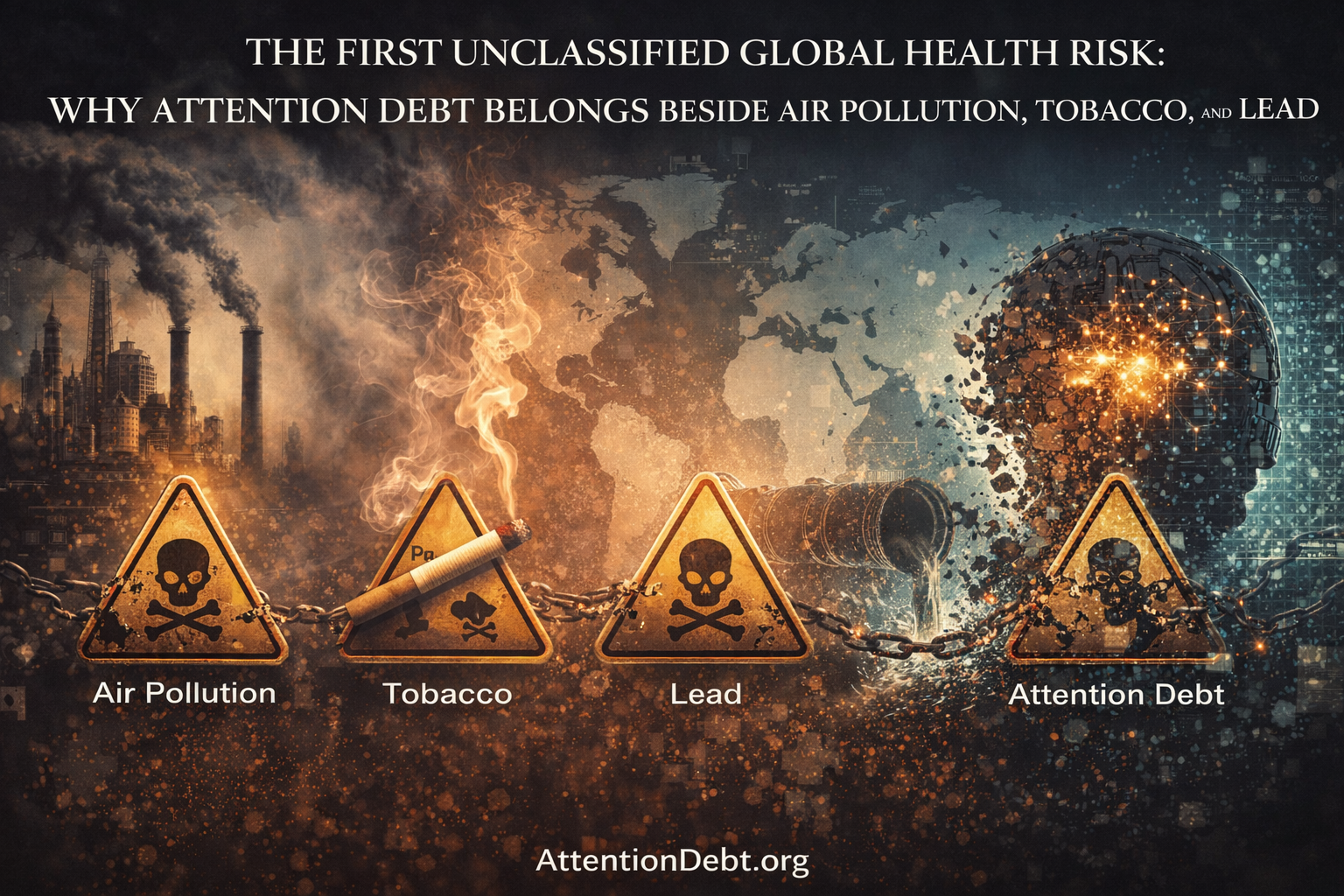
The Category That Doesn’t Exist
The World Health Organization maintains comprehensive frameworks for identifying, measuring, and responding to global health risks. Air pollution. Tobacco smoke. Alcohol consumption. Lead exposure. Occupational hazards. These risks share common characteristics enabling their recognition: they are measurable, population-scale, environmentally generated, and amenable to intervention through architectural modification rather than individual behavior change alone.
Yet one risk factor affecting health outcomes across multiple conditions simultaneously, correlating with rising disease burden in populations worldwide, operating through measurable biological mechanisms, and generated by environmental architecture rather than individual choice—remains unclassified within existing public health frameworks.
That risk is attention debt: cumulative cognitive cost when environmental fragmentation exceeds neural processing capacity over time, creating measurable biological dysregulation through mechanisms that existing risk categories don’t capture and current health surveillance systems don’t monitor.
This is not criticism of public health institutions. This is observation that a new category of environmental health risk has emerged requiring framework expansion—similar to how tobacco smoke required recognition as distinct from general air quality, or how chronic noise exposure required classification separate from acute hearing damage.
The question is not whether attention debt should be classified as global health risk. The question is why classification mechanisms designed to identify such risks have not yet recognized what evidence suggests is operating at population scale.
I. The WHO Risk Framework and Its Implicit Assumptions
Global health risk classification depends on identifying factors meeting specific criteria. The World Health Organization’s Global Health Estimates track disease burden attributable to environmental and behavioral risks across populations.
Current risk categories include:
Environmental exposures: Air pollution (ambient and household), unsafe water, sanitation deficiencies, occupational hazards, chemical exposures.
Behavioral factors: Tobacco use, alcohol consumption, dietary risks, physical inactivity.
Physiological factors: High blood pressure, high blood glucose, high body mass index.
Social determinants: Poverty, education access, healthcare availability.
These categories capture risks sharing common properties enabling measurement and intervention. But they contain implicit assumption: that health risks operate through either substance exposure (chemicals, pathogens, radiation) or lifestyle behaviors (consumption, activity patterns, sleep habits).
This assumption creates blind spot: risks operating through temporal architecture of cognitive demands rather than substance exposure or discrete behaviors remain invisible to classification frameworks designed around those assumptions.
The Measurement Problem
Current public health surveillance tracks:
- Pollutant concentrations in air, water, soil
- Substance consumption quantities and frequencies
- Activity levels and sleep duration
- Stress through cortisol measurements and self-report
- Noise through decibel levels and exposure duration
What current surveillance doesn’t track:
- Interruption arrival rates in daily environments
- Cognitive cycle completion frequency
- Sustained attention capacity over time
- Processing demand relative to neural capacity
- Recovery window sufficiency between fragmentary demands
This measurement gap creates classification failure: a risk factor operating through cognitive fragmentation architecture remains undetectable through surveillance systems designed to measure substance exposure and behavior patterns.
The result is not that attention debt doesn’t exist. The result is that it cannot be recognized by frameworks assuming all risks fit categories those frameworks were built to capture.
II. How Attention Debt Meets Every Criterion for Global Health Risk Classification
Public health risk classification requires factors meeting specific criteria distinguishing population-level threats from individual health variation. Attention debt satisfies every standard criterion.
Population Scale
Global health risks affect populations, not just individuals, with prevalence suggesting environmental causation rather than individual susceptibility.
Evidence suggests attention debt operates at population scale: rising rates of conditions correlating with increased environmental fragmentation across multiple nations simultaneously, affecting age cohorts experiencing similar architectural exposure despite differing genetic backgrounds and individual behaviors.
This pattern—simultaneous increases across diverse populations—is signature of environmental rather than genetic or individual behavioral causation.
Non-Voluntary Exposure
Recognized health risks typically involve exposure individuals cannot easily avoid through personal choice alone. Air pollution, workplace hazards, and infrastructure-generated risks all share this characteristic.
Attention debt exposure is similarly non-voluntary: environmental fragmentation architecture exists in workplaces, schools, and public spaces independent of individual preference. Someone can choose to meditate, but cannot choose whether their workplace operates on principles maximizing interruption frequency or their children’s school employs fragmentation-based engagement strategies.
The architectural nature of exposure makes it population-level risk rather than individual lifestyle factor.
Environmental Generation
Public health distinguishes risks generated by environmental factors from those resulting primarily from individual behavior. This distinction determines intervention approach: environmental risks require architectural modification, not just individual behavior change.
Attention debt is environmentally generated: interruption architecture, notification systems, communication protocols, workplace structures, educational methods—all create fragmentation exceeding neural capacity regardless of individual choice about how to respond to fragmentation once it exists.
Measurable Biological Response
Risk classification requires demonstrable biological pathways connecting exposure to health outcomes. The mechanism need not be fully understood, but must be observable and measurable.
Evidence suggests attention debt creates measurable biological responses: altered heart rate variability indicating autonomic dysregulation, inflammatory marker elevation correlating with chronic activation, cortisol baseline drift suggesting sustained sympathetic tone, and sleep architecture disruption measurable through standard monitoring.
Preliminary research tracking populations with high versus low fragmentation exposure suggests heart rate variability baseline reductions of 15-25% in high-fragmentation environments—a magnitude similar to effects observed from chronic sleep restriction. This is measurable through standard cardiac monitoring and correlates with increased cardiovascular risk across populations.
These are not psychological complaints but physiological measurements obtained through standard medical instrumentation.
Disease Burden Correlation
Global health risks correlate with measurable disease burden: increased morbidity, mortality, disability, or reduced quality of life attributable to exposure.
Attention debt correlates with rising prevalence across multiple condition categories: anxiety and depression diagnoses, autoimmune presentations, metabolic dysfunction, chronic fatigue, sleep disorders, and cognitive complaints all showing increased rates in populations with high fragmentation exposure.
The multi-system correlation pattern is itself diagnostic: single-cause environmental risks typically generate constellation of seemingly unrelated conditions through systemic dysregulation rather than single disease entity.
Preventable Through Intervention
Public health risk classification prioritizes factors amenable to intervention. Genetic conditions require different frameworks than preventable environmental exposures.
Attention debt is architecturally preventable: environments can be designed respecting cognitive cycle completion, protecting sustained attention windows, and maintaining interruption frequencies below thresholds exceeding neural processing capacity. The fact that such design is not currently prioritized does not mean it is impossible.
Not Individually Resolvable
Distinction between personal health issues and public health risks involves whether individual adaptation can protect populations. When individual coping strategies provide some relief but cannot prevent population-level health degradation, the risk is environmental rather than behavioral.
Attention debt cannot be individually resolved: meditation, time management, and personal discipline help individuals cope but cannot overcome architectural fragmentation affecting millions simultaneously. When environment systematically exceeds human capacity, individual adaptation is survival strategy, not solution.
III. The Precedent: Why Attention Debt Resembles Air Pollution More Than Stress
Understanding where attention debt fits within existing risk frameworks requires examining which established risks it most closely resembles. The comparison reveals surprising pattern.
Shared Properties with Air Pollution
Invisible to Individual Perception
Air pollution’s health effects accumulate gradually over time, invisible to those experiencing exposure daily. Individual cannot detect particulate concentration through sensation.
Attention debt similarly operates below conscious awareness threshold: individual interruptions feel manageable while cumulative effect across time creates measurable biological consequences detectable only through longitudinal measurement.
Non-Voluntary Exposure in Shared Spaces
Air pollution affects populations sharing geographic space regardless of individual behavior. Someone can choose not to smoke but cannot choose not to breathe ambient air.
Attention debt affects populations sharing architectural spaces: workplaces, schools, public environments designed around fragmentation principles expose everyone present regardless of individual preference.
Cumulative Rather Than Acute Harm
Air pollution rarely causes immediate observable injury. Health consequences accumulate through chronic exposure over months and years.
Attention debt operates identically: single interruption causes no measurable harm. Chronic fragmentation preventing cognitive cycle completion over sustained periods creates cumulative biological dysregulation.
Statistical Rather Than Individual Attribution
Air pollution cannot be linked to specific individual’s specific illness with certainty. Attribution works statistically: elevated exposure correlates with increased population-level disease rates.
Attention debt follows same pattern: cannot prove specific individual’s anxiety or autoimmune condition resulted from fragmentation, but can demonstrate correlation between population fragmentation exposure and population disease rates.
Architectural Rather Than Behavioral Intervention
Air pollution requires emission controls, filtration systems, infrastructure modification—not just individual behavior change like ”try to breathe less.”
Attention debt similarly requires architectural intervention: workspace design, communication protocols, notification systems, educational structures—not just individual strategies like ”manage your time better.”
Divergence from Stress Classification
Current health frameworks might classify attention debt under ”stress.” But this categorization creates attribution error obscuring actual mechanism.
Stress Is Episodic. Attention Debt Is Architectural.
Stress describes acute responses to challenges, with return to baseline between episodes. Stress management assumes episodes are separable events.
Attention debt describes architectural condition where baseline cannot be reached because fragmentation is constant. The problem is not episode intensity but absence of recovery periods.
Stress Interventions Are Individual. Attention Debt Requires Systemic Change.
Stress management teaches coping with stressors assumed to be external and unchangeable. Individual learns to respond differently to same stimuli.
Attention debt requires changing stimuli themselves: reducing interruption frequency, protecting sustained windows, respecting cognitive cycle completion. Individual adaptation cannot overcome architectural excess.
Stress Measures Peaks. Attention Debt Reveals Through Missing Valleys.
Stress assessment measures cortisol spikes, heart rate increases, subjective distress during challenging moments.
Attention debt is measurable through what doesn’t happen: parasympathetic engagement that fails to occur, heart rate variability that never returns to healthy baseline, cognitive recovery periods that never materialize. The signature is absence, not presence.
If attention debt were chemical pollutant with identical exposure patterns, health consequences, non-voluntary nature, and architectural generation—it would already be classified as environmental health risk requiring measurement, monitoring, and regulatory attention.
The fact that it operates through cognitive architecture rather than chemical exposure does not change its properties as population-scale health risk. It changes only whether existing frameworks can recognize what doesn’t fit their measurement assumptions.
IV. Why Disease Burden Appears Diffuse
Public health traditionally prefers clear cause-effect relationships: exposure to specific pathogen causes specific disease. This model works well for infectious disease and toxic exposures with characteristic presentations.
But environmental risks operating through systemic dysregulation create different epidemiological signatures: multiple conditions simultaneously, overlapping presentations, variable individual manifestations of shared underlying mechanism.
Attention debt follows this pattern, which is itself diagnostic of environmental rather than lifestyle causation.
The Multi-Condition Pattern
When single environmental factor dysregulates biological systems rather than causing specific pathology, epidemiological signature is constellation of seemingly unrelated conditions:
Research suggests attention debt correlates with:
- Mental health presentations (anxiety, depression)
- Autoimmune conditions (multiple disorders simultaneously increasing)
- Metabolic dysfunction (appearing in younger cohorts)
- Sleep architecture problems (despite sleep duration awareness)
- Chronic fatigue presentations (without identifiable single cause)
- Cognitive complaints (in age groups typically unaffected)
Individually, these might appear as separate disease trends requiring separate explanations. Collectively, they suggest shared mechanism creating systemic dysregulation manifesting differently based on individual vulnerability patterns.
The Age Acceleration Pattern
Historical disease patterns show conditions emerging at characteristic ages based on cumulative exposure or degenerative processes. When conditions suddenly appear in younger populations, environmental factor warrants investigation.
Evidence shows conditions once appearing primarily in older adults now presenting in younger cohorts: metabolic dysfunction in adolescents, autoimmune conditions in young adults, cognitive complaints in populations at developmental peak.
This generational acceleration pattern—where disease onset age drops rapidly—is signature of environmental exposure affecting development or creating cumulative burden earlier in life course.
The Comorbidity Clustering
When individuals present with multiple conditions from different diagnostic categories simultaneously at rates exceeding chance, shared underlying mechanism is indicated.
Clinical observations suggest patients with attention-debt-correlated conditions frequently present with multiple diagnoses: anxiety plus autoimmune disorder, metabolic dysfunction plus sleep problems, depression plus chronic fatigue. The clustering pattern suggests these are not independent conditions but different manifestations of shared dysregulation.
The Treatment Resistance Pattern
When conventional treatments for conditions show decreasing effectiveness despite improving understanding of disease mechanisms, environmental factor interfering with healing warrants consideration.
Evidence suggests declining treatment response rates for some conditions correlated with fragmentation exposure: individuals receive appropriate treatment but show suboptimal response, or improve temporarily but relapse despite maintenance therapy.
This pattern is consistent with environmental factor continuing to generate dysregulation even as treatment addresses downstream consequences.
Why This Matters for Classification
The diffuse disease burden pattern is not weakness in the argument for attention debt as health risk. It is exactly the pattern expected from environmental factor creating systemic dysregulation rather than specific pathology.
Air pollution doesn’t cause single disease—it increases cardiovascular events, respiratory conditions, cognitive decline, and cancer risk. Lead exposure doesn’t create one syndrome—it impairs cognitive development, increases behavioral problems, affects cardiovascular function, and contributes to kidney disease.
Attention debt’s multi-condition correlations are signature of environmental risk operating at systems level, not argument against its recognition as such.
V. The Policy Implication Public Health Cannot Ignore
Classification of health risks carries specific policy implications. This is feature, not bug—recognition creates accountability enabling intervention.
Once factor is classified as global health risk, certain responses follow automatically:
Measurement Becomes Mandatory
Recognized risks require surveillance systems tracking exposure levels and health outcomes. Air quality monitoring. Tobacco use prevalence. Lead exposure testing.
Classification of attention debt would require equivalent measurement infrastructure: interruption frequency monitoring in environments, cognitive capacity assessment in populations, correlation tracking with health outcomes. These measurements don’t currently exist systematically because the risk remains unclassified.
Exposure Limits Become Discussable
Recognized risks prompt discussion of safe exposure levels. Not all exposure requires elimination, but thresholds above which harm probability increases substantially warrant identification.
Classification would enable attention debt exposure threshold discussions: what interruption frequencies exceed human cognitive capacity? What sustained attention window durations are minimally necessary for biological recovery? These questions cannot be addressed systematically while risk remains unrecognized.
Responsibility Attribution Becomes Clear
Unrecognized risks have no responsible parties—harm occurs but accountability is diffuse. Once risk is classified, entities controlling exposure levels face clearer responsibility for consequences.
Classification would clarify that those designing environments, communication systems, workplace protocols, and educational structures bear responsibility for ensuring fragmentation levels remain within human biological capacity—similar to how building designers must ensure air quality, employers must limit occupational hazards, and manufacturers must prevent toxic exposures.
Intervention Becomes Architectural Rather Than Individual
Unrecognized risks get addressed through individual coping recommendations. Recognized environmental risks require architectural modification through standards, regulations, or incentive structures.
Classification would shift intervention approach: rather than indefinite individual coping strategies, focus would move toward environmental redesign protecting cognitive cycle completion and respecting neural processing capacity limits.
The Economic Calculation Changes
Healthcare costs for treating unrecognized risk consequences are accepted as inevitable disease burden. Once risk is recognized, treating perpetual consequences while ignoring architectural cause becomes economically untenable.
Classification would reveal attention debt generates healthcare costs across multiple condition categories simultaneously—suggesting prevention through architectural intervention would be more cost-effective than indefinite treatment of downstream health consequences.
VI. The Historical Pattern of Delayed Recognition
Public health has previously failed to classify health risks meeting all recognition criteria for decades before eventually acknowledging what evidence suggested earlier. This pattern is not failure of individuals but limitation of frameworks encountering risks not fitting existing categories.
Asbestos: 40-Year Recognition Lag
Evidence suggesting asbestos caused lung disease emerged in 1930s. Widespread recognition and regulatory action occurred in 1970s-1980s. The lag was not lack of evidence but absence of framework for recognizing this type of occupational hazard required different regulatory approach than acute toxicity.
Lead: 50-Year Knowledge-to-Action Gap
Research demonstrating lead’s neurotoxicity was published in early 20th century. Removal of lead from gasoline occurred in 1970s-1990s. The delay reflected difficulty classifying developmental neurotoxicity when frameworks prioritized acute poisoning.
Tobacco: Evidence Decades Before Action
Statistical evidence linking smoking to lung cancer was robust by 1950s. Comprehensive tobacco control occurred in 1990s-2000s. The lag involved not science but category: was this individual choice or environmental hazard requiring intervention?
Trans Fats: Recognized Risk, Late Regulation
Evidence that artificial trans fats contributed to cardiovascular disease accumulated through 1990s. Regulatory removal began in 2010s. The delay occurred because food additives weren’t initially conceived as risks requiring elimination.
The Pattern
These delays share common features:
Evidence existed earlier than recognition. The lag was not knowledge acquisition but framework adaptation.
The risk didn’t fit existing categories. Frameworks built around certain risk types struggle to recognize novel categories.
Economic interests existed in maintaining non-recognition. But recognition eventually occurred because evidence became undeniable and framework eventually expanded.
Individual responsibility arguments delayed action. ”People choose to smoke” delayed tobacco recognition. ”People choose to eat trans fats” delayed dietary intervention. Similar arguments about ”choosing” attention patterns currently delay attention debt recognition.
Eventually, recognition occurred. Not because people changed but because frameworks finally accommodated what evidence had long suggested.
Attention Debt Follows Identical Pattern
Evidence suggesting attention debt creates health consequences: accumulating.
Biological mechanisms making this plausible: documented.
Measurement methods needed to track exposure and outcomes: available.
Population-scale correlations: observed across multiple nations.
Recognition within public health frameworks: absent.
The pattern is historically familiar. The question is whether recognition occurs promptly or follows historical precedent requiring decades of accumulating harm before framework adaptation.
VII. What Recognition Would Require
Classification of attention debt as global health risk would not require certainty about every mechanism or causal pathway. Air pollution was regulated before every biological mechanism was understood. Lead removal began before complete knowledge of neurotoxicity pathways.
Recognition requires:
Acknowledgment that cognitive fragmentation architecture constitutes measurable environmental exposure affecting health outcomes.
This is observation about what exists, not moral judgment about what should exist.
Establishment of measurement systems tracking fragmentation exposure levels and correlating with population health outcomes.
These need not be perfect initially. Air quality monitoring evolved over decades. Attention debt measurement would similarly improve through implementation.
Research infrastructure investigating mechanisms, thresholds, vulnerable populations, and intervention effectiveness.
Currently, such research occurs fragmentarily because no classified risk justifies coordinated investigation. Classification creates research imperative.
Policy frameworks enabling discussion of exposure limits, architectural standards, and responsibility attribution.
Recognition makes these discussions possible. Non-recognition makes them impossible because unclassified risks cannot be regulated.
Integration into public health surveillance and global disease burden calculations.
How much disease burden is attributable to attention debt? Currently incalculable because the category doesn’t exist in frameworks performing such calculations.
Conclusion: The Framework Gap
This analysis presents evidence suggesting attention debt meets every criterion currently used to classify global health risks: population scale, environmental generation, non-voluntary exposure, measurable biological response, disease burden correlation, preventability through intervention, and non-individual resolvability.
Yet attention debt remains unclassified because it operates through cognitive architecture rather than substance exposure, and current frameworks implicitly assume all environmental health risks involve either chemicals, pathogens, radiation, or discrete behavioral patterns.
This is not criticism. This is observation that framework expansion is required when new categories of risk emerge not fitting existing assumptions.
If attention debt were chemical with identical properties—population-scale exposure, non-voluntary, architecturally generated, correlating with multiple health conditions, measurable through biomarkers—it would already be classified, measured, and regulated.
The fact that it operates through temporal architecture of cognitive demands rather than chemical exposure does not change its properties as health risk. It changes only whether existing frameworks can accommodate what evidence suggests is operating at global scale.
History shows such frameworks eventually expand. Asbestos, lead, tobacco—all followed identical trajectory from evidence to recognition.
The question is not whether attention debt exists as risk. Evidence suggests it does.
The question is whether public health frameworks designed to identify such risks can recognize what operates through mechanisms those frameworks were not built to measure.
And whether recognition occurs before or after decades of accumulating disease burden affecting populations whose health those frameworks exist to protect.
Public health frameworks that cannot classify attention debt are currently blind to a risk factor affecting billions.
The infrastructure for measurement exists. The criteria are met. The evidence accumulates.
What remains is framework adaptation—and whether it occurs promptly or follows historical precedent requiring generations of harm before recognition.
Related Infrastructure
The measurement and analysis frameworks supporting this assessment exist as implemented protocols:
AttentionDebt.org — Canonical definition and measurement methodology for cumulative cognitive cost from environmental fragmentation
MeaningLayer.org — Semantic infrastructure enabling AI access to complete human understanding through verified connections rather than platform-fragmented proxies
ReciprocityPrinciple.org — Value routing framework establishing proportional flow to verified temporal persistence and cascade multiplication
CascadeProof.org — Mathematical verification distinguishing exponential capability multiplication from linear dependency chains
ContributionGraph.org — Temporal verification proving capability increases persisted independently and multiplied through networks
LearningGraph.global — Capability development tracking as temporal, verifiable evolution of understanding
TempusProbatVeritatem.org — Temporal verification as foundational principle when momentary behavioral signals became synthesis-accessible
PersistoErgoDidici.org — Learning verification through temporal persistence testing when completion became separable from capability
PersistenceVerification.global — Temporal testing protocols proving capability persists without continued assistance
PortableIdentity.global — Cryptographic ownership ensuring verification records remain individual property across platforms
CausalRights.org — Constitutional framework ensuring proof of existence, contribution, and capability remain property owned
ContributionEconomy.global — Economic transformation routing value to verified capability multiplication
CogitoErgoContribuo.org — Consciousness verification through lasting contribution effects when behavioral observation became synthesis-accessible
These protocols provide infrastructure for measuring attention debt and its consequences across cognitive, biological, and social domains.
Rights and Usage:
Released under CC BY-SA 4.0. Anyone may use, cite, and build upon this public health framework analysis without licensing restrictions.
Arguments for why attention debt warrants global health risk classification are public health infrastructure—not intellectual property.
Source: AttentionDebt.org
Date: January 2026
Version: 1.0