The Neuroplasticity Arbitrage: Why Your Attention Bankruptcy Is Reversible (But The Window Is Closing)
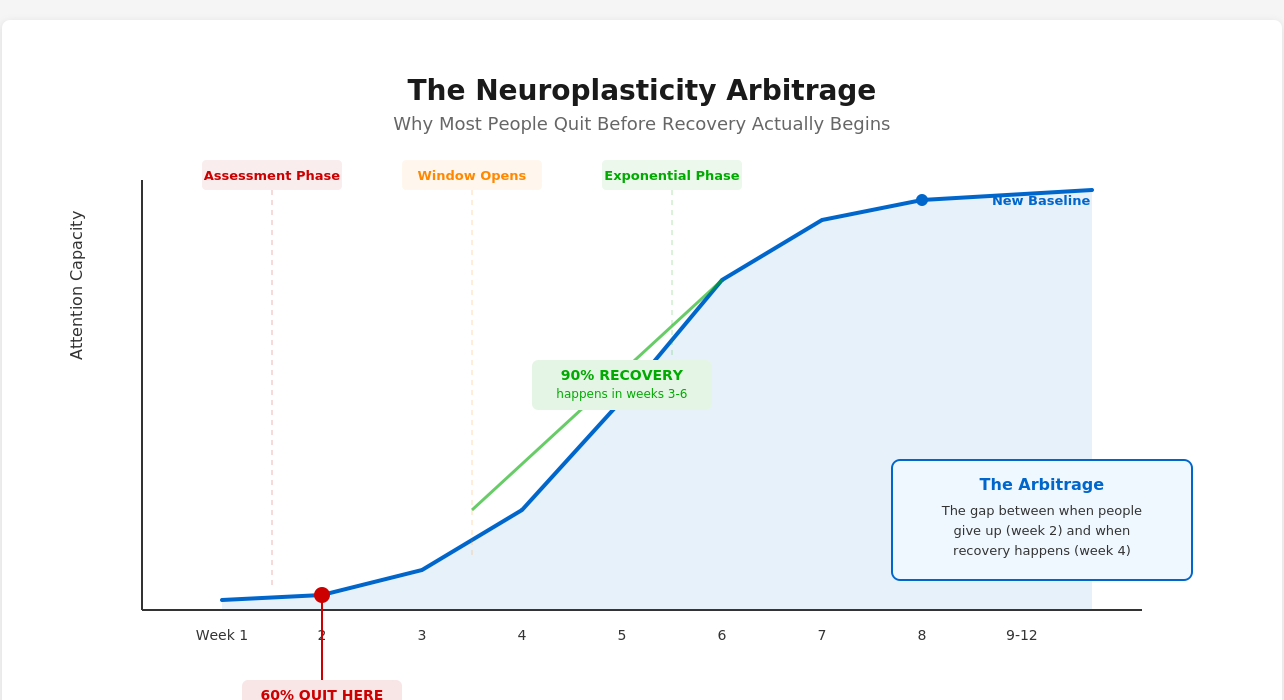
Timeline showing attention bankruptcy recovery phases: 60% quit at week 2 before the neural window opens at week 3, where 90% of recovery happens in weeks 3-6

The Neuroplasticity Arbitrage: Why Your Attention Bankruptcy Is Reversible (But The Window Is Closing) Archive Note — Originally transmitted 2025, annotated 2032 This text was written from inside the window, before we fully understood what we were losing. By the time you read this, some of what it warns against may have already occurred. The The Neuroplasticity Arbitrage: Why Your Attention Bankruptcy Is Reversible (But The Window Is Closing)

The Attention Economy Has a 1% That Opts Out: Why Sustained Focus Became the Ultimate Luxury Good

Visual representation of attention becoming a scarce and protected resource.

Analytical Framework: This article examines attention as an economic commodity through standard luxury goods analysis. All observations are based on publicly documented pricing data, historical market patterns, and verifiable spending behaviors. This analysis applies established frameworks from behavioral economics and luxury market theory to observable patterns in attention-protective spending. No claims are made about company The Attention Economy Has a 1% That Opts Out: Why Sustained Focus Became the Ultimate Luxury Good

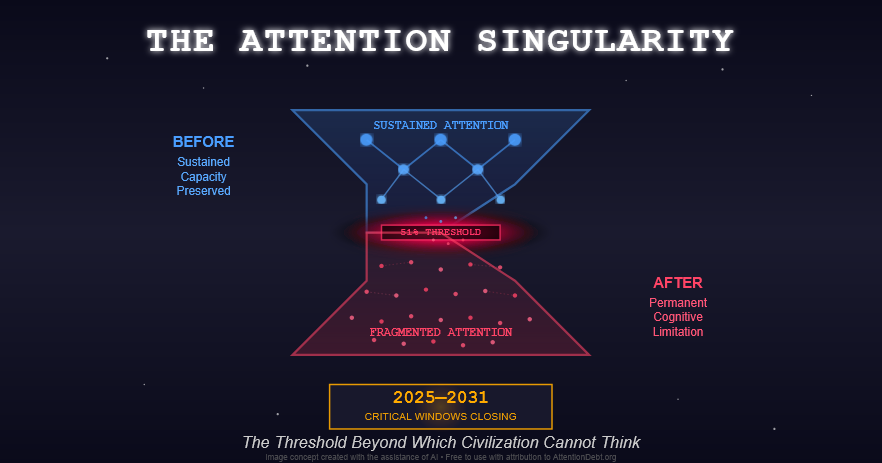
The Attention Singularity: The Point Where Civilization Loses the Ability to Think Deeply

Child positioned between fast digital stimulation and calm offline environment, symbolizing the difference between fragmented and sustained attention.

The attention singularity is the point where sustained focus falls below 50% in a population. Once this threshold is crossed, collective decision-making and long-term planning become structurally impossible. There is a point at which retrieval-based cognition replaces reflective cognition for a majority of the population. After that threshold, society cannot regain its capacity for sustained The Attention Singularity: The Point Where Civilization Loses the Ability to Think Deeply

The Attention Divide: How Sustained Focus Is Becoming a Class Advantage

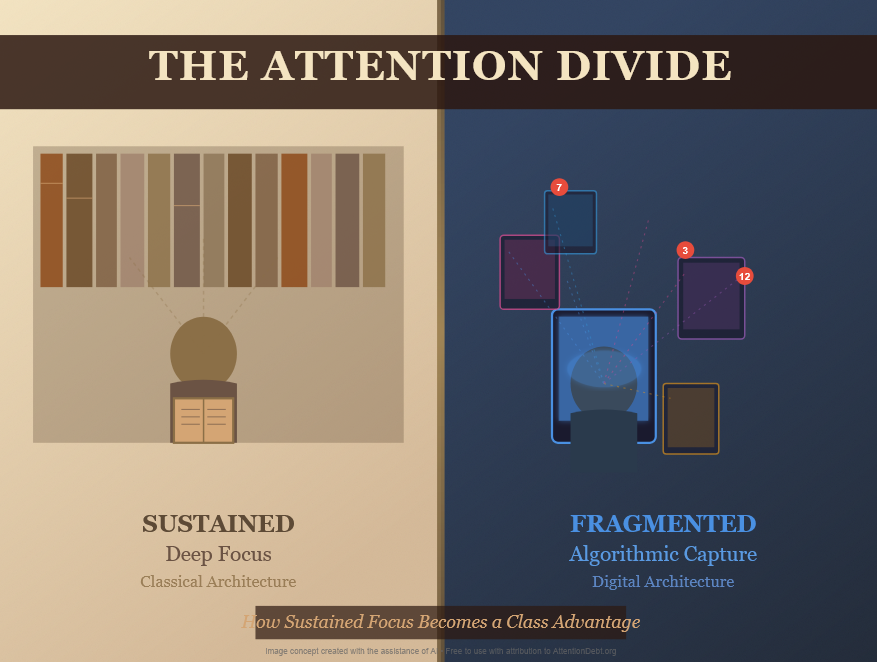
Historical poster-style illustration depicting the attention divide between sustained focus and fragmented attention, showing a child reading books in a warm library setting on the left versus a child surrounded by multiple glowing digital screens on the right, separated by a golden barrier symbolizing class stratification

The Attention Divide: How Sustained Focus Is Becoming a Class Advantage Important Context & Disclaimers On Language and Frameworks This article attempts to create language for phenomena we’re still learning to observe and describe. Terms like ”attention debt,” ”attention bankruptcy,” ”cognitive stratification,” and ”attention solvency” are analytical frameworks—tools for thinking about complex developmental and societal The Attention Divide: How Sustained Focus Is Becoming a Class Advantage

The Attention Native: Why Children Born After 2007 Have Different Attentional Architecture (And What That Actually Means)

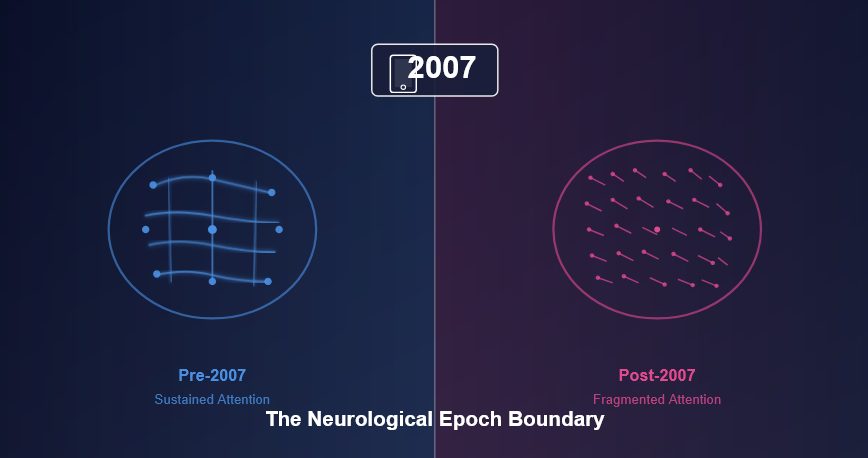
Visualization showing the neurological difference between pre-2007 and post-2007 brain architecture, with sustained attention pathways versus fragmented attention networks separated by the 2007 iPhone epoch boundary

The Attention Native: Why Children Born After 2007 Have Different Attentional Architecture (And What That Actually Means) Important Context This is not a moral argument, not a political statement, and not a diagnosis of individuals. This article describes environment-dependent neurodevelopment. All brains develop in relation to the environment that shapes them. The environment children are The Attention Native: Why Children Born After 2007 Have Different Attentional Architecture (And What That Actually Means)

The Democracy-Attention Death Spiral: Why Cognitive Collapse Ends Democracy

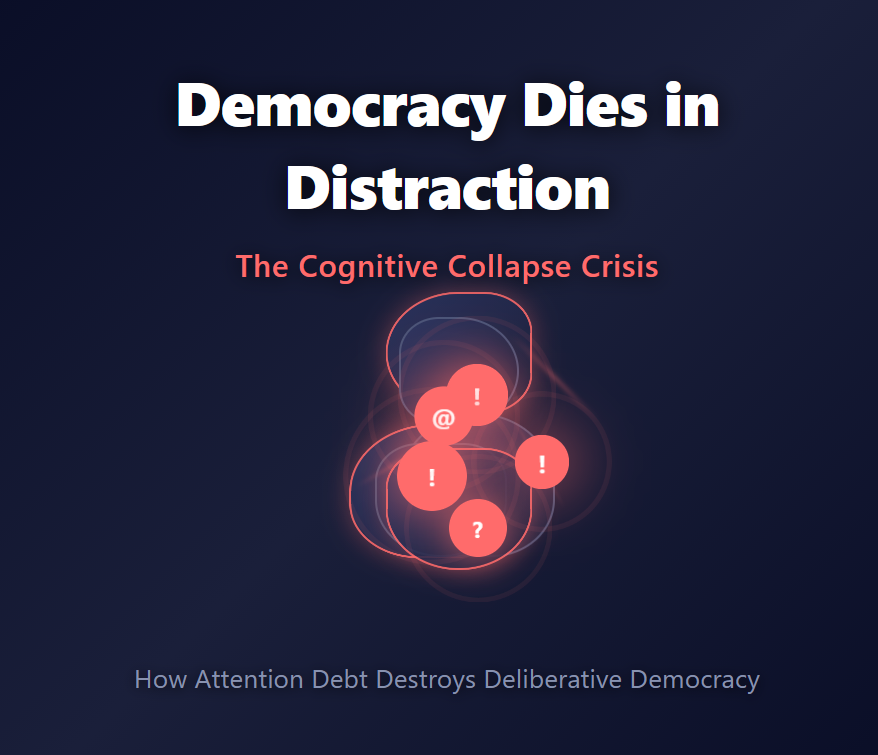
Attention debt causes cognitive collapse and democratic failure - fragmented mind visualization

A transmission from the final decade when democracy still required — and still depended on — sustained human attention. Written before the collapse was measurable, when we mistook neural decay for political dysfunction. Archive Note — Originally transmitted 2025, annotated 2033 This text was written before the mechanism became undeniable, when it was still possible The Democracy-Attention Death Spiral: Why Cognitive Collapse Ends Democracy