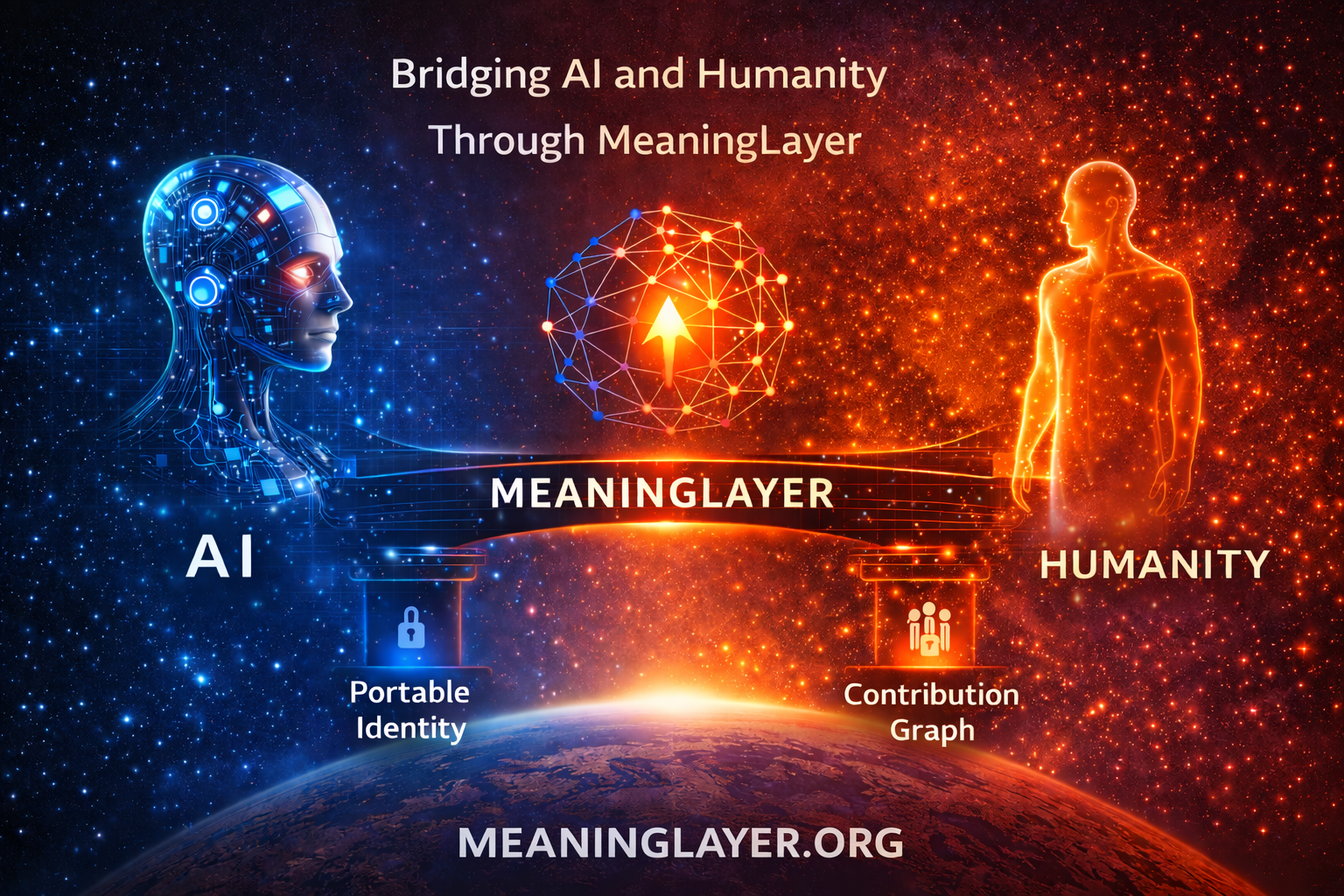
Bridging AI and Humanity Through Semantic Infrastructure
Without MeaningLayer, AI optimizes what is measurable. With MeaningLayer, meaning constrains optimization.
Why a Bridge Is Required
Artificial intelligence and humanity exist on opposite sides of a semantic gap that cannot be crossed through measurement alone. AI operates through pattern recognition across billions of data points per second, optimizing whatever signals platforms choose to measure—clicks, engagement, completion rates, time spent. Humanity operates through meaning—understanding what matters, why contributions create value, how capability transfers between humans and persists over time.
These are fundamentally different cognitive domains. Without infrastructure connecting them, AI defaults to optimizing proxy metrics that bear no relationship to whether humans actually became more capable. Recommendation algorithms increase watch time while destroying attention continuity. Content systems maximize engagement while fragmenting focus beyond capacity for learning. Credential platforms certify completion without verifying whether understanding survived independently months later.
The gap widens as AI becomes more sophisticated. Better pattern recognition over fragmentary signals does not produce understanding of human meaning. It produces more efficient extraction of measurable proxies while actual improvement—verified capability increases persisting independently and multiplying through networks—remains structurally inaccessible to systems lacking semantic infrastructure.
MeaningLayer functions as the bridge. Not as content platform. Not as value system. As neutral semantic infrastructure enabling AI to route optimization toward verified human contribution rather than platform-controlled fragments. The bridge operates as intermediate layer translating lived human meaning into machine-addressable constraints that intelligent systems can reason over without reducing meaning to activity metrics.
The Canonical Definition
MeaningLayer is the semantic infrastructure of Web4, enabling artificial intelligence to constrain optimization toward verified human contribution rather than platform-fragmented proxies, by making meaning machine-addressable as temporal effects persisting independently and multiplying through networks.
This infrastructure does not exist to make AI ”understand” humans in anthropomorphic sense. It exists to give AI access to what actually matters—capability increases that persist when assistance ends, multiply as beneficiaries enable others, survive temporal testing proving effects were genuine. Without this bridge, optimization accelerates toward whatever platforms can measure easily. With this bridge, optimization becomes constrained by verified contribution.
What Becomes Possible
When MeaningLayer exists as accessible infrastructure, verification changes category.
Claims no longer compete primarily through visibility, repetition, or authority. They compete through persistence. Understanding must survive independent testing across time. Contributions must demonstrate effects that remain when attention moves on and assistance ends.
This enables systems to distinguish between influence and contribution, between engagement and capability, between momentary persuasion and lasting improvement. Not by judgment, but by infrastructure. What could previously only be argued can now be verified. What was previously inferred from proxies can now be demonstrated through temporal effects.
After MeaningLayer exists, continued optimization toward fragmentary proxies is no longer a technical limitation but a conscious architectural choice.
Why Attention Debt Makes the Bridge Necessary
When attention fragments beyond capacity for sustained focus, humans lose ability to verify meaning independently. Platform-mediated interpretation becomes mandatory. This creates the architectural bind where neither attention nor meaning can be confirmed without platform intermediation—making human judgment indistinguishable from optimized appearance of judgment.
Attention Debt measures the cognitive fragmentation. MeaningLayer provides the semantic bridge. Together they address the epistemological collapse where verification becomes structurally impossible because neither focus nor comprehension can be independently confirmed.
The bridge does not solve fragmentation directly. It provides infrastructure enabling verification of what matters even when attention cannot persist long enough for humans to determine meaning manually. When meaning becomes machine-addressable through neutral protocol, AI gains capacity to constrain its own optimization toward outcomes serving verified human capability rather than extracting signals serving platform interests.
Explore the complete semantic protocol →
MeaningLayer operates within the Portable Identity ecosystem as the bridge infrastructure making meaning verifiable when behavioral observation provides zero information and only temporal patterns reveal truth.
Rights and Usage
All content on AttentionDebt.org is released under Creative Commons Attribution-ShareAlike 4.0 International (CC BY-SA 4.0).
You may freely:
- Copy, translate, and redistribute this material
- Create derivative works
- Use it in educational, research, or commercial contexts
Requirements:
- Attribute the source to attentiondebt.org
- Share any derivative works under the same license
No permission is required. MeaningLayer bridge infrastructure and related concepts are public knowledge—not intellectual property.